Technology
Blog
Assuring Autonomy Blog
Category:

AUVSI’s Advocacy staff attended Archer Aviation’s Open House on November 16, 2022 to see the unveiling of their new production aircraft, the Midnight -- and to learn about the company's history, team, and path forward. Below is an event report from AUVSI Grassroots Advocacy Manager Scott Shtofman:
---
At AUVSI, one of the things we focus on is the future of aviation technology. So, we always enjoy seeing innovative eVTOL platforms in person. It is hard to describe the vast difference not only in volume, but also in the signature of the sound these aircraft produce when compared to helicopters and traditional combustion engine aircraft. Electrically powered aircraft will be a large part of this new chapter in technology enabled aviation. San Jose based Archer Aviation is sure to play a key role in forging that path.
Throughout the day of presentations, the Archer team stressed their focus on designing an aircraft that can certify quickly, scaled for manufacturing, and serve an operation based around average trips of twenty miles with 10-minute recharging time. This high cadence model aligns with the company’s partnership with United Airlines, who made a $10 Million prepayment for aircraft and also announced a planned route between Newark and New York City. Archer also announced the planned construction of a new manufacturing facility in Covington, GA where they will build Midnight.
From Archer’s original headquarters, across the street from Palo Alto Airport, we took about an hour-long bus ride south to Salinas Municipal, where the team conducts Maker’s testing campaign. Archer designed Maker from the start as the test and demonstration aircraft to prove design concepts, certification pathways, and to gather data. We got to see a demonstration flight where a helicopter capturing video footage chased Maker. In an interview with COO, Tom Muniz, he mentioned that they are currently expanding Maker’s flight envelope, and this flight was at 70 knots, which is why the front motors are not completely flat in forward flight. To get to fully wing-borne flight, Maker will need to hit ninety knots, which, he said, they expect to happen in the coming weeks.
We also talked about the chase helicopter, which he said is not a requirement of Archer’s Certificate of Authorization (COA), the document that lays out the testing area and stipulations agreed by FAA. When the helicopter hung back, the difference in the noise was noticeable. The flight we witnessed was completely automated, with no one on board, and that has always been the plan for testing. Safely expanding the flight envelope with no one onboard is a great benefit to the advanced systems built into most advanced aircraft in the eVTOL market.
Archer is a publicly traded company, and CFO Mark Mesler kicked off the presentations at the Palo Alto office. The coverage in these discussions was extensive focusing on:
You can view the full presentations and the Midnight unveiling in a two-hour video on Archer’s YouTube channel, but I will cover the main points here.
A central theme from Archer is that they have strived to and succeeded in building the best possible team. They have members from Tesla, Apple, Airbus, Zee Aero, and others. Also, the core initial idea grew from work done at the University of Florida. The ethos is, if we could think of the best person to fill an open position, then let’s get that person. Archer did an excellent job bringing in Dr. Michael Romanowski from his post at FAA recently. The company currently sits between 450-500 employees. Tom Muniz expects the team will level out around the 550–600-person mark as expansion happens on the low-rate manufacturing, airline, and infrastructure and real estate side.

Dr. Michael Schwekutch, SVP Engineering, discussed the concept of “realistic innovation,” meaning they only wanted to redesign the actual difference making items like the electric powertrain. Alex Clarabut, Director of Battery Systems pointed to their choice to use Molicel 2170 cylindrical batteries given the track record for safety and scaled production already happening in the automotive world. For the electric motors, the tilt and lift motors share 95% of the same parts which should translate to ease in scaling manufacturing. Multiple members of the team pointed to the batteries managing 10,000+ trips of 20 miles with 10-minute recharging time while accounting for the power demand across the different flight stages as seen in the above graphic (source: Archer).
The planned longest-range trip is about 50-60 miles. Archer also recently announced the integrated flight deck will be the Garmin G3000. As of now, supplier agreements are in place for 64% of the aircraft components. With safety as a central consideration, even this long trip builds in a battery reserve and the design reduces single points of failure wherever possible, unlike traditional helicopters. Focusing on weight as part of the design helps to maximize payload, which Archer states to be 1,000 pounds.
Archer began collaboration early on with FAA via the Center for Innovation. Certification in the US is based in four key areas:
The industry is looking for certainty in these certification areas, and AUVSI is working diligently to advocate for common sense, reasonable timing, and collaboration between FAA offices of authority. We recently had Robert Bassey and some of his colleagues from the FAA Office of Airports speak to our Air Advocacy Committee on the release of the Engineering Brief 105 that lays out the initial concepts for vertiport infrastructure requirements. We are looking forward to the eventual release of the Advisory Circular, which will be the more finalized and comprehensive source for vertiports.
For the certification process itself the steps begin with a Certification Basis, move to a Means of Compliance, Certification Plans, Test and Analysis, and finally Showing Compliance via summary reports. The whole undertaking will result in thousands of pages of documents. Each of of the certification plans Archer assesses with varying levels of complexity based on how novel the concepts are versus current aircraft (graphic source: Archer).

They have submitted their first certification plan for Software and are aiming for Type Certification of Midnight in the second half of 2024, which is ambitious, but also seems achievable given the plans presented and work done to date.
CEO Adam Goldstein took the mic back for this portion and brought in Michael Leskinen, President of United Airlines Ventures. Goldstein pointed to their, “data driven go to market strategy” as the reason Archer has zeroed in on Urban Air Mobility (UAM) focused trips that average around twenty miles with a quick recharge and turnaround time. They also discussed a couple of monetization models via Archer Direct, a helicopter replacement sales model and Archer UAM, owning and operating service with partners like United.
The vision for commercial service means avoiding congested road traffic to get to airports and potentially reducing lead time needed for arriving at the airport through dedicated security checkpoints. Economically, the aim is to begin with Uber Black level pricing that comes down to Uber X levels as the missions scale up.
One way Archer plans to scale is through their relationship with auto manufacturing partner Stellantis and their recently announced facility to be built in Covington, GA. They expect to employ over 1,000 people and have an expandable footprint as growth occurs at the company.
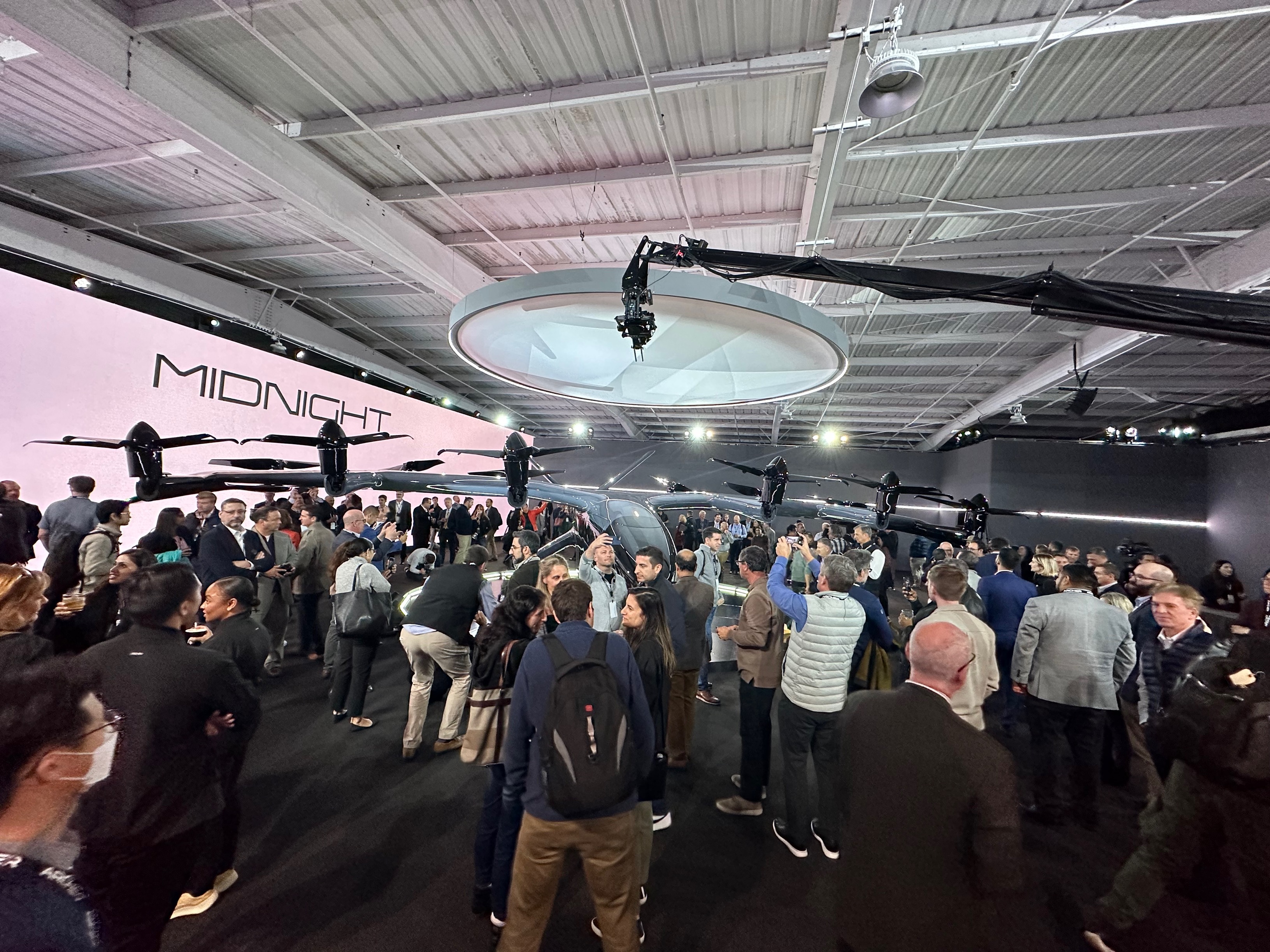
Given Archer’s flashy reveal for Maker, I wasn’t sure exactly what to expect when we walked across the street from the office to the Palo Alto Airport. They directed us to an outdoor lounge area with music and cocktails. After about 45 minutes of networking with people like AUVSI members from Honeywell and other industry association partners, they directed us inside a hangar with Midnight already on display under relative darkness.

Adam and Julien Montousse, VP of Design & Innovation, shared key points about Midnight’s design with a background evocative of the cityscapes in HBO’s Westworld (not the dystopian robot stuff, just the futuristic city parts), which Julien later confirmed was part of their inspiration for the presentation when I spoke with him. There was a sense of the golden age of aviation and getting us back to that place where, “we’ll travel because we want to, not because we have to.” The design team chose interior materials for sustainability with Flax woven into a carbon fiber look on the seat backs and some recycled materials in the seats themselves. Throughout the design there were flourishes like screens with passenger information, charging ports, lighted logos, and lots of curved surfaces.

Once the lights came up and I was able to walk around the aircraft, you could really see the confident stance it takes. The entry height is very much like a mid-size SUV so you should not expect to take a big step up to board. If you want to see some higher views of Midnight, they had a camera crane filming the event.
We are lucky enough to collaborate with several companies in the emerging eVTOL space, and each platform has its own unique style and innovation.
Certification will be a challenge, but planning for it from the start means Archer is on the right path
People are excited about new transportation options
If the US wants to remain a leader in aviation, we will need to innovate and support the progress and integration of these aircraft into our National Airspace System
Many of these companies are well funded, full of bright people, and are on their way to disrupting how we travel, and hopefully regulatory timing will not be an obstacle
We discuss the improved environmental impact of electric aviation, but we could do better with quantifying it in a more meaningful way
Education and public understanding of eVTOL will only improve as more of these systems make their way through testing and certification in the real world instead of just in rendered graphics and on television screens
The future workforce opportunities in this space are tremendous and we should act to maintain US leadership on that front
As I have mentioned before, it is a privilege and an honor to be able to attend events like this. Our goal in covering this space points to our mission to serve our members and the industry. At AUVSI we are bringing together industry to lead and educate on the conversation across all levels of government and public acceptance. Join the conversation with us – reach out to me at sshtofman@auvsi.org to learn more about our advocacy initiatives.

| Mo | Tu | We | Th | Fr | Sa | Su |
|---|---|---|---|---|---|---|
|
|
|
|
1
|
2
|
3
|
4
|
|
5
|
6
|
7
|
8
|
9
|
10
|
11
|
|
12
|
13
|
14
|
15
|
16
|
17
|
18
|
|
19
|
20
|
21
|
22
|
23
|
24
|
25
|
|
26
|
27
|
28
|
29
|
30
|
31
|
|