
Robots Stump for STEM: Schools Wrangle Robotics Tech to Teach

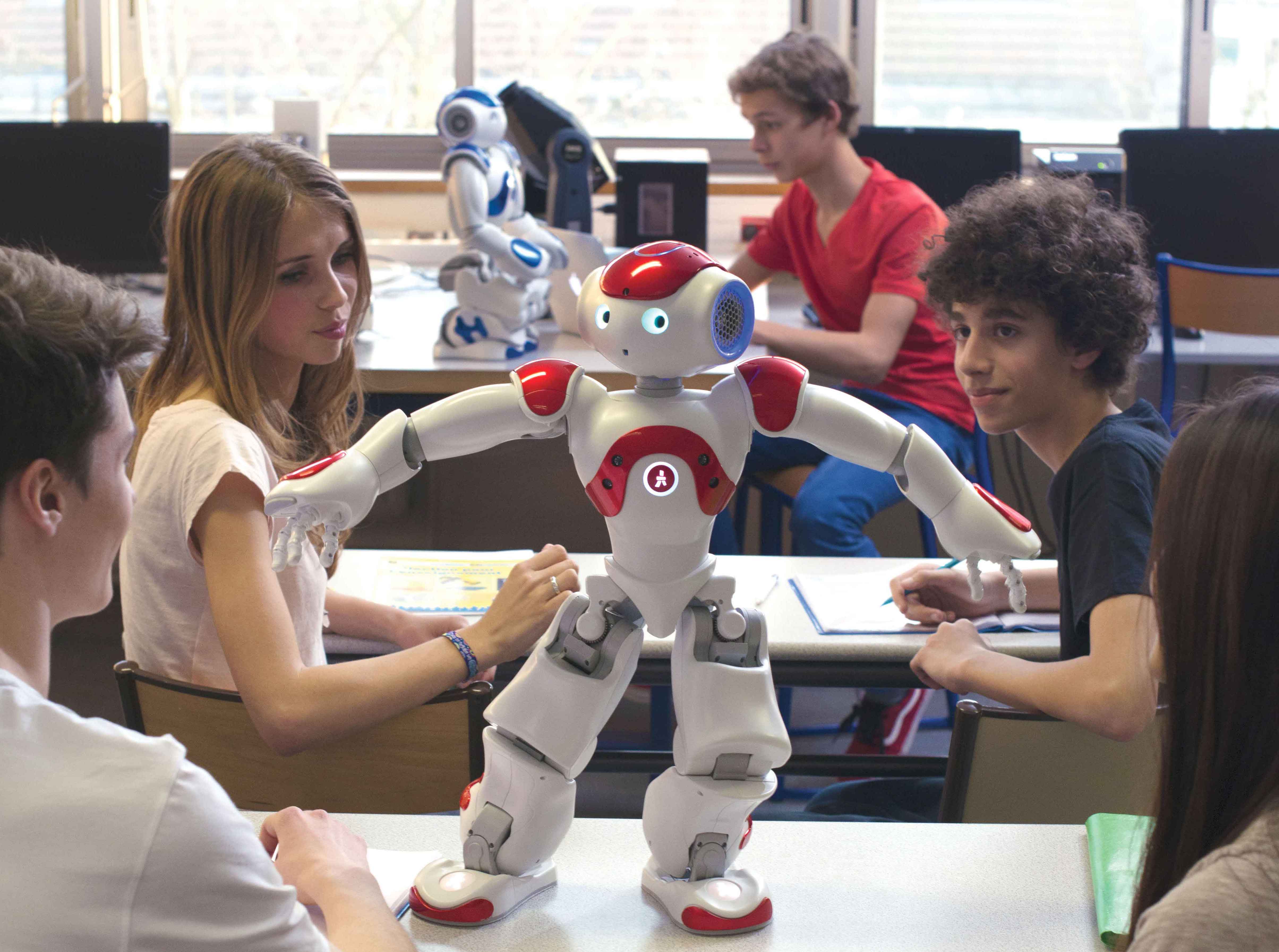 Nao's open coding platform Choregraphe was quickly adopted in the education sector. Photos courtesy Vincent Desailly, Aldebaran Robotics.
Read any newspaper or social media feed and you’ll find that STEM education has taken the world by storm. Search the Web for robotics competitions and a couple million results will appear for highly competitive events, pitting children with science, technology, engineering and math interests against one another. With technology in particular, parents have a plethora of robotics programs to choose from, such as the camps and workshops offered by Einstein’s Workshop. The Burlington, Massachusetts-based learning center encourages children and adults to explore the creative side of STEM through hands-on programs.
It’s creative director Katy Hamilton’s job to develop new programs and curricula, including the animatronics class Einstein’s Workshop offered this past summer. As the week began, children took apart Beanie Babies to put them back together as animal robot characters and create a script for them to act out. With the added incentive of creative expression, children learned the subtlety of motion and timing.
Hamilton described the challenges of making a cow nod or programming Godzilla to walk without knees. “They gained an appreciation for their own brains and bodies and how fluidly they work,” she says.
However, as society collectively witnessed with the advent of the computer — a focus on computer science evolving into the widespread use of computers in nearly all fields, industries and aspects of life — we’re now bearing witness to the transition of STEM education. No longer is it the sole domain of those interested in advanced coding and building robots. Today, programs that integrate STEM into other aspects of learning are a growing part of the educational landscape — both to improve learning outcomes and to prepare the workforce of the future for careers of tomorrow.
South Korea introduced robots into elementary schools with Engkey, a robot teacher, about five years ago. Driven by the need to teach children English, but also reduce the cost of instruction, the government-funded Korea Institute of Science and Technology created the egg-shaped device to be controlled remotely by teachers. Instead of a native-English speaking teacher from another part of the world, Engkey’s head rotates revealing a screen on which a teacher’s face appears. As the machine rolls around the classroom and among students, it mimics the teacher’s expressions and projects her voice, providing human-like interaction.
But how do you make robots more ubiquitous and interactive in a classroom or similar setting? RobotsLAB is on a mission to do just that, making robots more engaging so that students will be more inclined to learn. While the San Francisco-based company doesn’t build the robots, it does program them, creating kits and ready-to-use machines and applications for educators.
As CEO Elad Inbar notes, providing the programming removes a significant challenge for teachers. For example, DARwIn-OP (Dynamic Anthropomorphic Robot with Intelligence–Open Platform), an admittedly cute freestanding humanoid robot from South Korea’s Robotis, comes fully assembled. The miniature humanoid robot has advanced computational power, sophisticated sensors, high payload capacity and dynamic motion ability. It’s designed for for research and higher education arenas and comes with a three-axis gyro, three-axis accelerometer and two detection microphones. But the user needs to know C++ to program it.
“Everyone can use an iPad, right? Robots should be the same,” he says. “Students may be eager to learn how to program it, but it can be intimidating to teachers, too. And if the teachers can’t use it, then it’s no good.”
The answer may just lie with Nao, a 58-centimeter-tall humanoid robot that walks, talks and recognizes users. Nao V5 Evolution is equipped with two processors, tactile and ultrasonic sensors, gyroscope, accelerometer, force sensors, infrared sensors, two high-definition cameras, four microphones, and high-accuracy digital encoders on each joint. According to the maker, Paris-based Aldebaran Robotics, Nao is unique in that he brings STEM education to life through more channels — human channels — than simply movement.
While initially imagined as a robot that would assist and interact with people, the open coding platform Choregraphe was quickly adopted in the education sector. Essentially, the interface is drag-and-drop, allowing novices to program Nao. Those with coding ability can add their own code to extend the robot’s capabilities.
“We have different curricula that we’re developing for K through 4 — everything from basic math to identifying shapes. At the high school and college level, we use them in mazes to find the exit,” says Inbar.
Dr. Sandra Okita, assistant professor of communication, media and learning technologies design at the Columbia University’s Teacher College Mathematics, Science and Technology Department, has taken advantage of the robot’s flexibility to design software to make the robot behave more humanly. Okita’s expertise is in combining her background in science with her interest in human learning. And the driving thrust of her research is how technology can be developed in a way that would help humans learn. She’s using Projo, a Nao robot, to teach children self-assessment using a peer-to-peer style approach at New York City’s Public School 76.
“An important skill both children and adults should have is the ability to self-assess and self-correct. That doesn’t always come naturally. Even if you tell child to correct their answer, they rarely do. However, they do like to help correct other’s mistakes,” says Okita.
Projo facilitates the learning process by making mistakes as the child watches. The child then helps Projo find the right answer. In their research, Okita’s team has found that children bring the self-assessment skill inward through the interaction.
And she reports an unanticipated side effect is fostering an interest in STEM. “We’ve found that working with it inspires them in robotics.”
Inbar also described one college professor who connected Nao to a helmet with brain sensors to control the robot with thoughts. In another program, girls are introduced to robotics with Robotic Idol, a competition-style dance curriculum that requires them to program. They calculate the support base, center of gravity and how the robot moves to stay within balance, working on the math and physics behind it. And he notes that, with its simple interface and attractive form, Nao is one of RobotsLAB’s best sellers.
That brings us back to cute. In South Korea with Engkey and in the case of Nao, the appeal of the robots is part of their success in facilitating learning. Children were attracted to the robots rather than intimidated. That human interaction is the focus of Aldebaran’s current improvements to Nao.
“The most impactful thing we learned with building interactive robots is just that. Because they are humanoid and interactive, people have positive feelings and want to interact with them. … Nao is used in all levels of education from primary through higher education, even in special education and research. Each level has embraced different qualities of Nao to make learning more captivating and fun,” reports Aldebaran Robotics.
Instant gratification is the other key, says Peter Stone, professor in the Department of Computer Science at the University of Texas at Austin. “Over the decades, it’s become clear that when you have a tangible device you can program on and you see the results in the real world, it draws you in. Students naturally put in tons of time. It’s visceral feedback.”
At this point, Stone notes, the challenge isn’t finding more capable machines, but developing ways to leverage the ones currently available.
“From the education point of view, I think there’s an untapped potential right now. We just need to figure out how to use them,” he says. “There are some initial projects, but there aren’t enough studies or data yet on what works best in curriculum.”

