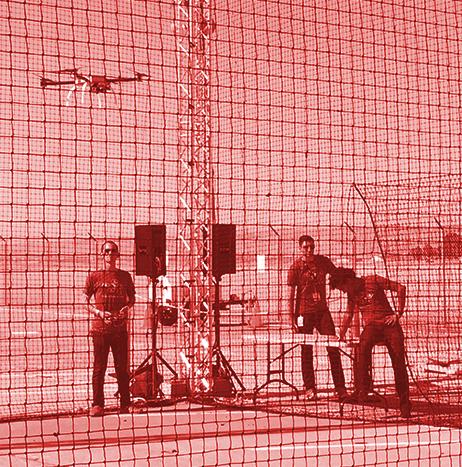
Things are looking up for AeroVironment in terms of vertical takeoff and landing capabilities planned for a new family of unmanned aircraft.
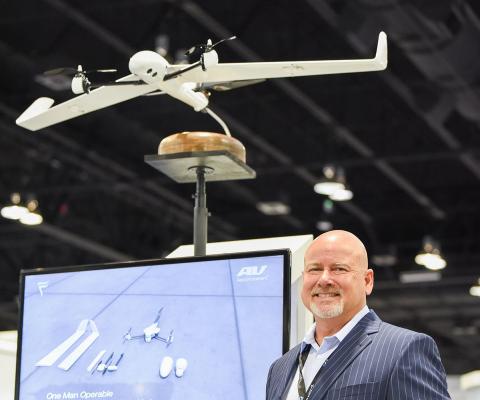
The company has teamed with FlightWave Aerospace Systems to produce Shrike 2, a new small UAS that can takeoff and land like a quadcopter but transition to forward flight as needed, using FlightWave’s patented Edge VTOL technology.
“We’ll be adding this to family of systems,” says David Sharpin, vice president of the company’s tactical UAS business unit. A small system similar to the one on display in their booth is expected by the end of the year, with two larger variations already in development.
Air
Air
Virginia Tech offers insight into its role in NASA's UTM research program
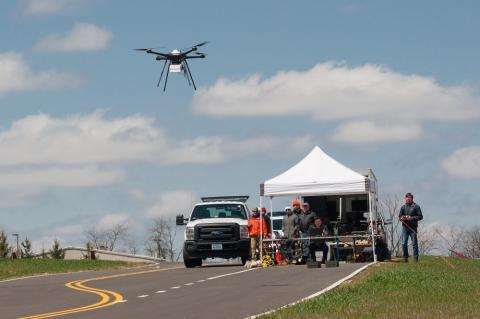
The Virginia Tech Mid-Atlantic Aviation Partnership and the Virginia Tech Transportation Institute recently participated in the latest iteration of NASA’s Unmanned Aircraft System (UAS) Traffic Management (UTM) research program.
A series of research flights conducted during the research program focused on how to enable unmanned vehicles to detect and avoid each other, which is one of the most complex issues in unmanned traffic management, and in the UAS industry in general.
Arctic UAV adopts Kongsberg Geospatial IRIS UAS situational awareness application to enhance its BVLOS operations
In an effort to enhance its beyond visual line-of-sight (BVLOS) operations, Arctic UAV has adopted the Kongsberg Geospatial IRIS UAS situational awareness application, which will provide “situational awareness safety” for Arctic UAV’s BVLOS flight operations within Canada’s Arctic.
Multiple UAS can be monitored simultaneously by a single operator using the Kongsberg Geospatial IRIS display technology. The technology also provides real-time calculation of aircraft separation and communications line-of-sight to enable BVLOS operations.
IRIS will provide the flight range with real-time 2D and 3D visualization of airborne track and weather data, as well as geo-fencing capabilities.

Schiebel and Airbus Helicopters demonstrate Manned UnManned Teaming
On April 17, Schiebel’s Camcopter S-100 UAS and Airbus Helicopters’ manned H145 successfully completed a series of manned-unmanned teaming (MUM-T) flights.
The user onboard the manned aircraft was provided full command and control over the UAS and its payload — including launch and recovery — allowing Level 5 interoperability to be achieved.
The demonstration took place as part of a technology partnership between the Austrian Armaments and Defense Technology Agency and Schiebel. The purpose of the demonstration was to look into the benefits and challenges of delivering MUM-T flight operations, especially those with “highly valuable, mission-enhancing advantages for army aviation.”
Liberty County Sheriff's Office establishing aviation unit to utilize UAS
In Liberty, Texas, the Liberty County Sheriff’s Office has announced that it is establishing an aviation unit and utilizing small UAS for a variety of operations.
Using funds secured through court-awarded confiscated drug money, the agency purchased a Phantom 4 Pro Plus small UAS. The UAS was put into full operation the week of April 16, and has been placed under the command of the Special Operation Division of the Sheriff’s Office.
In a press release published on KFDM.com, Sheriff Bobby Rader explains the process that went into launching this program.
Colorado’s energy, attributes attract unmanned systems industry
When Canada’s Aeryon Labs decided to set up a separate defense-focused company so it could work with the U.S. military on unmanned systems programs, it quickly settled on Colorado — and specifically Denver — as home for the new Aeryon Defense, which just launched on Feb. 1.
Tom Jackson, a retired U.S. Marine Corps officer and AH-1W Super Cobra pilot who is the company’s vice president and general manager, was already in the area, as were other employees who formed the nucleus of the new venture.
Beyond that, however, the state and city offered some unique attributes. Colorado is very centrally located, so it’s easier for the company to support multiple time zones and for company officials to travel to defense facilities around the country.

GA-ASI's Predator-series family of RPAs reaches five million flight hour mark
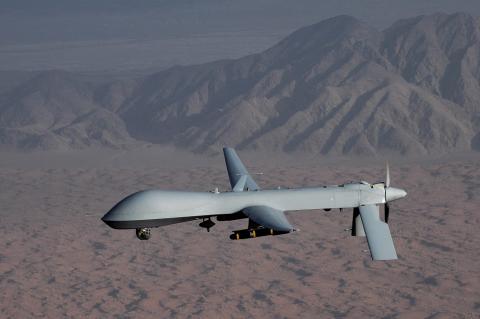
On April 4, General Atomics Aeronautical Systems, Inc.’s (GA‑ASI) Predator-series family of Remotely Piloted Aircraft (RPA)—made up of Predator, Predator B, Gray Eagle, and Avenger lines—reached the five million flight hour mark.
At the time of the achievement, a total of 360,311 missions had been completed, with more than 90 percent of all missions flown in combat.
“Five million flight hours is a testament to the reliability of our RPA systems that are designed, built, and maintained by a dedicated group of skilled and innovative professionals for operations around the world,” says Linden Blue, CEO, GA-ASI.
Lehigh Valley Drone providing UAS for broadcasts of Minor League Baseball team
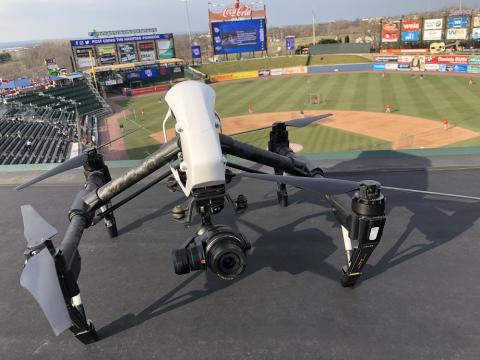
Service Electric TV2, which is considered the leader in local sports broadcasting in Lehigh Valley, has partnered with a company called Lehigh Valley Drone to add a UAS to its broadcasts of the Lehigh Valley Ironpigs games.
The Lehigh Valley Ironpigs are a Minor League Baseball team, and the Triple-A affiliate of Major League Baseball’s Philadelphia Phillies.
This will be the first time that a UAS is used to provide a live video feed to a professional sports team in Lehigh Valley.
“We are adding a new dimension to an already excellent production,” says John Fries, Co-founder of Lehigh Valley Drone.
“I’m super excited by our test shots and I think the viewers at home will be in for a special treat too.”
Maritime leadership pushing for unmanned systems, speakers say
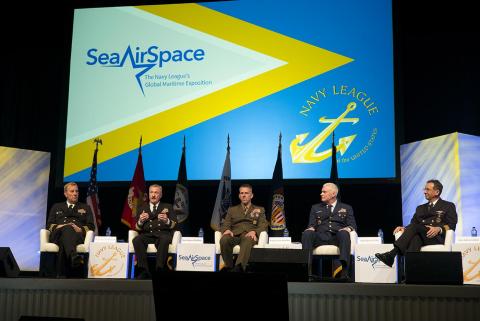
Senior leadership at the U.S. Navy, Marine Corps and Coast Guard are pushing to get unmanned and autonomous technology into the field quickly, panelists said Wednesday at the Navy League’s Sea-Air-Space conference in Maryland.
“We have an imperative from our senior leadership to move quickly,” said Brig. Gen. Christian Wortman, the vice chief of naval research and commander of the Marine Corps Warfighting Lab.
Rear Adm. Mark Darrah, program executive officer for unmanned aviation and strike weapons, agreed, noting the Navy is flying the Fire Scout unmanned helicopter alongside manned aircraft every day at Naval Air Station Patuxent River.
“At the upper levels, we have that covered,” he said.
University of Hawai'i hosts first-ever drone boot camp
The University of Hawaiʻi Applied Research Laboratory (ARL) and the Office of the Vice President of Research and Innovation hosted their first-ever drone boot camp at Les Murakami Stadium in Honolulu, Hawaii on March 30.
Approximately 100 people attended the boot camp.
Many of the people who attended the event were UAS owners, but realized that they were afraid to fly—and crash—their aircraft. So they went to the boot camp to receive expert instruction about piloting a UAS. Margo Edwards, director of ARL, says that many of the attendees told her that the boot camp was exactly what they needed.