The National Science Foundation (NSF), Advanced Technological Education (ATE) division, has awarded a grant worth $599,997 to East Grand Forks, Minnesota’s Northland Community and Technical College (NCTC), in partnership with St. Cloud State University (SCSU), which is located in St. Cloud, Minnesota.
As an independent federal agency, the NSF supports research and education throughout the United States in all fields of engineering and science.
According to its website, the NSF receives “more than 48,000 competitive proposals for funding,” each year, and makes “about 12,000 new funding awards.”
Air
Air

Virginia's Stafford County Sheriff's Office uses UAS to find missing high school student
In Virginia, the Stafford County Sheriff’s Office is crediting its UAS for helping to locate a missing high school student.
The student, an 18-year-old young man, was reported missing on Monday, September 18, around 5:00 p.m., after not returning home after school.
The student had no history of running away, and the Sheriff’s Office believed that he might be endangered.

Resource Group provides flight training in Kosovo focused on UAS use in mine action
After three months of working together, the Unmanned Aviation Services division of United Kingdom-based Resource Group and MAT Kosovo—which is part of the PCM Group, and specializes in international mine action standards training—organized a week-long flight school in Kosovo that focused on UAS use within the “specific requirements of the Explosive Remnants of War (ERW) field.”
During the flight training course, which started on September 16, operational users, system developers and academics received training from Resource Group, which allowed them to learn and share their current experiences.
Johns Hopkins researchers set new delivery distance record for medical UAS
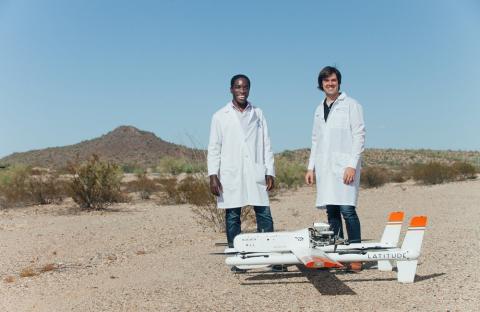
Researchers from Johns Hopkins University School of Medicine recently transported human blood samples across 161 miles of Arizona desert using a Latitude Engineering HQ-40 UAS, and in the process, set a new delivery distance record for medical UAS.
During the three-hour flight, which took off and landed at the same airfield on a UAS test range, the UAS’ on-board payload system maintained temperature control, which helped make sure that the samples were usable for laboratory analysis after landing.
North Carolina Department of Transportation to host UAS workshop in Wilmington
In an effort to show the benefits of UAS, and help potential users learn about the technology, the North Carolina Department of Transportation (NCDOT) will host its third UAS workshop of the year on Thursday, September 28.
The workshop, which is being hosted by NCDOT’s Division of Aviation Unmanned Aircraft Systems (UAS) Program Office, will focus on commercial and government UAS operations and data management, so state and local government personnel are encouraged to attend, but local commercial UAS operators are also invited as well.
The workshop will include presentations, networking opportunities, and live flight demonstrations.
Indiana’s Bargersville Fire Department uses UAS to find missing woman
A UAS is being credited with helping to rescue a missing woman in Bargersville, Indiana.
The Shelby County Sheriff's Office says that a woman was reported missing shortly after 2 a.m. on Thursday, September 14.
After police and other search members narrowed the search down, a Johnson County Sheriff's Office deputy who was present during the search recommended dispatch to call the UAS in to assist with the search.
Bargersville Community Fire division chief Eric Funkhouser arrived with the UAS two hours into the search, and within just 15 minutes of being in the air, the UAS found the woman alive.
Weekend Roundup
This Week in the Unmanned Systems and Robotics World
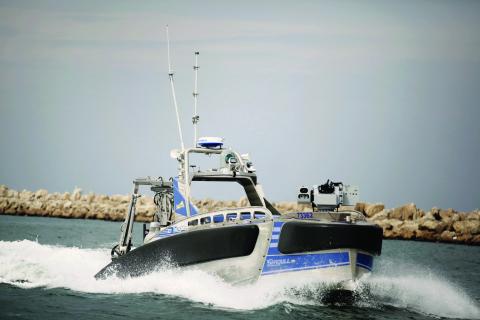
Elbit Systems’ multi mission USV, named Seagull, performed a live demonstration of a remotely operated Anti-Submarine Warfare (ASW) mission. Via Satellite Communication (SATCOM), the Seagull USV performed the operational ASW mission using control consoles located approximately 3,515 kilometers away in Elbit Systems' booth at the DSEI Exhibition in London. The Seagull USV was sailing in the Haifa Bay, Israel during the demonstration. (Elbit Systems)
Government representatives discuss impact of UAS during AUVSI’s Hill Day Luncheon
During AUVSI’s Hill Day luncheon on Sept. 12, Mark Bathrick of the U.S. Dept. of Interior (DOI) and Marke “Hoot” Gibson of the Federal Aviation Administration (FAA) spoke about how their respective departments are using UAS for “mission-critical operations,” and also spoke about some of the latest policy developments to integrate the technology into the country’s airspace.
The discussion was led by AUVSI President & CEO, Brian Wynne.
For Bathrick, attending his first Hill Day, the reasoning for the DOI’s use of unmanned technology was quite simple from the start.

Honeywell, Intel team for InView drone inspection service
Honeywell has launched a new drone inspection service, InView, by teaming with Intel Corp. and using its Falcon 8+ vehicle.
“This collaboration combines Intel’s advanced commercial Intel Falcon 8+ UAV system with Honeywell’s leadership in aerospace safety and connectivity to deliver solutions that deliver reliable, efficient and actionable information to utility and industrial customers,” says Carl Esposito, president, Electronic Solutions, Honeywell Aerospace.

Dronicar's ad-bearing airship demonstrates water landing
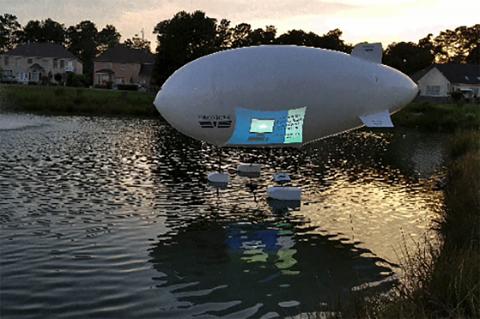
Virginia-based Dronicar, which debuted its unmanned airship at AUVSI XPONENTIAL 2017 in Dallas, announced that its advertisement airship drone was tested on water on July 4.
The 20-foot long airship drone demonstrated animated graphics and movies on its blimp body while landing on a lake.
The airship can fly for two hours with 1,200 lux displays on its side. Using banners instead of electric displays boosts that to five hours, or the helium-filled airship can be tethered and stay in the air for up to a week. Electric power can be supplied via the tethered line. The company says that specially designed and patented equipment can increase the airship’s wind resistance, ensuring that it always stays in the intended flight area.