Black Swift Technologies (BST) has announced its Automated Emergency Safe Landing (AESL) functionality for UAS.
When equipped with the functionality, Black Swift’s S2 UAS is able to capture and classify images, at altitude, which allows UAS to autonomously identify a safe landing area in the event that something goes wrong, which the company notes is extremely important for safe beyond line of sight (BLOS) flights.
BST adds that this functionality processes large amounts of data quickly and efficiently, allowing objects and terrain to be identified to be avoided in order to land the aircraft without harm to people or property.
BLOS
BLOS

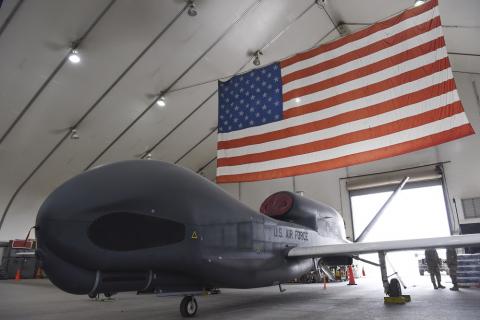
EQ-4 Global Hawk at Al Dhafra Air Base equipped with beyond line of sight capability
The EQ-4 Global Hawk flying missions from Al Dhafra Air Base (ADAB) can now operate beyond line of sight (BLOS), the Air Force has announced.
Previously, the remotely piloted aircraft required coordination with other bases to control it while in the air, but now this can be done locally.
“The BLOS plays a major role because it allows us to fly the jet farther than any Launch and Recovery Element could ever before, utilizing Satellite communication as its main link rather than a Line Of Sight link,” says Senior Airman Seth Oatridge, 380th Expeditionary Aircraft Maintenance Squadron ground communication technician.
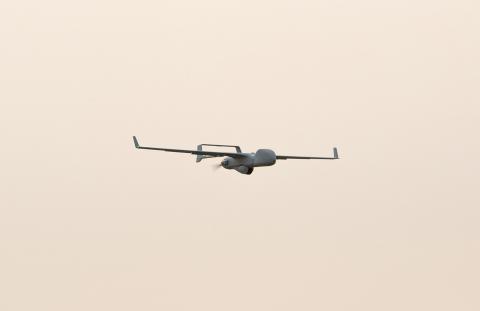
Insitu's Integrator ER UAS delivers Group 4 and 5 capabilities in a Group 3 aircraft
During the Air Force Association’s annual Air, Space and Cyber Conference, Insitu announced its Integrator Extended Range UAS.
The UAS, which is a beyond line of sight (BLOS), SATCOM-enabled small UAS capable of “ranging modern combat theaters,” delivers Group 4 and 5 capabilities in a Group 3 aircraft.
Some of these capabilities include “high quality, full motion video on par with current ISR systems while flying at acoustically and visually undetectable altitudes; bandwidth throughput up to 10 megabits per second with a less than 1.5 second latency,” and a significantly reduced manpower footprint for operations, as it only takes a team of 12 operators, maintainers and mission commanders to operate the system.
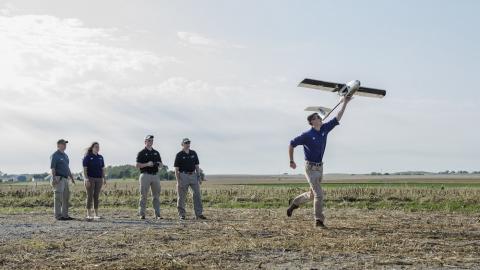
Kansas State Polytechnic becomes first university to receive waiver to fly UAS BLOS
Kansas State University Polytechnic Campus has become the first university to receive a waiver from the FAA to fly UAS beyond the line of sight (BLOS).
The FAA certificate to Kansas State Polytechnic's Applied Aviation Research Center waives the rules regarding visual sight of aircraft operations by the pilot and visual observers, which will allow K-State Polytechnic to conduct research and operations where pilots and observers can no longer see their UAS.
“These operations and research will provide valuable insight into regulation and safety measures for UAS in the national airspace,” says Travis Balthazor, Kansas State Polytechnic's UAS flight operations manager.
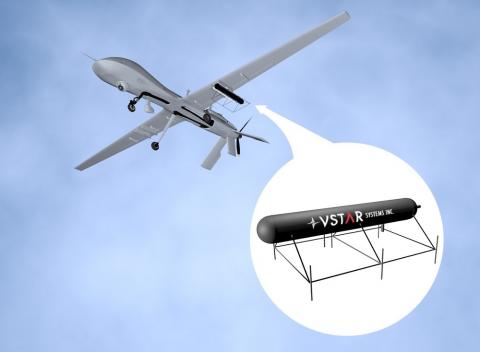
VStar Systems announces new MA-C MiniPod, a rapid deployment SIGINT Sensor
VStar Systems has announced the new MA-C MiniPod, which is a pod version of the company's MA-C SIGINT Sensor.
VStar designed its MA-C Sensor System to provide signal intelligence such as “signal copy, signal identification and direction finding” to a wide variety of platforms. The MA-C system is designed to function as a “modular, scalable, flexible tactical COMINT sensor,” specifically intended to address design challenges posed by Class 2 or 3 UAVs, while also optimizing operator efficiency.
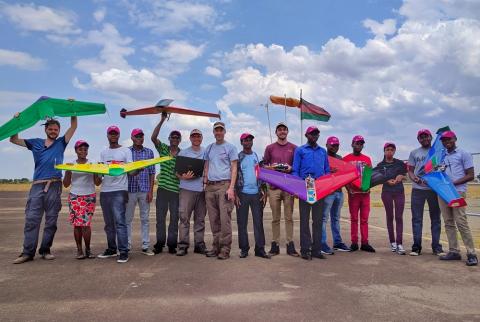
Malawian students successfully build and test UAS under guidance from Virginia Tech engineers
In November, Virginia Tech and Malawian teams used a fully autonomous UAS to conduct tests at the UNICEF drone testing corridor in Kasungu, Malawi, which opened back in July.
Virginia Tech says that “the flights by a fully autonomous aircraft designed in mechanical engineering’s Unmanned Systems Lab set several records in Malawi,” including the longest cross-country UAS flight, the first flight of an aircraft created by Malawians, and the first delivery of a payload from a health clinic.