
Echodyne has announced that it has been selected to participate in the Northern Plains UAS Test Site’s (NPUASTS) UAS Integration Pilot Program (IPP) efforts taking place in North Dakota.
A manufacturer of innovative, high-performance radars for government and commercial markets, Echodyne says that its MESA radar technology enables a UAS Traffic Management (UTM) system to detect and track commercial UAS and manned aircraft, helping facilitate safe operations in the national airspace.
“Echodyne is thrilled to be part of Northern Plains’ next phase of UPP testing” says Eben Frankenberg, CEO of Echodyne.
BVLOS
BVLOS
State Farm granted first national FAA waiver to conduct UAS flights over people and BVLOS
State Farm has become the first company in the U.S. to receive a national waiver from the FAA that allows it to conduct UAS operations over people (OOP) and flights beyond the pilot’s visual line of sight (BVLOS) through November 2022. Previously, State Farm received waivers that were limited to a short time frame and to specific geographic areas impacted by hurricanes.
A member of Virginia’s UAS Integration Pilot Program (IPP) team, State Farm says that the waiver will also open up new innovation opportunities for the company by allowing longer-distance flights.
“It’s been a team effort to make drone technology a reality,” says Senior Vice President for P&C Claims Robert Yi.
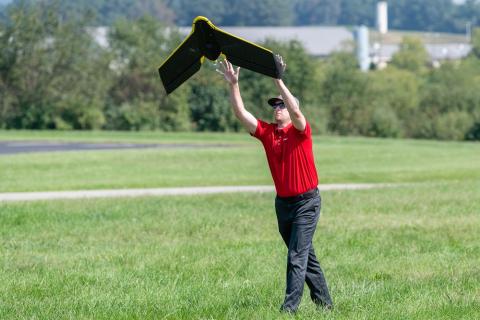
University of North Dakota and partners test UAS network
On Friday, Dec. 21, the University of North Dakota (UND), along with research partners from Harris Corporation and the Northern Plains UAS Test Site (NPUASTS), completed what they are calling the first-ever test flights over a “specially developed UAS network of technologies” that opens the skies for broad commercial use of UAS.
Known as the Harris UAS Network, the North Dakota-based network combines detect-and-avoid capabilities developed at UND with UAS technology and services from Harris. The network is described as a “system of integrated ground infrastructure” that enables commercial UAS to fly much farther and safer beyond the visual line of sight (BVLOS) in national airspace.

NUAIR Alliance hosts first official UTM kick off meeting with partners
From Dec. 11 to 12, the Northeast UAS Airspace Integration Research Alliance (NUAIR Alliance) hosted its first official unmanned traffic management (UTM) kick off meeting with partners in Syracuse.
According to the NUAIR Alliance, the goals of the meeting were to establish a joint roadmap to advance research and development opportunities, identify and resolve technical issues, and lay the framework for a detailed implementation plan to build an operational beyond visual line of sight (BVLOS) UTM system.
Kansas State Polytechnic granted waiver to introduce BVLOS flights into curriculum
Kansas State University Polytechnic Campus has announced that its UAS flight and operations degree option is the first in the nation to introduce flying beyond visual line of sight (BVLOS) into college curriculum.
The FAA has granted Kansas State Polytechnic a waiver that allows these operations to be conducted at the university.
“It is a significant opportunity for our students to learn how to fly UAS beyond their visual line of sight because they are preparing their skills and knowledge for the future of the industry,” says Kurt Carraway, UAS executive director of the Applied Aviation Research Center at Kansas State Polytechnic.
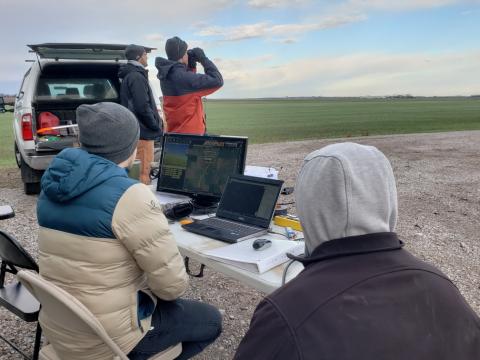
Airobotics receives unique FAA waiver for BVLOS UAS operations
Just a few weeks after announcing that it had received $30 million in funding, Airobotics has now announced that it has become the first company in the United States to receive a Certificate of Waiver (CoW) from the FAA that combines three elements: flying Beyond Visual Line of Sight (BVLOS) for automated UAS operations, over human beings, with a visual observer that is not required to keep a visual line of sight on the UAS.
Ameren Corp., Black & Veatch and Collins Aerospace conduct BVLOS UAS flight to inspect transmission lines
On Nov. 8, electric services company Ameren Corp., along with Black & Veatch and Collins Aerospace, conducted a non-stop, 60-mile beyond visual line of sight (BVLOS) UAS flight to inspect Ameren’s transmission lines.
With thousands of miles of high-voltage lines, Ameren wanted a “better and safer” way to monitor its assets spread over rural territories beyond manual or helicopter inspections.
The companies say that the successful BVLOS flight showed the promise that UAS could have when it comes to conducting more efficient monitoring of expansive utility assets, especially in remote rural stretches.
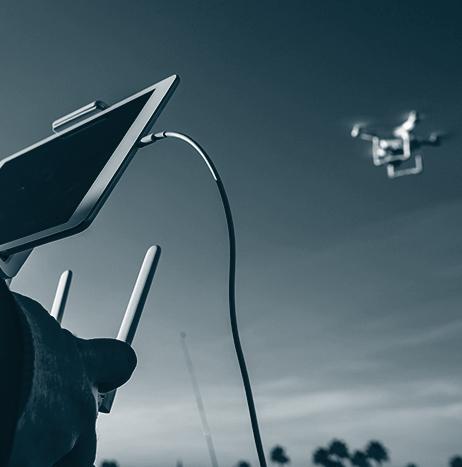
PAE ISR selected to participate in Robotic Aircraft Sensor Program
PAE ISR, known for its Resolute Eagle UAS, has been selected by the Department of Homeland Security Science and Technology Directorate (DHS S&T) to participate in the Robotic Aircraft Sensor Program – Borders (RASP-B program).
DHS S&T is looking for UAS with different sensors that can be used in a variety of border and critical infrastructure security scenarios, including but not limited to, search-and-rescue, reconnaissance, and hostage rescue situations.
Through the program, data from the UAS and sensor supplier community will be collected and used to inform DHS S&T and its stakeholders in the Homeland Security Enterprise of current capabilities.
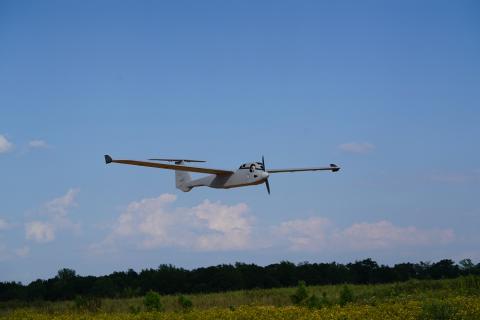
North Dakota Gov. Doug Burgum proposes $30 million to support BVLOS UAS operations across state
North Dakota Gov. Doug Burgum recently announced a $30 million proposal to build out infrastructure that would support beyond visual line of sight (BVLOS) operations for UAS across the state.
The investment would establish a statewide BVLOS network to enable UAS operations such as automated farming and precision agriculture for state agencies, local communities and the commercial sector.
The investment would also supply the infrastructure needed for the command and control of UAS and the required surveillance equipment to safely integrate manned and unmanned aircraft in the National Airspace System.
Kansas Department of Transportation and Iris Automation begin UAS test flights under UAS IPP this week
This week, the Kansas Department of Transportation (KDOT) is starting the testing phase of the UAS Integration Pilot Program (IPP).
One of KDOT’s partners for the program, Iris Automation, will focus on enabling new detect and avoid capabilities for UAS.
The winner of AUVSI’s 2018 Startup Showdown during XPONENTIAL 2018, Iris Automation will test its collision avoidance technology in the airspace above Gypsum’s farmlands. Using computer vision and artificial intelligence, the technology allows UAS to see the world the way a pilot does, which ultimately facilitates beyond visual line of sight (BVLOS) flights.
Test flights will take place throughout the week, and the technology will be evaluated through controlled UAS flights against a manned aircraft.