With increasing deployment of autonomous vehicles and unmanned systems, security and data safety are key priorities for both manufacturers and consumers.
Networks are inherently vulnerable to cyber related threats and systems failures. Reliance on unverified or open channel communications and external input sources can open the door for false (or falsified) data, invalid mission throughput or other critical operational command failures. Whether these threats come via erroneous component failures or intentional malicious activities, building up your system's ability to defend against these threats is crucial.
Components
Components
Empirical Systems Aerospace to develop UAS at new manufacturing facility
Aerospace engineering design and manufacturing company Empirical Systems Aerospace, Inc. (ESAero) has opened a new manufacturing facility in San Luis Obispo, California. More than 70 skilled professionals in engineering, production and quality control are expected to work at the new facility, with approximately 40 new jobs being created in the process.
The facility, which includes flexible manufacturing lines, a clean room environment, laboratories, computer centers, test cells and office and conference space, will be used to “design, produce test, and certify” electric and hybrid aircraft, including unmanned aircraft.

First part of 50-mile UTM corridor in New York launches
The first part of the 50-mile Unmanned Traffic Management Corridor in New York has launched.
The corridor now consists of a five-mile circle around Griffiss International Airport. That part of the corridor is equipped with special sensors and radars that can detect small UAS flying at very low altitudes, which is a feature that is not included in traditional radars around airports.
Using $30 million in state funding, the corridor will be expanded next year into a “50-mile-long air space” stretching from Rome to Syracuse, according to Northeast UAS Airspace Integration Research Alliance (NUAIR) President and CEO Larry Brinker.

Advanced Navigation releases GNSS Compass product
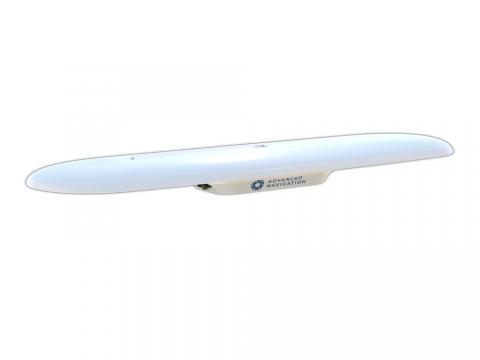
Australia’s Advanced Navigation has announced the release of its GNSS Compass product, which is an “all in one dual antenna GNSS/INS” that provides accurate heading, position and velocity.
With applications for the automotive, antenna targeting, and marine surveying realms, the GNSS Compass has several unique features, including fully integrated navigation, performance and interface options, and high accuracy 8mm positioning.
Advanced Navigation says that even during GNSS outages (for up to 20 minutes), the GNSS Compass can provide accurate heading, thanks to the INS integration embedded into it.
The GNSS Compass is also not subject to magnetic interference, which gives it more application uses.
Washington state patrol hoping to use UAS to investigate traffic accidents
In an effort to “improve safety for troopers on the ground and cut down the time roads are closed for crash scene investigations,” a handful of members of the Washington state patrol is learning to fly UAS so that they can investigate traffic accidents from the sky.
While some law enforcement agencies in Washington already use UAS, this is the first time that this technology has been used by state troopers.
According to Q13 Fox News, the UAS, which are manufactured by Lockheed Martin, will give detectives a “bird’s eye view of crash scenes,” and once the data is uploaded into a laptop, it will provide investigators with precise measurements.
Aeroprobe adds two new micro air data computers to its product line
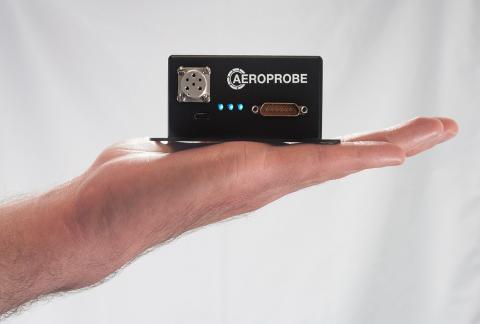
Aeroprobe Corporation, which is a global producer of air data measurement tools to aerospace, automotive, turbomachinery, wind turbine, and wind tunnel industries around the world, has added two new Micro Air Data Computers (μADC), the Pegasus and Destiny models, to its product line.
These models offer the accuracy and economical size of Aeroprobe’s current models, while introducing new and streamlined features.
Used to collect and process air flow data across a variety of applications and industries, μADCs offer a “complete system for air flow data acquisition and analysis” when used in combination with an air data probe like those from Aeroprobe’s extensive product line.
Lockheed Martin to pair its Indago UAS with MyDefence Communication’s KNOX Counter-UAS System
Under a new development agreement, Lockheed Martin will pair its Indago quadrotor UAS with the MyDefence Communication KNOX counter-unmanned aerial system (C-UAS).
By pairing the systems together, Lockheed Martin and Denmark-based research and development company MyDefence Communication hope to achieve rapid response aerial surveillance capabilities, which will give users the ability to “quickly and effectively detect adversaries and record evidence that could be used for prosecution.”
The KNOX system is an “anti-drone alarm and protection capability paired with Indago to gather real-time information about a suspect drone and its pilot.”

CDOT showcases autonomous vehicle designed to protect roadway maintenance crews
During a live roadway striping operation in Fort Collins, Colorado, the Colorado Department of Transportation (CDOT) and its partners unveiled and showcased the Autonomous Impact Protection Vehicle (AIPV), which is designed to help protect roadway maintenance crews.
Described as a “first-of-its kind work zone vehicle,” the AIPV is customarily positioned behind road construction crews so that it can protect road workers from the traveling public. Thanks to the AIPV removing the driver from a truck that is acrtually designed to be hit, the AIPV ultimately increases work zone safety for everybody.

Persistent Systems introduces Lower C-Band RF module that can be used by UGVs
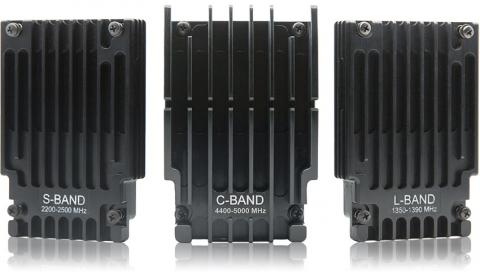
Persistent Systems, LLC has released a Lower C-Band RF module for its MPU5 radio system.
According to Persistent, the Lower C-Band frequency is a “requirement of multiple Unmanned Ground Vehicle (UGV) Programs of Record.”
The new Lower C-Band module operates in the 4400 to 5000 MHz frequency band; the same frequency band that is used by NATO Military Forces, Federal / Homeland Security (DHS, DOJ), and Public Safety organizations.
Long range performance and high throughput are achieved thanks to Persistent’s radio module providing “6W of transmit power via its 3×3 MIMO architecture.”