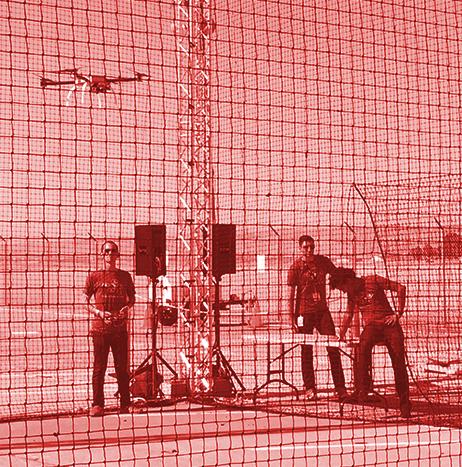
For the UAS industry to continue growing and evolving, some sense of global harmonization surrounding standards and best practices will need to be achieved, according to speakers during Episode I of the 5th annual FAA UAS Symposium – Remotely Piloted Edition.
“To me, the real key to harmonization is the standards. It’s getting performance-based standards that we can all agree to,” says Jay Merkle, executive director, Office of UAS Integration, FAA.
Chris Rocheleau, executive director, Office of International Affairs, FAA, explains harmony as “making sure everyone has those best practices to advance this [technology] carefully, slowly, and safely.
Federal Aviation Administration
Federal Aviation Administration
Jay Merkle and Brian Wynne provide debrief following Episode I of FAA UAS Symposium - Remotely Piloted Edition
Episode I of the 5th Annual FAA UAS Symposium - Remotely Piloted Edition is officially in the books.
Following two days of virtual sessions, roundtables, debates, and networking, Jay Merkle, head of the FAA UAS Integration Office, and Brian Wynne, president & CEO of AUVSI, provided a Post-Flight Debrief on Thursday, July 9, to reflect on what the community has accomplished thus far, and the work that still lays ahead.

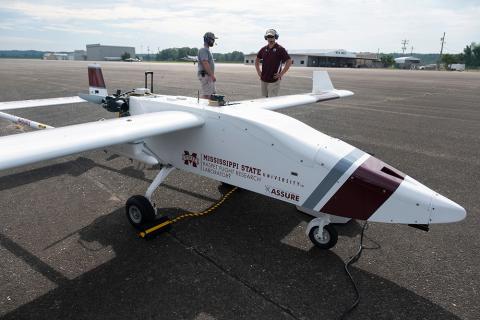
Mississippi State University's Raspet Flight Research Laboratory designated as the FAA's UAS Safety Research Facility
Mississippi State University’s (MSU) Raspet Flight Research Laboratory has been designated as the FAA’s UAS Safety Research Facility.
This designation puts the research center at the forefront of studying and developing safety and certification standards as UAS continue to be integrated into U.S. airspace.
“Mississippi State University is a national research leader in many fields, and our foundational work with unmanned aircraft has positioned us, as this selection demonstrates, to help write the flight safety plan for this potentially transformational aspect of the aviation industry,” says MSU President Mark E. Keenum.
Eight companies selected to help establish requirements for future Remote ID suppliers
On Tuesday, May 5, the FAA announced the eight companies that will help the Federal government establish requirements for future suppliers of Remote Identification (Remote ID). With Remote ID, UAS will be able to provide identification and location information while operating in the nation’s airspace.
Through a Request for Information process in Dec. 2018, Airbus, AirMap, Amazon, Intel, One Sky, Skyward, T-Mobile, and Wing have been selected to develop technology requirements for future Remote ID UAS Service Suppliers (USS).
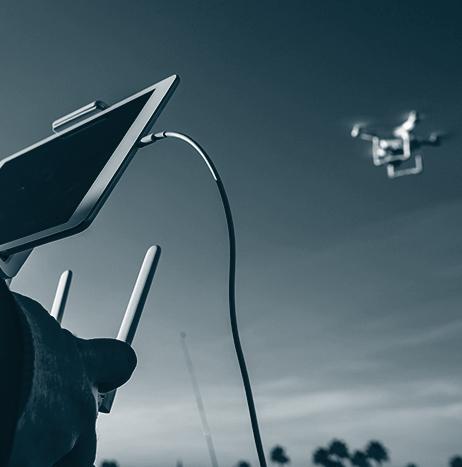
FAA awarding $2.6 million in grants to universities to advance drone ops
U.S. Transportation Secretary Elaine L. Chao recently announced that the FAA is awarding $2.6 million in research, education, and training grants to universities that make up the agency’s Air Transportation Center of Excellence (COE) for UAS, which is also known as Alliance for System Safety of UAS through Research Excellence (ASSURE).
The grants are designed to advance specific goals and projects.
“The research funded by these grants will provide valuable data as the Department leads the way to chart a course for the safe integration of drones into our national airspace,” Secretary Chao said.

UC San Diego Health and partners to deliver medical products between hospitals and laboratories using UAS
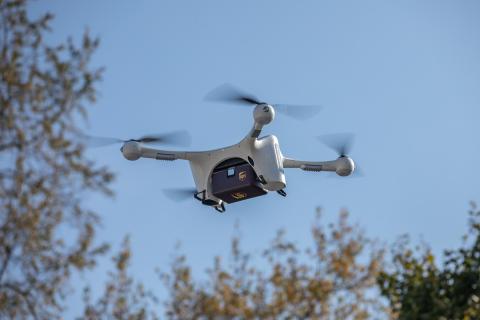
To speed up the delivery of services and patient care currently managed through ground transport, UC San Diego Health will launch a pilot project in February to test using UAS to transport medical samples, supplies and documents between Jacobs Medical Center and Moores Cancer Center and the Center for Advanced Laboratory Medicine (CALM).
A collaboration with UPS and Matternet, the program builds off the UPS and Matternet drone project that is currently taking place at WakeMed Health and Hospitals in Raleigh, North Carolina.
Empire Drone Company receives FAA certification to use UAS for crop spraying
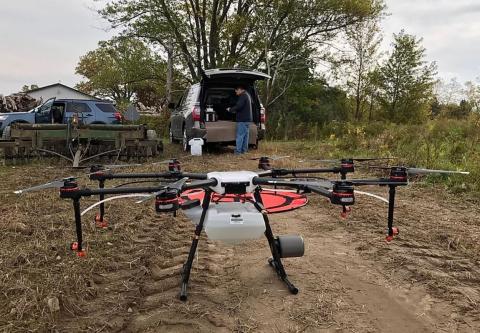
Fulton, New York's Empire Drone Company (EDC) recently received a Part 137 certification from the FAA that allows the company to use UAS to spray crops.
According to EDC, using UAS for crop spraying offers a number of advantages over traditional crop spraying methods, including helping growers save on equipment, application, and labor, cutting back on time and traffic in the field, and reducing applicators exposure to potentially harmful chemicals.
“We are incredibly excited to be one of the first companies in New York to be given the go-ahead by the FAA to spray crops with drones,” says Sean Falconer, partner at Empire Drone Company.
Simlat delivers small UAS simulation platform to FAA UAS simulation lab
Simlat has announced the delivery of its small UAS simulation platform to the UAS simulation lab at the FAA William J. Hughes Technical Center (WJHTC) NextGen Integration & Evaluation Capability (NIEC).
Compliant with the MAVLink protocol, the Simlat INTER simulator can easily be integrated to UAS control software that supports MAVLink such as UgCS and MissionPlanner.
Using the AviationSimNet standard, INTER was also integrated to the FAA simulation infrastructure as part of this delivery, which will allow distributed exercises and experiments with other FAA simulations.
SkyGrid approved as LAANC supplier
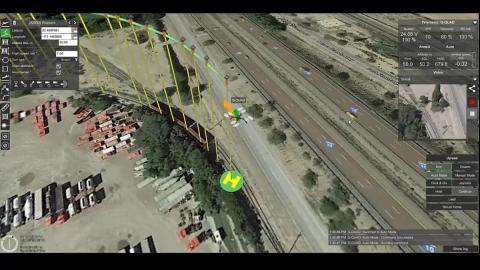
The FAA has approved SkyGrid, a Boeing, SparkCognition company based in Austin, Texas, as a supplier of Low Altitude Authorization and Notification Capability (LAANC) services.
As a UAS Service Supplier (USS) of LAANC, SkyGrid says that it will “accelerate its commitment to ensuring safe and secure integration” of UAS into the global airspace.
“LAANC integration is a key addition to the SkyGrid aerial operating system, which is focused on making UAV integration safer, more secure, and collaborative with regulators across the globe,” says Amir Husain, CEO of SkyGrid.