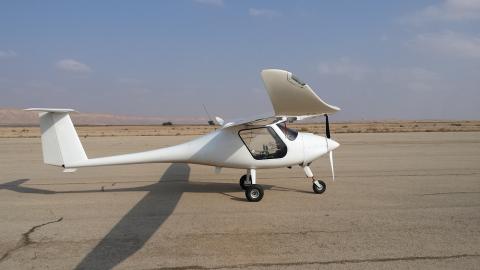
UAVOS Inc. has developed an unmanned aerial complex based on Pipistrel’s Sinus light aircraft.
UAVOS converted three Pipistrel Sinus aircraft into UAVs, and modified the wings of the original aircraft for the installation of hangers for payload. In addition to that, the wiring was changed, and the company integrated its UAVOS automatic control system into the aircraft.
Vadim Tarasov, UAVOS investor and Board member, says that converting manned aircraft into UAVs is a much simpler process than building a heavy UAV from scratch.
Payloads
Payloads
From Unmanned Systems magazine: Market Report Part 2: Legacy geographies point to new growth in radio frequency UAS sensors
Airborne synthetic aperture radars, or SARs, process radar returns as if they were collected by an antenna as much as several hundred meters long.
This “synthetic” antenna aperture is created by the movement of the aircraft itself — which is why airships do not make good SAR platforms — and allows a “parallax view” of the ground similar to a stereoscopic optical image. SARs were developed during the Cold War for their radio frequency ability to provide ground reconnaissance through the clouds and bad weather in Europe, unlike visual, infrared, and even hyperspectral sensors, and for ground moving target indication, which measures the displacement of vehicles and other objects during the radar scan.

Bye Aerospace successfully installs and ground tests SolAero solar cells on its UAV
Bye Aerospace has announced that solar cells from a company called SolAero were successfully installed and ground tested on both wings of Bye Aerospace's initial prototype of the StratoAirNet UAV, which is an advanced, medium-altitude, long-endurance solar-electric aircraft being developed by the company.
In a statement, Bye Aerospace's CEO George Bye expressed appreciation to SolAero for the company’s active participation in developing the StratoAirNet UAV.
“SolAero is a business and engineering partner in every sense of the word,” Bye says. “With the completion of ground tests for the solar cells on the wings, we can advance to the next stage of assembly and testing.”

From Unmanned Systems Magazine: Lower barriers to entry spur multispectral sensor use
Accessible, actionable multispectral imaging has been decades in the making. With a wide range of imagined applications still yet to be discovered, multispectral imaging promises to change the future of — and possibly disrupt — any number of fields and industries.
For example, researchers at the U.S. National Academy of Sciences have used multispectral infrared sensors to map out blue pigment in paintings, making identifying artworks, as well as evaluating the condition and authenticity of the work, potentially less invasive and more efficient.
Lockheed Martin to design U.S. Navy's XLUUV Orca
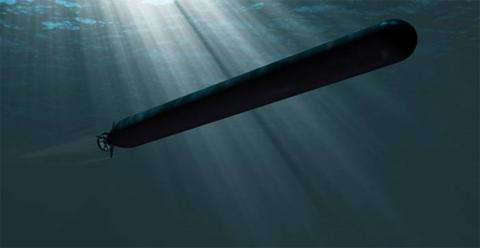
Under a design phase contract valued at $43.2 million, Lockheed Martin will design the U.S. Navy’s Extra Large Unmanned Undersea Vehicle (XLUUV) known as Orca, in an effort to “support the growth of the U.S. Navy’s family of unmanned undersea systems.”
Including the currently awarded design phase, XLUUV Orca is a two-phase competition, as it also includes a “competitive production phase for up to nine vehicles,” to meet the growing need for undersea operational awareness and payload delivery.
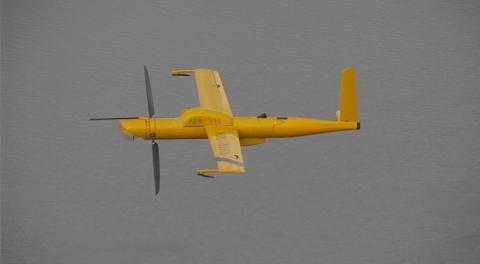
Aerovel's unmanned Flexrotor sets VTOL endurance record
Aerovel has announced that its unmanned Flexrotor, named Actaea, set a VTOL endurance record, as it flew just over 32 hours.
During its flight, Actaea, which is a unique miniature tailsitter, transitioned from hover to wing-borne flight, and conducted its journey through a “showery day, a blustery night, and then another day in the breezy and unsettled air behind a cold front.”
The UAS transitioned back to hover as dusk fell, and “dropped gently down onto a 12-foot square helideck underway at 8 kt.”
The UAS flew for a total of 32 hours and eight minutes, and had more than three hours’ worth of gasoline left in its tank upon landing. When it took off, the UAS had 7.5 kg of fuel onboard.
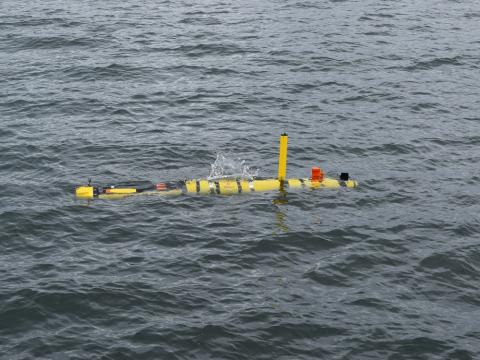
Hydroid teams with industry partners to demonstrate latest UUV capabilities during ANTX 2017
In August, during an advanced naval technology exercise known as ANTX in Newport, Rhode Island, Hydroid, Inc., L3 Aerospace Systems, Sparton Corporation and AeroVironment, Inc. collaborated to demonstrate the latest UUV capabilities of the Hydroid REMUS 600 UUV through a threat mission scenario conducted in the water.
The UUV was equipped with L3’s Rio Nino signals intelligence (SIGINT) collection payload, as well as a Sparton Hammerhead canister that contained an AeroVironment Blackwing UAV, which was launched during the exercise.
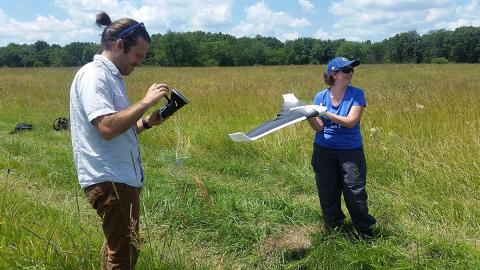
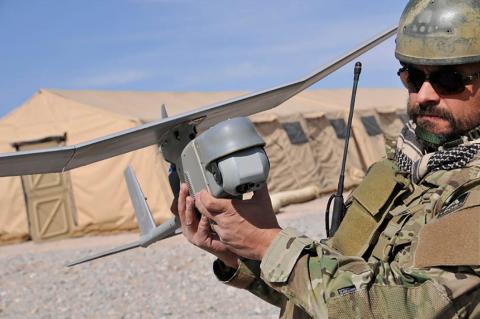
FlightWave to announce MAPIR as first partner in its Payload Partner Program
When FlightWave Aerospace Systems, Inc. introduced its premier system, the FlightWave Edge UAS, back in August, the company highlighted its “Payload Partner Program,” which is an initiative to “open-source an integration kit for the Edge’s payload/nosecone.”
With the goal of the program being to give customers their own unique flight experiences and functionalities while using the Edge UAS, FlightWave will announce its first partner in the program, a company named MAPIR, during the Drone World Expo on Wednesday, Oct. 4.
“We picked MAPIR as our very first partner because their company shares our approach to serving the UAS marketplace,” says FlightWave CMO Edmund Cronin.

From Unmanned Systems Magazine: ISIS, CHINa, rUSSIa FUeL NeW GrOWTH IN UaS SeNSOrS aNd TeCHNOLOGIeS
In this first of two articles, we will look at the 10-year future for the military unmanned aircraft sensor market, focusing on U.S. systems and programs, including international markets for U.S. systems.
UAS have primarily served as sensor trucks, and will largely continue to do so despite the growth of armed drones. Although Teal Group Corp. sees combat UAVs (UCAVs) as a major growth area, these and other UAS will continue to serve as vehicles for bringing ISR and other sensors to bear on an area or target — targeting sensors will just be more sophisticated and expensive.
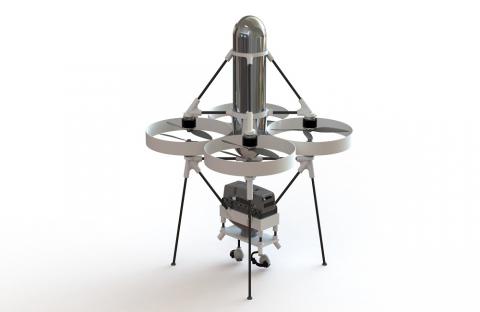
FlightWave introduces hydrogen-powered Jupiter-H2 UAS
A few weeks after introducing its FlightWave Edge UAS, FlightWave Aerospace Systems, Inc. has now introduced its hydrogen-powered Jupiter-H2 UAS, which is the company’s second offering to the UAS community.
Thanks to a partnership with a UK-based fuel cell company called Intelligent Energy, FlightWave was able to equip the Jupiter-H2 UAS with the hydrogen fuel cell technology that powers the aircraft.
The hydrogen fuel cell technology gives the UAS, which uses a “narrow-profile 70 cm airframe, with a high-thrust power plant consisting of eight motors driving cross-flowing fan blades,” several distinct features, such as its heavy-lifting capability. FlightWave notes that extra energy and lighter energy means more power to lift and carry the respective sensors of a user.