
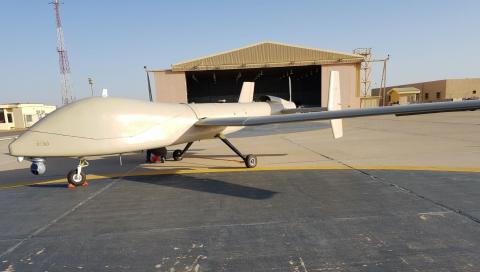
UAVOS and King Abdulaziz City for Science and Technology (KACST), Saudi Arabia are collaborating on the development of the newest member of the Saker MALE UAS family, the Saker-1C unmanned aircraft.
With ambitions to redesign and improve UAS features extending from engineering to operation, UAVOS and KACST are focusing on using advanced manufacturing technologies and integrating next-generation capabilities including state-of-the-art autonomy, navigation, communications, sensor processing and system of counter electronic warfare.
Software
Software
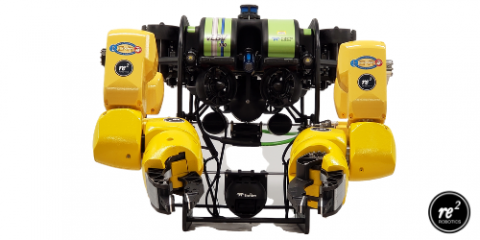
RE2 Robotics to equip Maritime Dexterous Manipulation System with autonomous capabilities
RE2 Robotics will continue the development and commercialization of its technology under the Dexterous Maritime Manipulation System (DM2S) program after receiving $2.5 million in funding from the Office of Naval Research.
Equipped with RE2’s DM2S technology, Navy personnel will be able to autonomously perform mine countermeasure (MCM) missions.
During the next phase of the program, RE2 Robotics will upgrade its dual-arm prototype, known as the Maritime Dexterous Manipulation System (MDMS), for deep ocean use. To enable autonomous manipulation capabilities, the company will also apply computer vision and machine-learning algorithms. Lastly, RE2 says that it will integrate with underwater vehicles that can autonomously navigate.
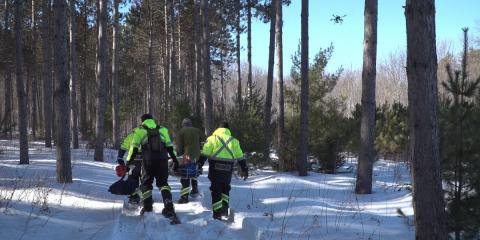
Kongsberg Geospatial, partners to use AI and UAS to improve search and rescue ops in Canada
Public Safety Canada has selected Kongsberg Geospatial, Larus Technologies, and the Civil Air Search and Rescue Association of Canada (CASARA) to help develop new methods for using drones in search and rescue operations in remote communities in Canada using geospatial software, artificial intelligence, and machine vision software.
Dubbed OVERSEE—an acronym for Optical Vision Enhancement and Refinement of Sensor Exploitation Effectiveness—the project will seek to address the unique challenges of conducting search and rescue operations using UAS platforms in remote areas such as indigenous communities in the Arctic and their immediate surrounding area.
Sonardyne demonstrates tech that will help autonomous vehicle ops in challenging environments
Under a project funded by the UK’s national Defence and Security Accelerator (DASA), Sonardyne International Ltd. demonstrated technologies that it says will help autonomous vehicle operations in challenging environments.
Sonardyne worked with a 12-meter-long SEA-KIT X class USV, and tested and validated sensors already used by UUVs for use on USVs in support of missions in coastal waters.
The SEA-KIT X was equipped with Sonardyne’s SPRINT-Nav hybrid inertial navigation instrument, which was tested against local real-time kinematic (RTK) GPS positioning as part of the DASA program to fast-track autonomous vehicle capability in challenging or harsh conditions.

Weekend Roundup: May 22, 2020
This Week in the Unmanned Systems and Robotics World
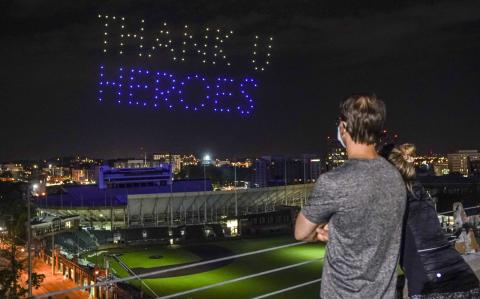
Drones were used to show thanks and appreciation for health care heroes, frontline workers and first responders on the evening of Friday, May 15 at Vanderbilt Stadium in Nashville, Tennessee. 140 coordinated drones lit the sky in formations depicting inspiring words and images. (Vanderbilt University)
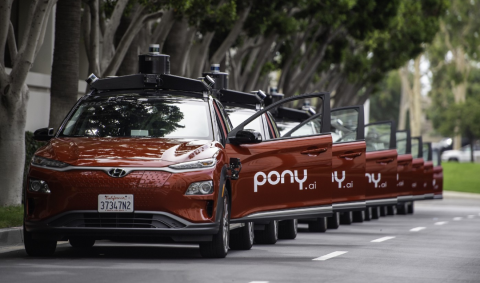
Pony.ai to equip its robotaxi fleet with the NVIDIA DRIVE AGX Pegasus platform
To meet the massive computing demands required to bring robotaxis to market, Pony.ai will equip its robotaxi fleet with the NVIDIA DRIVE AGX Pegasus platform, the company recently announced.
According to Pony.ai, DRIVE AGX Pegasus achieves an unprecedented 320 TOPS (trillions of operations per second) of deep learning. The platform integrates two NVIDIA Xavier SoCs and two NVIDIA Turing Tensor Core GPUs; both of which achieved top results in MLPerf Inference, the first industry-standard, independent AI benchmarks.
Rocos, Boston Dynamics partner to enhance existing capabilities of Spot robot
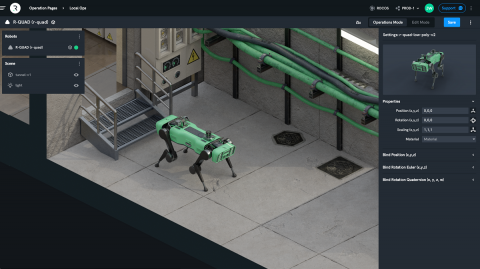
Robot operations software platform provider Rocos has partnered with Boston Dynamics to enhance the existing capabilities of Boston Dynamics’ Spot robot. Through the partnership, remote mission design and execution, as well as a teleoperation functionality, will be integrated into Spot.
Built to go where other robots cannot, Spot is a mobile, durable, and customizable robot. Equipped with the Rocos platform, the robot can now be managed from a remote location. Missions can be designed and edited on the fly, and remote teams can access sensor data collected during the mission. The robot can also be manually teleoperated to investigate issues, capture new data, or be redirected as required.
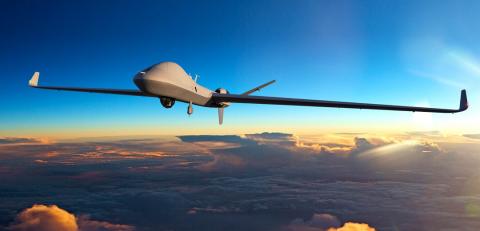
GE Additive AddWorks helps GA-ASI complete milestone first flight with 3D-printed metal part
GA-ASI has spent the last nine years building deep experience with polymer-based additive technologies. Over the last few years, the company has made improvements in the development of its metal additive roadmap, as well as a dedicated additive manufacturing team.
After establishing the required ecosystem requirements to develop its metal additive manufacturing application space, the GA-ASI Additive Manufacturing (AM) team identified a series of parts and families of applications that had potential favorable business cases.
Woolpert hired to conduct UAS surveys in Colorado
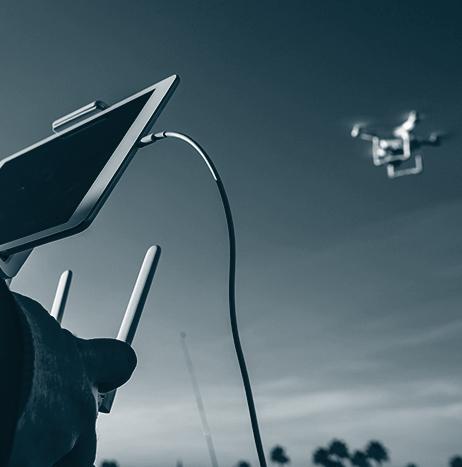
Woolpert has announced that it has been hired to complete right-of-way (ROW) and TMOSS design surveys in Castle Rock, Colorado using UAS.
The design and ROW plan surveys are being conducted in accordance with Colorado Department of Transportation (CDOT) standards. TMOSS, which stands for InRoads Terrain Modeling Survey System, represents the best practices followed by CDOT surveyors and contract consultant surveyors.
UT Dallas professor awarded grant to develop autonomous driving hardware and software
The National Science Foundation (NSF) has awarded Dr. Yang Hu, assistant professor of electrical engineering at The University of Texas at Dallas, a five-year, $500,000 grant to develop new hardware and software capable of handling the complexity of an automated driving ecosystem in which cars not only communicate with other cars, but with roadside information nodes as well.
A member of the Erik Jonsson School of Engineering and Computer Science (ECS) since 2017, Hu earned the NSF Faculty Early Career Development (CAREER) Award for his project, “Rethinking the Architectures and Systems for Autonomous Driving Infrastructure.”