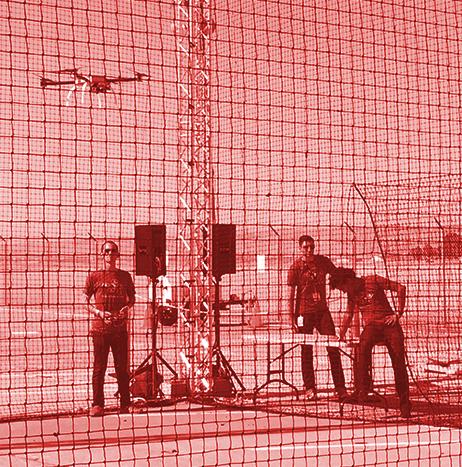
Northwest UAV leaders are excited about early test results for a hydrogen fuel cell prototype that have exceeded expectations and that they hope will herald a trend toward hydrogen-powered propulsion in unmanned flight.
NWUAV, in collaboration with the U.S. Naval Research Laboratory (NRL), is developing the proton-exchange-membrane fuel cell with an eye toward what Chief Technical Officer Jeff Ratcliffe called a growing “middle market” between long-range military drone missions that require internal combustion engines and less demanding military and commercial drone use that tends to rely on battery power.
Testing
Testing
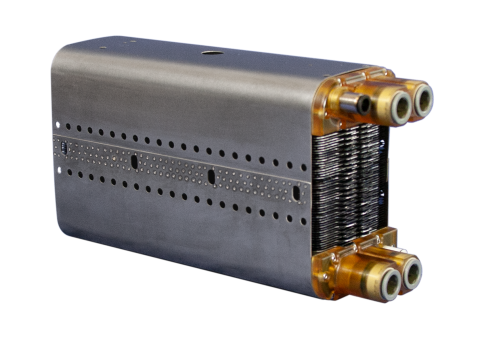
COVID-Fighting Collaboration Proves Potential of UAS for Test Transport
Exercise in upstate N.Y. shows how flight could replace drives through downtown traffic.
A team of more than a dozen COVID-19-motivated entities with expertise in public health, public safety and unmanned flight recently enjoyed a hard-won peek into the future of UAS in medical transport in upstate New York.
Weekend Roundup: December 4, 2020
This week (and last) in the Unmanned Systems and Robotics World
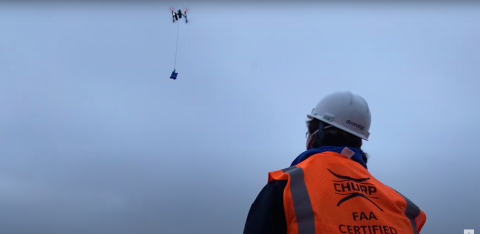
Mississippi State University (MSU) engineers in the university’s Raspet Flight Research Laboratory are leading research efforts that could make UAS operational by the U.S. government, as well as civilian aviation, in icy conditions. The U.S. Department of Defense is hoping that the icing system development and technology team being led by MSU will result in lightweight anti-icing systems, which would lead to certification for UAS to operate in forecasted icing conditions. (Mississippi State University)
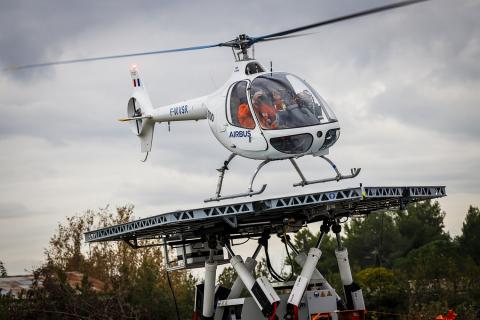
Using inertial and position measurements in testing and survey projects – bridging the gap between autonomous vehicle development and survey
OxTS Inertial Navigation Systems are used throughout the world to provide autonomous vehicle testing engineers and surveyors with highly accurate, absolute position and orientation measurements. These measurements help users realize cm-level surveying and testing accuracy, while at the same time increasing repeatability. But how do these two industries dovetail when it comes to using this information? Join NavtechGPS and OxTS as we discuss “Using inertial measurements in testing and survey projects – bridging the INS gap between autonomous vehicle development and survey.”
Speakers:
Paris Austin, Business Manager, Survey & Mapping, OxTS
Franck Boynton, VP and CTO, NavtechGPS
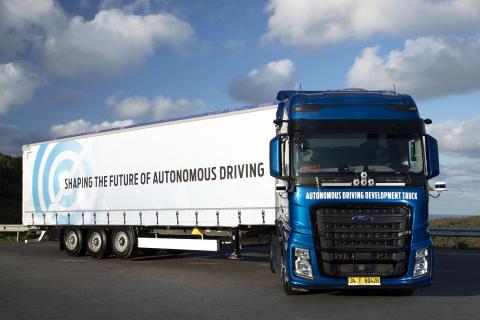
Velodyne Lidar, Ford Otosan collaborating to develop and test autonomous heavy commercial trucks
Velodyne Lidar and Ford Otosan will work together on product development and testing of autonomous heavy commercial trucks.
To enable safe navigation and collision avoidance in next generation vehicles, Ford Otosan is testing and planning to use Velodyne Velarray H800 lidar sensors, which are described as a “powerful solution that can greatly improve automated safety and advanced driver assistance systems (ADAS).”
“Autonomous vehicle technology, powered by lidar, can bring multiple efficiency and safety benefits to the trucking industry,” says Burak Gökçelik, assistant general manager, Ford Otosan.
Boeing completes tests of its advanced autonomy technology
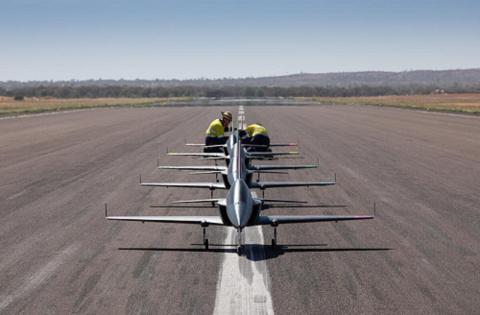
Boeing has announced that it recently completed flight tests with five high-performance surrogate jets operating autonomously in a team at the new Queensland Flight Test Range in Cloncurry, Australia.
The 11-foot aircraft were used to test Boeing’s advanced autonomy technology, including on-board command and control and data sharing capabilities.
“The tests demonstrated our success in applying artificial intelligence algorithms to ‘teach’ the aircraft’s brain to understand what is required of it,” says Emily Hughes, director of Phantom Works International.
Weekend Roundup: November 20, 2020
This Week in the Unmanned Systems and Robotics World
Students and faculty at James Madison University in Harrisonburg, Virginia are working on an autonomous vehicle that can transport the elderly. The JMU Autonomous Cart (JACart) research group tested its second autonomous (AV) golf cart on the university’s campus in a fixed course on Wednesday, Nov. 18. (WHSV-TV)
Drone Delivery Canada successfully tests several critical aspects of its Robin XL UAS
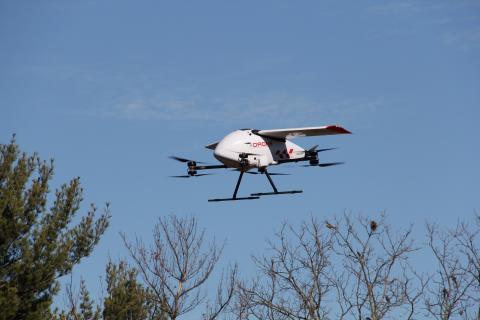
Drone Delivery Canada (DDC) has announced that it has successfully tested numerous critical aspects of the Robin XL drone at its ‘Tranquility Base’ test range.
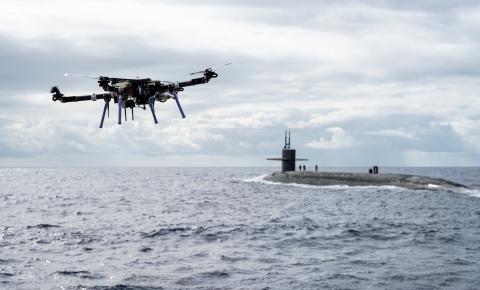
Skyfront's Perimeter drone used to perform first ship-to-submarine delivery via small UAS
Skyfront has announced that its Perimeter drone was recently used to perform the first ship-to-submarine delivery via small UAS.
During the flight, the long-endurance hybrid-electric Perimeter drone showcased its ability to resupply submarines at sea in a quick and cost-effective manner.
Skyfront’s command and control handoff capability was unveiled during the flight. Pilots aboard the surface vessel launched the drone and flew it near the submarine. Once there, pilots aboard the submarine took control of the drone and released the package onto the top of the sub.
Weekend Roundup: November 13, 2020
This Week in the Unmanned Systems and Robotics World
Scientific Systems Company Inc. (SSCI) has demonstrated a team made up of a fully autonomous UAS and a search and rescue canine working together without intervention from a human handler to conduct a simulated search and rescue mission. During the demonstration, SSCI's newly developed Teammate Aware Autonomy (TAA) system was used together with its Collaborative Mission Autonomy (CMA) and Finding Objects thru Closed Loop Understanding of the Scene (FOCUS) software. (PRNewswire)