
Hydroid Inc. has announced that it equipped a REMUS 600 UUV with the Kongsberg High-Resolution Interferometric Synthetic Aperture Sonar (HISAS) 2040 for a customer.
According to Hydroid, the integration of the in-mission processing allows for the quick download of high-resolution images from the HISAS module once the vehicle returns from its mission.
“The integration is the first of its kind at Hydroid, allowing faster processing of data to shorten post-mission analysis timelines,” says Duane Fotheringham, president of Hydroid.
“We’re excited to offer this as an option to customers who have time-sensitive missions but also need the high-resolution data of the HISAS module.”
UUV
UUV
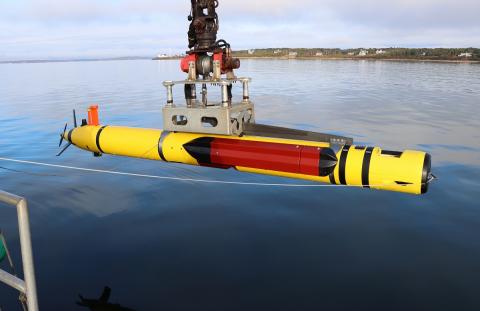
Mikros Systems awarded SBIR Phase I contract to develop software for USVs and UUVs
The Naval Sea Systems Command has awarded advanced technology company Mikros Systems Corporation a $150,000 Small Business Innovation Research (SBIR) Phase I contract for topic number N193‑A02: “Unmanned Surface Vehicle (USV) and Unmanned Underwater Vehicle (UUV) Autonomous Behavior Development.”
Through this contract, Mikros Systems will develop a Sensor In-stride Diagnostic, Correction, and Confidence Component (SID3C) that can be installed on current and future USV and UUV vehicle platforms. SID3C will monitor shipboard sensors and sensor data to detect degradation or failures and correct recoverable sensors. The component will also help autonomy systems appropriately filter unreliable sensor data.

From Unmanned Systems Magazine: The present and future of Commercial unmanned maritime systems
Autonomous and unmanned maritime systems are being used for a plethora of operations commercially.
Unmanned Systems takes a look at some of the companies creating these platforms and the technologies that power them and gets perspectives from industry leaders on how to inspire the next generation of robotic maritime innovators.
Conveying action
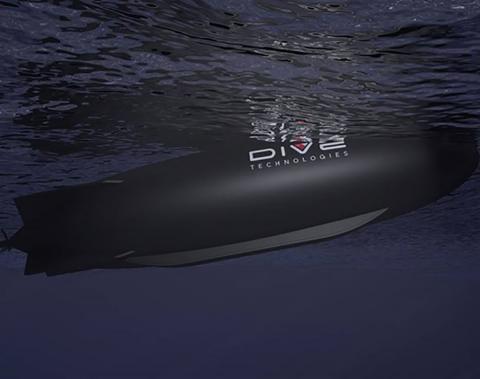
Formed in 2018 by a group of engineers working in the AUV industry, Dive Technologies was launched with the intent of developing a low-cost, large-displacement AUV that could support the emerging needs of commercial and defense customers by being rapidly configured with different payloads and sensors.
From Unmanned Systems Magazine: Europe looks to unmanned systems for mine countermeasure work
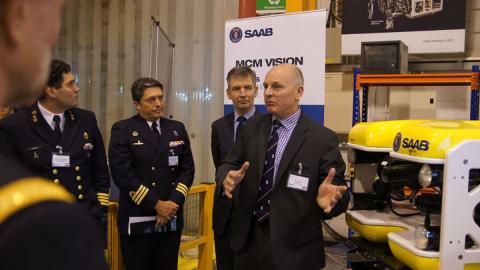
As increasing demands continue to be placed upon naval forces across the contemporary operating environment, European maritime forces are on the verge of successfully exploiting autonomous mine countermeasure (MCM) technology to not only save levels in manpower but also extend operational effectiveness.
From Unmanned Systems Magazine: Researchers work to improve communications for unmanned underwater vehicles
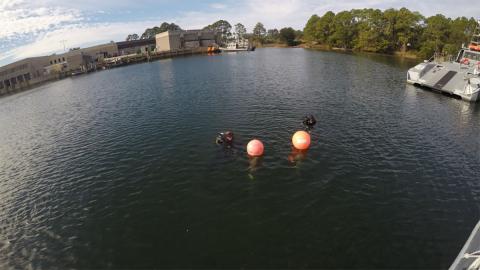
As the development of autonomous watercraft progresses, engineers and designers are busy making sure these devices can communicate effectively.
In time, these vessels will become as ubiquitous a part of the seascape as those piloted by humans. Swarms of them will patrol harbors, support military missions, conduct search-and-rescue operations, transport goods, and nearly every other maritime operation for which their presence would prove practicable.
AUVSI's Unmanned Systems and Robotics Database: An overview of commercial unmanned maritime vehicles
Unmanned vehicles operating in the maritime domain can be grouped into three main categories: Autonomous Underwater Vehicles (AUVs), Remotely Operated Vehicles (ROVs), and Unmanned Surface Vehicles (USVs). Each vehicle type offers unique capabilities which support a wide range of commercial applications.
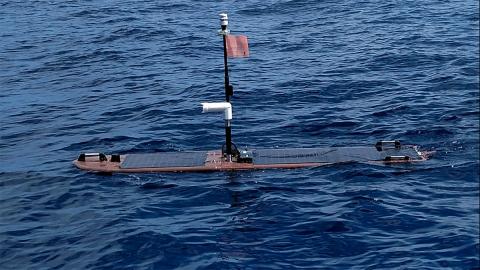
General Dynamics Mission Systems introduces new Bluefin-12 autonomous UUV
During Defense and Security Equipment International (DSEI) 2019, General Dynamics Mission Systems introduced its new Bluefin-12 autonomous UUV.
Building off of the Bluefin autonomy, the Bluefin-12 is capable of completing long endurance, high-consequence and changing missions for users by leveraging shared Bluefin Robotics' core capabilities, increased mission modularity and embedded intelligence.
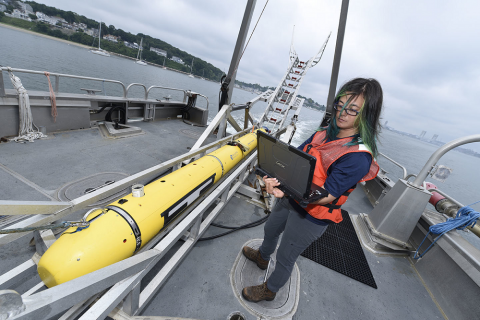
UTA researchers, Lockheed Martin collaborating on project surrounding sensors on unmanned vehicles
Two University of Texas at Arlington researchers are working with Lockheed Martin to “optimize how unmanned vehicles use sensors to gather information.”
Frank Lewis, the Moncrief-O’Donnell Chair and professor of electrical engineering, and Yan Wan, an associate professor of electrical engineering, are helping Lockheed figure out how to use sensors on vehicles underwater, on the ground and in the air, to measure and predict the activities of a target.

Northland Community & Technical College awarded grant to form National Center for Autonomous Technologies
The National Science Foundation (NSF) has awarded Northland Community & Technical College and five partner agencies a $7 million grant to form the National Center for Autonomous Technologies (NCAT), which will be hosted on Northland’s Aerospace site in Thief River Falls, Minnesota.
The NCAT will join the NSF’s large circle of Advanced Technological Education Centers (ATE).
“We will build upon the work of several other NSF ATE program investments, including Northland’s DRONETECH programs, MATE, CAAT, and GeoTech,” says Jon Beck, Northland Unmanned Aerial Systems (UAS) instructor & NCAT principal investigator.