Blog

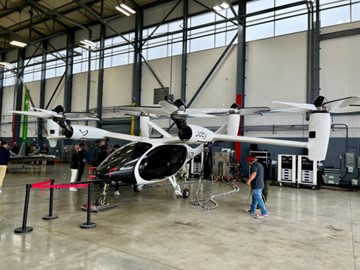
AUVSI’s Advocacy staff attended Joby’s Field Trip on October 13, 2022 – the first time the company opened the doors of their Marina facility, where they are building a vertically integrated ecosystem for Electric Vertical Takeoff and Landing (eVTOL) aircraft.
Below is an event report from AUVSI Grassroots Advocacy Manager Scott Shtofman:
--
Joby’s Vision
The vision for Joby’s aircraft, and those of their peers, is to enable a number of use cases. The broader Advanced Air Mobility (AAM) ecosystem is comprised of both Urban Air Mobility (UAM) and Regional Air Mobility (AAM). UAM is focused on transportation in a metropolitan environment - think of a flight from a busy downtown to the airport - which closely fits with Joby’s recently announced partnership with Delta Airlines. RAM is about closing the gap in those areas that may have limited access to commercial aviation or making that longer than comfortable drive more attainable via the air. The space covers both passenger and cargo carrying operations.
Facility tour
The day began with remarks from Joby’s senior team:
Teresa Thuruthiyil, Joby’s Head of Investor Relations
Founder JoeBen Bevirt discussed the importance of vertical integration
Head of Aircraft OEM Didier Papadopoulos covered the flywheel process of design, build, test, and repeat and the benefits vertical integration provide in speeding that process.
Head of Government Affairs Greg Bowles provided a policy and regulatory update, plus a look at the current aviation infrastructure and a path to use existing infrastructure to enable the eVTOL near future. This means leveraging the more than 5,000 general aviation airports around the United States, as well as a significant network of more than 5,000 mostly private use heliports, but also the unique opportunity for expanded options from these lower noise signature aircraft.
Photography was permitted in the public areas, but not while inside the production facilities
Attendees toured the “pilot production” facility, so called because it serves as a test bed for building processes that will scale. The tour consisted of a comprehensive walkthrough of the facility from the composite layup floor, to the tooling, curing, and part testing operation, into the software and hardware testing and simulation operations, and finally a look at the modular production line.
The tour showcased the technology the facility uses:
Laser projectors and tablets used in the composite operation ensure consistent and correct work gets done every time.
The Automated Fiber Placement (AFP) machine consists of a track mounted arm, which has multiple degrees of freedom and can efficiently place the carbon fiber needed to build large and complex parts like wing spars.
Flight demos and simulators
The culmination of the event was a live flight demonstration of the S4 aircraft. Under current approvals, Joby must use a chase aircraft, so there was both a helicopter and plane in the air for the task. When the day began, it was gloomy and foggy, but as noon rolled around, the boundary layer burned off and the sun was shining through. This meant we got a truly integrated picture of the airspace. Multiple general aviation aircraft and skydiving tours were safely in operation during the demonstration. Traffic was being monitored and deconflicted from both the air and ground operations center ensuring safe separation. I had the opportunity to speak with former Deputy and Acting FAA Administrator, Dan Elwell about the excitement surrounding the event. During the demo, attendees spoke softly to experience how quiet and different the noise signature was for the S4 versus the helicopter and the airplane and the normal yelling that would accompany standing along the flight line.
I finished the day in the mobile flight simulator, a trailer-based setup, with a full cockpit and projector system to emulate the flight characteristics and environment of the real thing. This trailer was part of a contract Joby has with the DoD that required them to build two simulators. The controls are very intuitive, and the learning curve is fast. The right stick controls elevation and yaw and the left stick controls speed. There is a glass cockpit, meaning that digital screens, as opposed to analog gauges, display telemetry information as well as aircraft health and airspace information. These simplified, computer-aided controls, mean that the bar for operation is low, nonetheless, they will use certified pilots.
Joby’s partnerships
Joby recently announced a partnership with Skyports, a leader in the growing infrastructure picture for Vertiports. Think of a vertiport as a specialized terminal for eVTOL and other electric aircraft like drones, that do not need the full footprint or support of a commercial airport. This is where passengers will check-in and wait for their flight, and for operators, this is where they will find the necessary charging systems, weather sensors, radio links, and logistical support. Skyports and Joby had their “Living Lab” modular vertiport concept onsite. It is made up of multiple finished shipping containers with HVAC, comfortable places to sit, and screens that will provide flight information. The Living Lab will be going on a cross-country tour over the next 18 months to help people better imagine the experience.
Additionally, part of the manufacturing development process involves having several Toyota employees in residence. Toyota has made a large investment in Joby not only through a $400 million financial commitment, but also in the collaboration in manufacturing best practices. The whole process is a mix of automation using robots and technology where they make sense, while also heavily using humans as well. The foundation of the line is built to scale as demand and production ramp up.
Field trip takeaways
Joby is committed to aviation safety.
Their team is highly experienced, including backgrounds from Boeing, General Atomics, Apple, and Tesla. Joby has more than 1,300 employees and is growing, and the future of U.S. advanced aviation leadership means we the industry will require many more aerospace and software engineers, maintenance technicians, and updated infrastructure to be successful.
Their parts and processes have become smaller, stronger, and better integrated through iterative design and testing.
The experience left me energized and excited about the work the eVTOL and AAM industry has ahead in developing and supporting enabling legislation not only at the federal level, but also at the state and local level. At AUVSI we are bringing together industry to lead and educate on the conversation across all levels of government and public acceptance. Join the conversation with us – reach out to me at sshtofman@auvsi.org to learn more about our advocacy initiatives.
| Mo | Tu | We | Th | Fr | Sa | Su |
|---|---|---|---|---|---|---|
|
|
|
|
|
|
|
1
|
|
2
|
3
|
4
|
5
|
6
|
7
|
8
|
|
9
|
10
|
11
|
12
|
13
|
14
|
15
|
|
16
|
17
|
18
|
19
|
20
|
21
|
22
|
|
23
|
24
|
25
|
26
|
27
|
28
|
|