
With the development of its new tiltpod — which the company describes as a compact motor, propeller and servo with a thrusting and tilting function — FlightWave Aerospace Inc. believes that it can effectively eliminate the pitch and roll aspect of quadcopters, which will lead to improved stability for the UAS.
Known for its FlightWave Edge UAS, which is equipped with the tiltpod, FlightWave says that the tiltpod allows an aircraft to hover without tilting its whole body forward, enabling pilots to eliminate pitch and roll. So instead of tilting the aircraft, only the motor would need to be tilted.
Air
Air
Davis, Bowen & Friedel launches in-house UAS service
A full-service architectural, engineering, planning and surveying firm called Davis, Bowen & Friedel Inc. (DBF) has announced its new in-house UAS service.
DBF says that its new UAS program will provide “more efficient, safer and cost-effective” UAS-based aerial data collection, as areas of land can be scanned in a fraction of the time using the technology.
The firm adds that using a high precision, professional grade UAS to collect photogrammetric data will offer its clients “ample and unique possibilities,” including construction videos monitoring site progress, post disaster evaluations, and enhanced due diligence reports.
Boeing completes first test flight of its autonomous passenger air vehicle prototype
On Tuesday, Jan. 22, Boeing successfully completed the first test flight of its autonomous passenger air vehicle (PAV) prototype in Manassas, Virginia.
During the flight, the PAV prototype, which is 30-feet long and 28-feet wide, completed a controlled takeoff, hover and landing, which tested its autonomous functions and ground control systems.
Boeing says that future flights will test forward, wing-borne flight, as well as the transition phase between vertical and forward-flight modes—a phase that is usually the most important engineering challenge for any high-speed vertical takeoff and landing (VTOL) aircraft, according to Boeing.

FLIR Systems awarded contract for its Black Hornet 3 nano-UAS
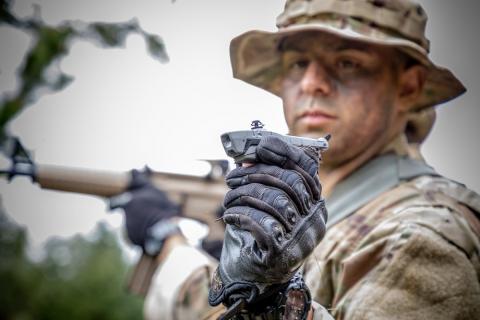
In support of the French Operational Pocket Drone (DrOP) program, the French Defense Procurement Agency (DGA) has awarded FLIR Systems Inc. a contract for its FLIR Black Hornet 3 nano-UAS and Personal Reconnaissance System (PRS) to support French Armed Forces operations.
The contract has a ceiling value of $89 million.
“We are honored to support the French Armed Forces’ mission with the delivery of the Black Hornet PRS and related services,” says Jim Cannon, president and CEO at FLIR Systems.
Echodyne to provide its radars for UAS IPP efforts in North Dakota
Echodyne has announced that it has been selected to participate in the Northern Plains UAS Test Site’s (NPUASTS) UAS Integration Pilot Program (IPP) efforts taking place in North Dakota.
A manufacturer of innovative, high-performance radars for government and commercial markets, Echodyne says that its MESA radar technology enables a UAS Traffic Management (UTM) system to detect and track commercial UAS and manned aircraft, helping facilitate safe operations in the national airspace.
“Echodyne is thrilled to be part of Northern Plains’ next phase of UPP testing” says Eben Frankenberg, CEO of Echodyne.

Meet the IPP Sites: Collaboration plays integral role in North Dakota DOT's IPP efforts
When the UAS IPP was initially announced over a year ago, governments, municipalities and companies across the United States envisioned conducting landmark UAS operations in an effort to push the industry forward and make this technology a regular part of society.
One of the entities with interest in participating in the program was the North Dakota Department of Transportation (NDDOT), which initiated a conversation with the Northern Plains UAS Test Site — located in Grand Forks — to collaborate on the pursuit of this endeavor.
“We felt it would be a stronger project pulling in key stakeholders across the state,” Russ Buchholz, UAS integration program administrator at NDDOT, tells Unmanned Systems.
LAPD's SWAT uses small UAS for first time
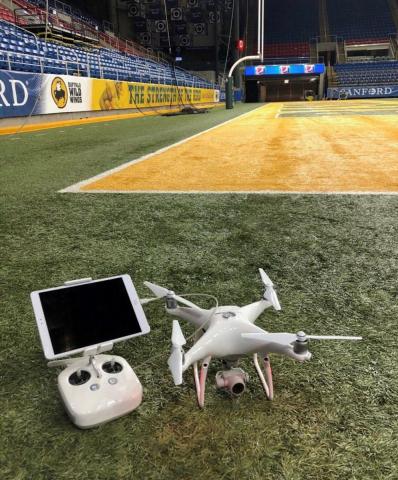
The Los Angeles Police Department’s (LAPD) Metropolitan Division, Special Weapons and Tactics Team (SWAT) recently used a small UAS for the first time during a barricade incident involving a robbery suspect.
On Jan. 9, a specialized small UAS pilot (SWAT officer) used a UAS to find the third suspect of an armed robbery that occurred at a convenience store the night of Dec. 13, 2018.
While searching for the third suspect, Metropolitan Division police officers went to an apartment where they believed the suspect was located as a result of investigative techniques that they were implementing. The suspect refused to exit, though, and officers and detectives believed that the suspect could be armed with a firearm, which led them to requesting SWAT.
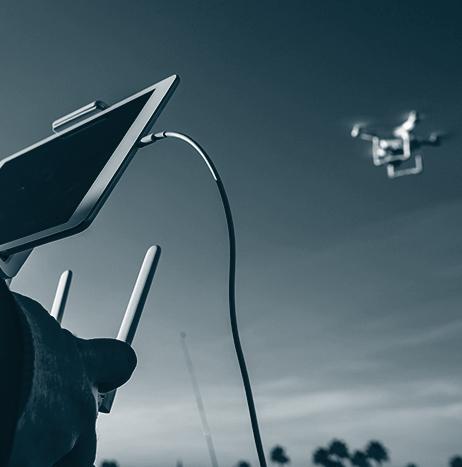
CyPhy Works becomes Aria Insights, an AI drone company
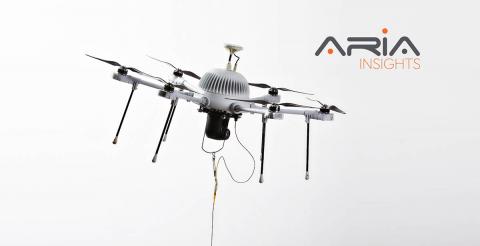
CyPhy Works has leveraged its tethered drone technology and morphed into a new company, Aria Insights, to harness the data collected by drones by integrating AI and machine learning into its hardware.
Aria Insights, or AI, will provide customers with intelligent, autonomous drones that collect and analyze data to create actionable insight, thus speeding decision time.
“After 10 years of innovating and redefining drone technology, the team at CyPhy saw the limitations facing the industry — namely the complications and risks of retrieving and analyzing data,” says Lance Vanden Brook, CEO of Aria Insights.
FAA moves forward with rulemaking on UAS flights over people, safety, traffic management
In a move that could further accelerate the unmanned aircraft systems industry, the U.S. Federal Aviation Administration today announced a notice of proposed rulemaking for the operation of small UAS over people, as well as another about the safe and secure operations of drones.
In addition, it announced three contracts for UAS test sites to develop an unmanned traffic management (UTM) program that will be separate from the existing air traffic management system but is expected to complement it.
Autonomous tech moves up, down and underwater at CES 2019
Drones and self-driving cars continue to be all the rage at CES, the former Consumer Electronics Show, but autonomous technology is also making its way into things such as motorcycles with self-driving capabilities, flying cars and even underwater drones.
BMW made a splash at the show with its iNEXT vehicle, which aims to answer the question about what a vehicle interior can look like when the car no longer has to be driven by a human.
“The interior can be a place for relaxation, interaction, entertainment, or concentration, as preferred,” the company says. “It is more like a comfortable and fashionably furnished “living space” on wheels — a new ‘favorite space.’”