
Air
Air

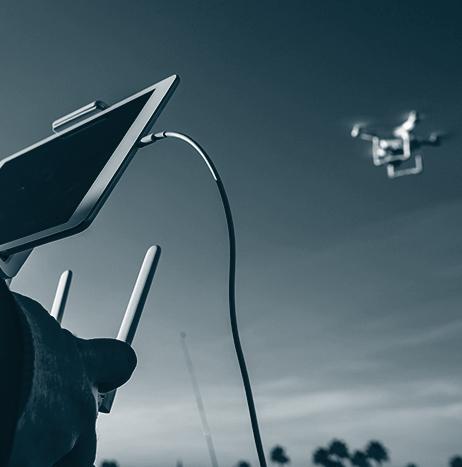
Canada's new UAS rules set to go into effect on June 1
On Jan. 9, Canada’s Minister of Transport, Marc Garneau, announced Canada’s new rules for UAS, which will go into effect on June 1, 2019.
The rules will apply to all UAS pilots flying UAS between 250 grams and 25 kilograms (.55 pounds to 55 pounds) that are operated within the pilot’s visual-line-of-sight, regardless of whether the UAS is flown for fun, work or research.
Transport Canada says that the new simplified rules reflect a great amount of consultation with Canadians and the industry, with the final regulations introducing two main categories of UAS operation—basic and advanced—that are based on distance from bystanders and airspace rules.
Project RACHEL's fuel cell powered UAS completes 70-minute flight
With a goal of developing a hydrogen fuel cell powered multi-rotor UAS, Project RACHEL recently eclipsed its original test flight target of 60 minutes with a five-kilogram payload, as the purpose-built fuel cell powered UAS flew for an uninterrupted 70 minutes carrying a five-kilogram payload.
The flight was completed using a UAS that had less than a 20-kilogram maximum take-off mass, using a six-liter cylinder containing hydrogen gas compressed to 300 bar.
Supported by Innovate UK, Project RACHEL is led by Productiv, a venture engineering company, on behalf of BATCAM, a UAS filming specialist based in the United Kingdom.

From Unmanned Systems Magazine: Harsh climate, few resources force innovation in unmanned systems use in the Arctic
Espen Olsen’s job is a little different from that of most police officers.
He’s the police chief inspector for the Governor of Svalbard’s office and is in charge of its new drone program. He has begun using small drones in this Norwegian archipelago, situated roughly halfway between mainland Norway and the North Pole.
Drones have been used in the Arctic for several years, including Aeryon Scouts, Insitu ScanEagles and AeroVironment Pumas, which have aided in studying sea ice, monitoring wildlife and keeping an eye on climate change. Olsen probably has the most unique uses for his collection of DJI drones, however, which includes an older Phantom 3, two Mavic Pros and a Matrice.

Forest Service seeks info on drones to create prescribed burns
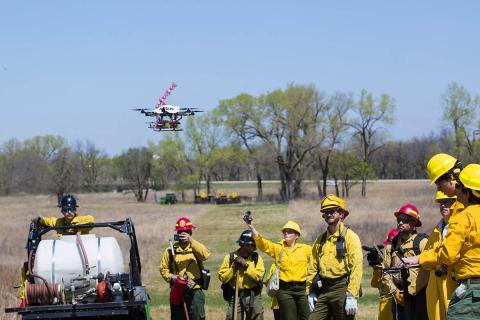
The U.S. Forest Service is requesting information from industry about using drones to create controlled burns to help fight forest fires.
In a year when fires have raged out of control in the West, particularly California, the Forest Service has posted a request for information about how drones could create controlled or prescribed burns, also known as hazard reduction burning, to reduce the amount of fuel available to a fire.
The RFI, which has a response date of Jan. 25, may also include a live demonstration of an “aerial ignition system,” according to an RFI posted on Federal Business Opportunities. Such a demonstration could occur between February and May 2019.

California's Monterey County Sheriff's Office uses UAS to locate and arrest armed suspect
On Sunday, Dec. 9, the Monterey County Sheriff’s Office (MCSO) in California used its UAS to locate an armed suspect that had broken into the historical buildings at the Point Sur Lighthouse in Monterey, California the night of Saturday, Dec. 8.
Using its UAS, MCSO deputies directed California State Park Rangers to the suspect’s location, where he was subsequently arrested.
The sheriff’s office notes that this situation was dangerous for several reasons, including the steep terrain of the location, the involvement of a firearm, and the unknown intent of the suspect.
With all of these factors, the UAS proved to be a beneficial option for the sheriff’s office.
Meet the IPP Sites: KDOT focusing on infrastructure inspections, precision ag for UAS pilot program
More than 70 percent of the world's general aviation fleet is manufactured in Kansas, so needless to say, aviation is the state’s primary industry.
With unmanned aircraft being the newest edition to the aviation industry, Kansas has a strong interest in making sure this technology is integrated safely into the airspace. The state is an ideal location for this technology to be tested during the UAS Integration Pilot Program over the next few years, especially considering Kansas is home to 140,000 miles of public roads — many in rural areas — and the Kansas Department of Transportation maintains 10,000 miles of highway and over 5,000 bridges.