The trigger for the upcoming virtual summit, “Disruptive Women Powering Our Autonomous Future,” won’t likely make any history books, but it felt like a milestone – or at least an aha moment.
Pamela Gauci, events director for Velodyne Lidar, was reviewing the lineup for a panel discussion that was to be part of another event that the company hosts, an annual conference on safety and autonomous vehicles. With her was Sally Frykman, Velodyne Lidar’s chief marketing officer.
Neither the general topic of that other conference nor the specific topic designated for the panel – the regulatory road ahead – had anything to do with gender. Yet every expert on the list was a woman.
Ground
Ground

Wibotic launches software to simplify complexity that comes with keeping large fleets charged
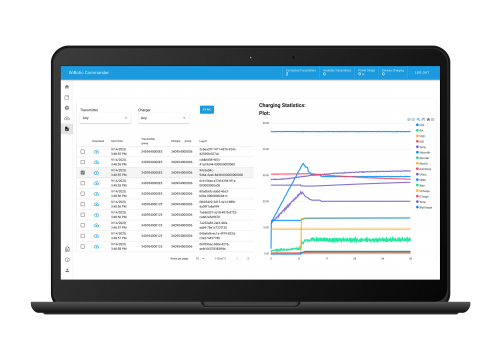
Seattle-based Wibotic last week launched a software package to help customers manage the increasingly complex array of tasks necessary to keep vehicles in growing unmanned fleets charged and ready to perform.
The software, called Commander, offers constant, at-a-glance awareness of all vehicles through a user-friendly interface, said CEO and co-founder Ben Waters. Users will be able to assess quickly how soon vehicles need to be charged, as well as to gather data on things like power usage and battery performance over time – to inform future scheduling and purchasing decisions.
“It might be used for a single vehicle on a single site, or a single vehicle on hundreds of sites, or it could be used for hundreds of vehicles on one site,” Waters said.
Introducing: Assuring Autonomy
Welcome to AUVSI’s new blog, titled Assuring Autonomy. That brand may sound familiar, as our CEO and President Brian Wynne rolled out a video series spotlighting leaders within the unmanned systems industry under the same name in the summer of 2020. However, since the quest to increase knowledge about and familiarity with unmanned systems will be many-pronged in nature, the Assuring Autonomy brand will now encompass this blog as well as future iterations of educational videos.
CA State Senator Allen Emerges as Autonomous Vehicle Thought Leader
Media Contact: Jackie Beckwith, jbeckwith@auvsi.org
For Immediate Release: December 10, 2020
CA State Senator Allen Emerges as Autonomous Vehicle Thought Leader
Milrem Robotics, John Cockerill Defense showcase Type-X Robotic Combat Vehicle
In front of select military forces from across the globe, Milrem Robotics and John Cockerill Defense showcased the Type-X Robotic Combat Vehicle with the Cockerill Protected Weapons Station Gen. II (CPWS II).
The Type-X chassis features what the companies describe as a “revolutionary design” for a mobile modular multi-mission vehicle that provides a platform for a family of unmanned armored vehicles. According to the companies, the Type-X is the “first combat vehicle that is purposefully designed to be unmanned intended to be an integral part of mechanized units.”

Aquiline Drones to power GuardBot's spherical and amphibious robotic vehicles via AD Cloud
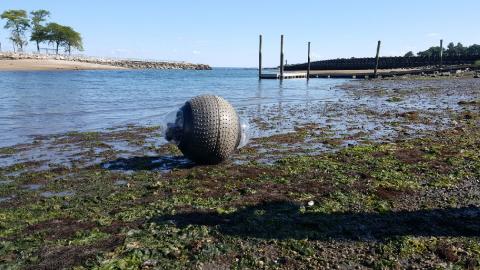
Cloud and drone technologies company Aquiline Drones (AD) has announced that it will power the spherical and amphibious robotic vehicles from engineering company GuardBot using the AD Cloud (ADC).
Aquiline notes that ADC takes full advantage of its capacity, modularity and truly salient features for autonomous assignments, operations and quests, which makes it ideal for unmanned vehicle operations.
“In the coming months, ADC will undergo rigorous testing, hosting and management trials with GuardBot’s proprietary software application. ADC’s highly modular AI architecture is suitable for crucial customization of solutions typically not available in the open marketplace,” explains Barry Alexander, founder and CEO of Aquiline Drones and AD Cloud Services.
Persistent Systems to develop Protected Communications for Manned-Unmanned Teams for U.S. Army
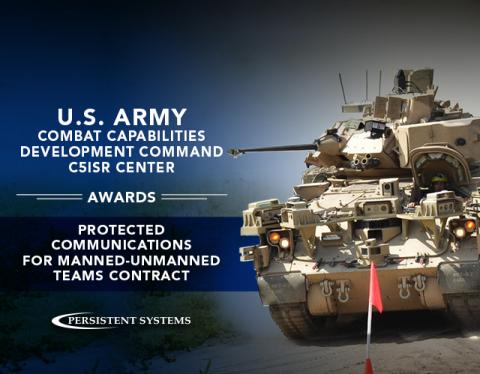
The U.S. Army Combat Capabilities Development Command C5ISR Center has awarded Persistent Systems LLC a $5.4M contract to develop Protected Communications for Manned-Unmanned Teams (MUM-T).
The Army has a vision for a next-generation Optionally Manned Fighting Vehicle (OMFV) that can be networked with up to four unmanned Remote Combat Vehicles (RCVs) and their assorted sensor/weapons payloads. The vehicle would also be networked with the broader force and command structure.
In order to make these manned-unmanned teams a reality, they will need a robust, secure, and high-throughput communications network, which is where Persistent Systems comes in.
DARPA's OFFSET program deploys swarms of autonomous air and ground vehicles during third field experiment
DARPA’s OFFensive Swarm-Enabled Tactics (OFFSET) program deployed swarms of autonomous air and ground vehicles to demonstrate a raid in an urban area during the agency's third field experiment.
According to DARPA, OFFSET sees a day where swarms of up to 250 collaborative autonomous systems will provide important insights to small ground units in urban areas where limited sight lines and tight spaces can obscure hazards, as well as constrain mobility and communications.

Textron Systems, Howe & Howe and FLIR Systems unveil Ripsaw M5 Robotic Combat Vehicle
During the 2019 AUSA Annual Meeting & Exposition in Washington, D.C., Textron Systems, Howe & Howe and FLIR Systems debuted the Ripsaw M5 Robotic Combat Vehicle (RCV).
The Team Ripsaw offering for the U.S. Army’s RCV program, the Ripsaw M5, which is described as a “low-risk, ready-now solution,” is capable of performing a variety of missions thanks to its aggressive mobility and modularity.
“Bringing together Howe & Howe, Textron Systems and FLIR Systems really represents a dream team,” says President & CEO Lisa Atherton of Textron Systems.
Built Robotics raises $33 million for autonomous construction technologies
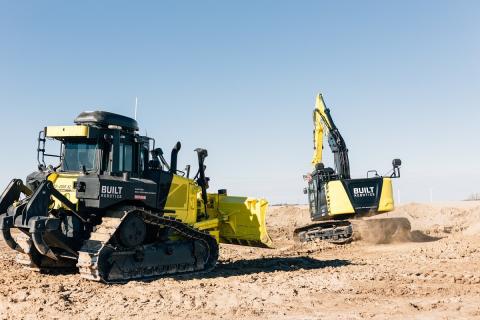
Built Robotics, a developer of technology that transforms construction equipment into fully autonomous robots, has announced the close of a $33 million Series B.
Existing equipment from any manufacturer can be equipped with Built Robotics’ automated guidance systems, while still maintaining the ability to have complete manual operation. The upgraded equipment can perform a variety of tasks fully autonomously including digging trenches, excavating foundations, and grading building pads.
A web-based platform manages the autonomous fleet, which allows the robots to be supervised by remote equipment operators.