
The United States Department of Defense’s Combating Terrorism Technical Support Office (CTTSO) has awarded Planck Aerosystems (Planck Aero) a contract worth $2 million to produce mobile tethered UAS that can be integrated onto tactical ground vehicles.
The mobile tethered UAS are equipped with Planck Aero’s autonomy and vision-guided navigation technology, which the company says is ideal for flying from moving platforms, GPS-denied operation, and target detection and tracking.
Ground
Ground
Swarms of air and ground robots tested during second field experiment for DARPA's OFFSET program
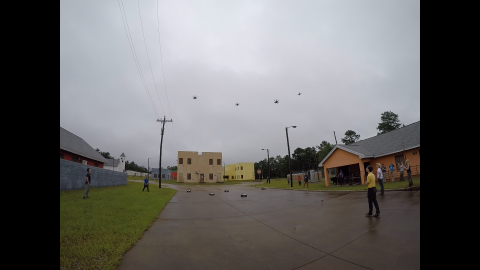
DARPA has announced that during the second field experiment for its OFFensive Swarm-Enabled Tactics (OFFSET) program, teams of autonomous air and ground robots tested tactics on a mission to isolate an urban objective.
During the experiment, which took place in June at the Selby Combined Arms Collective Training Facility in Fort Benning, Georgia, the robots started off by identifying locations of interest, and then created a perimeter around the focal point, similarly to how a firefighting crew establishes a boundary around a burning building.
From Unmanned Systems magazine: Fiscal 2020 defense budget request includes billions for unmanned systems
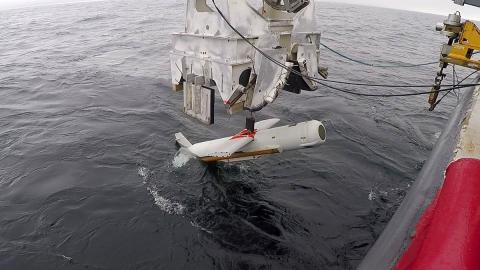
In March, the White House released a fiscal 2020 defense budget request totaling $718.3 billion, which it said would invest in space and cyber warfighting domains, modernize air, maritime and land domains, innovate more rapidly to strengthen the nation's competitive advantage, and sustain the forces and readiness.
As part of the request, the services release budget estimates that detail unclassified procurement and research, development, test & evaluation (RDT&E) efforts.
Persistent Systems selected to equip U.S. Army's backpackable robot with Wave Relay MANET
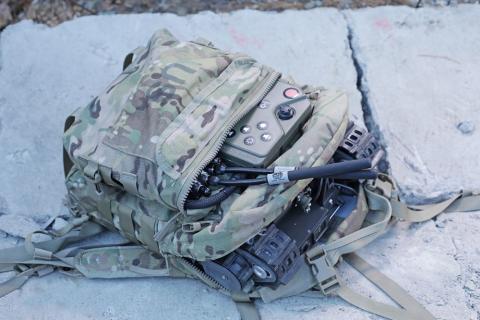
Persistent Systems has announced that it will supply the QinetiQ North America (QNA) team chosen for the U.S. Army’s Common Robotic System-Individual (CRS(I)) program of record with its Wave Relay mobile ad hoc networking technology (MANET).
Weighing less than 25 pounds, CRS(I) is a backpackable robot that dismount users can carry with sensor suites for viewing and detecting threats, which provides greater situational awareness in the field.
“We’re excited to, once again, deliver the Wave Relay MANET to the U.S. Army and help lead the drive towards networking the battlefield,” says Leslie Hulser, director of Programs for Persistent.
From Unmanned Systems Magazine: Automated trucks gain traction
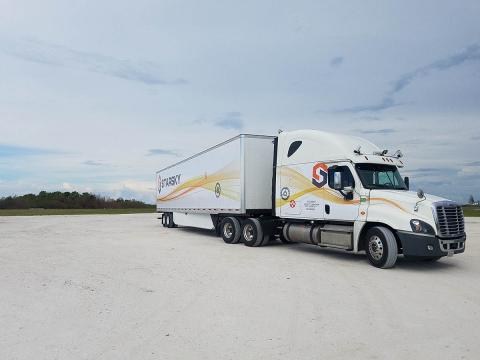
When it comes to self-driving vehicles, cars seem to get most of the publicity but many new and established players are seeking to transform commercial trucking by developing automation technology that helps or removes the driver.
Companies have equipped trucks with various sensors, software, tracking devices and wireless communications gear and are testing their souped-up vehicles on real roads, sometimes with customer freight onboard.
According to proponents of such efforts, autonomous trucking offers many benefits, including increased safety. In the United States, about 4,000 people a year die in truck accidents, most of which are caused by human error.
Driverless trucks could also save money and boost productivity.
UAVOS introduces new ground control station to monitor and control UAS
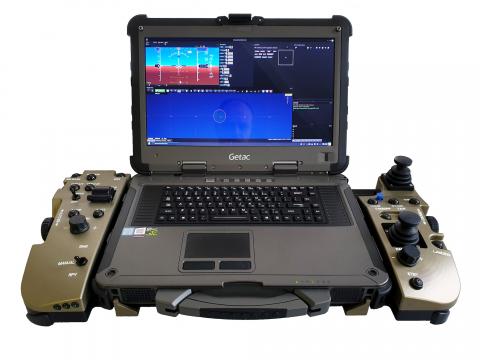
UAVOS has introduced its new Portable Ground Control Station (PGCS 3), which is “implemented as a console with controls collected on the ergonomic control panel,” the company says.
In its basic configuration, PGCS 3 comes with a military-grade rugged Getac X500 laptop. Thanks to the ability to integrate different 15-inch laptop computer models, the PGCS 3 is an “even more” versatile platform to use, UAVOS notes.
Described as a “detachable computer and a console with additional controls,” the PGCS 3 is fully compatible with UAVOS autopilot. Console joysticks, push-buttons and switches are all industrial water-proofed units, and the panel is equipped with a quick-release mechanism for docking the laptop.
RE2 Robotics uses its RADR robotic applique kit to preform robotic disaster cleanup in Florida
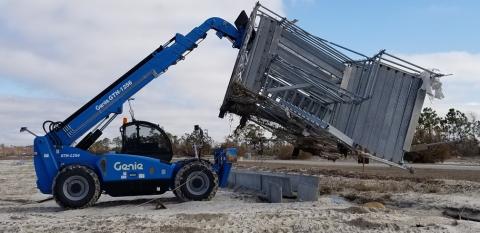
RE2 Robotics has announced that a commercially available telehandler equipped with its Rapid Airfield Damage Recovery (RADR) robotic applique kit performed teleoperated disaster clean-up at the Air Force Civil Engineering Center (AFCEC) in Florida.
Located at Tyndall Air Force Base, AFCEC was badly damaged during Hurricane Michael in October 2018.
“Tyndall Air Force Base sustained catastrophic damage during Hurricane Michael,” says Jorgen Pedersen, president and CEO of RE2 Robotics.
“When we were asked to use the Air Force-funded RADR robotic retrofit kit technology to assist with the clean-up efforts, we deployed our team without hesitation.”

QinetiQ North America wins U.S. Army's Common Robotic System-Individual program
QinetiQ North America (QNA) has announced that it has won the competition for the U.S. Army’s Common Robotic System-Individual (CRS(I)) program.
Valued up to more than $164 million, the seven-year Indefinite Delivery Indefinite Quantity (IDIQ) contract is for the delivery of small ground robots, and includes a Low Rate Initial Production (LRIP) phase worth approximately $20 million over one-to-two years, which will be followed by a series of annual production releases.
As part of the LRIP phase, QNA has been awarded a $4,051,837 initial order.