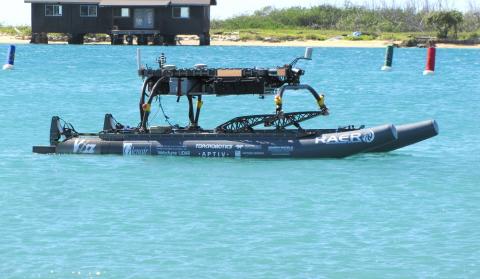
Students at Embry–Riddle Aeronautical University recently debuted their Minion autonomous surface vessel during the Maritime Robot X Challenge in December 2018.
Built by engineering student members of the Robotics Association at Embry–Riddle, the 16-foot long boat navigated an open water obstacle course, adapted to the waves and wind on the bay, and launched and recovered a small submarine before returning to dock.
According to Embry-Riddle, the Minion was created to compete in the Maritime Robot X Challenge, which is a weeklong biennial international competition co-sponsored by the Office of Naval Research (ONR), RoboNation, and a Hawaii-based company called NAVATEK that designs ships and other amphibious vehicles.
Maritime
Maritime
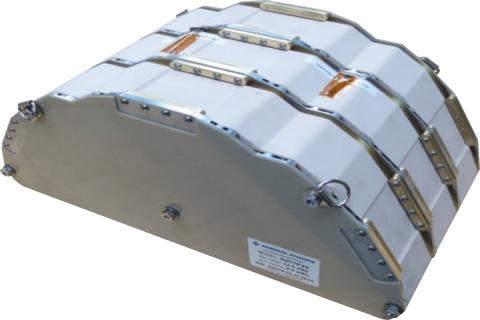
GA-EMS to develop and demonstrate prototype LiFT battery system for Snakehead LDUUV
Advanced Technology International (ATI) has awarded General Atomics Electromagnetic Systems (GA-EMS) a contract to develop and demonstrate a prototype Lithium-ion Fault Tolerant (LiFT) battery system for the U.S. Navy’s prototype “Snakehead” Large-Displacement Unmanned Undersea Vehicle (LDUUV).
Built to increase endurance, range, and payload hosting capabilities in support of various future mission and operations requirements, the Snakehead LDUUV’s propulsion and support systems will be powered by the LiFT battery system.
Teledyne Gavia to formally introduce SeaRaptor AUV in April
Teledyne Gavia has announced that it will formally introduce its new 6000-meter rated AUV, SeaRaptor, in April.
SeaRaptor incorporates a variety of Teledyne components, including ascent and descent weight releases, multi-beam echosounders, obstacle avoidance multi-beam sonar (Teledyne RESON, Denmark) and Current, Temperature, and Depth sensor (CTD) (Teledyne RD Instruments, San Diego, CA).
Teledyne Gavia notes that the first vehicle delivered also carried an Edgetech Side Scan Sonar with Dynamic Focus capability, an iXblue Phins 6K INS system, and a CathX Camera and strobe system.

LCS Mission Module Program successfully completes shipboard integration testing of unmanned systems
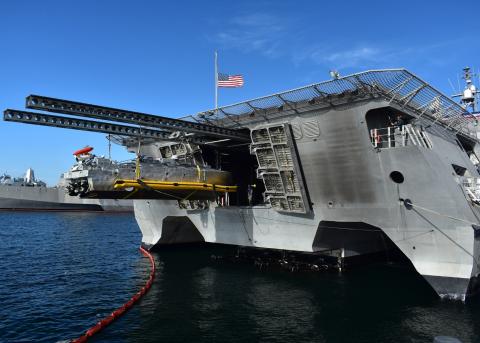
The Naval Sea Systems Command (NAVSEA) has announced that on Jan. 14, the Littoral Combat Ship (LCS) Mission Module Program successfully completed shipboard integration testing of two unmanned systems on board USS Independence (LCS 2).
The Knifefish UUV and Unmanned Influence Sweep System (UISS) are part of the Mine Countermeasures Mission Package (MCM MP), which targets specific portions of the water column and segments of the MCM detect-to-engage sequence using a system-of-systems approach.
During the integration events, the Knifefish UUV and UISS both successfully verified the communications link between Independence and the unmanned systems. Additionally, several launch and recovery evolutions from the ship were also executed.
Autonomous ocean robots spend year traveling under ice sheet and reporting long-term observations
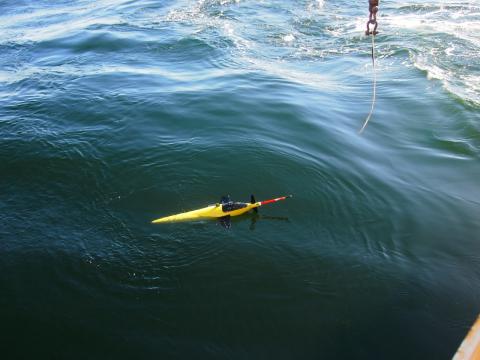
Over the last year, a team of autonomous ocean robots has successfully traveled under an ice sheet and returned to report long-term observations, the University of Washington (UW) has announced.
A partnership between a number of entities including the University of Washington’s College of the Environment, the UW Applied Physics Laboratory, the Lamont-Doherty Earth Observatory of Columbia University, the Korean Polar Research Institute and Paul G. Allen Family Foundation, the robotic mission has traveled under the ice shelf 18 times, and has routinely reached more than 25 miles into the cavity.
Ocean Infinity to use its AUVs for mapping and inspections in Brazil
Ocean Infinity has announced that its partner, Brazilian offshore consulting company Cepemais, has been awarded a contract to provide high-resolution hydrographic mapping services to Brazilian national oil company Petrobras.
During the project, which is for the Campos, Espirito Santo and Santos basins, offshore Brazil, Ocean Infinity will work under contract to Cepemais to map an area of 5,000 square kilometers and inspect 12,000 kilometers of pipelines using its AUVs.
Ocean Infinity’s AUVs will operate from the company’s ‘Island Pride’ vessel, and will work in water depths between 50 and 3,000 meters. Cepemais will interpret and report on the data that Ocean Infinity collects during the project.
Autonomous tech moves up, down and underwater at CES 2019
Drones and self-driving cars continue to be all the rage at CES, the former Consumer Electronics Show, but autonomous technology is also making its way into things such as motorcycles with self-driving capabilities, flying cars and even underwater drones.
BMW made a splash at the show with its iNEXT vehicle, which aims to answer the question about what a vehicle interior can look like when the car no longer has to be driven by a human.
“The interior can be a place for relaxation, interaction, entertainment, or concentration, as preferred,” the company says. “It is more like a comfortable and fashionably furnished “living space” on wheels — a new ‘favorite space.’”