Automated car developers and regulators need to be proactive to deal with the issues facing the industry, from public education to safety to employment dislocations to city planning, said speakers at the second full day of the Automated Vehicles Symposium in San Francisco.
The arrival of automated vehicles will inevitably lead to changes in employment, said Erica L. Groshen, a visiting senior scholar at Cornell University’s School of Industrial Labor Relations.
“Innovation is not new,” she said. “Let’s learn from the past.”
Her team has studied past technology-driven dislocations dating back to the industrial revolution and found that even when jobs are lost, eventually full employment returns.
Self-driving Cars
Self-driving Cars
DOT chief Chao urges AV community to educate the public
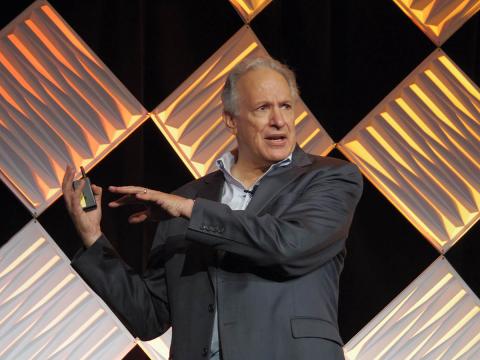
The “quite brilliant” engineers and technologists who are developing automated vehicles need to “step up and educate the public about this new technology” to boost confidence, U.S. Department of Transportation Secretary Elaine Chao said Tuesday.
“Without public acceptance, automated technology will never reach its full potential,” Chao said in her keynote address at the Automated Vehicles Symposium’s first full day. “Consumer acceptance will frame the limitations to growth of this technology, so we all need to work together to get it right.”
The DOT held a “listening session” in March to get input on the autonomous revolution, covering topics including accessibility, public safety, insurance and liability, jobs, cybersecurity and public outreach.

The Automated Vehicles Symposium moves to Orlando in 2019
The Automated Vehicles Symposium takes the show on the road in 2019 and heads to Orlando, Florida. The event takes place July 15-18, 2019 at the Orlando World Center Marriott.
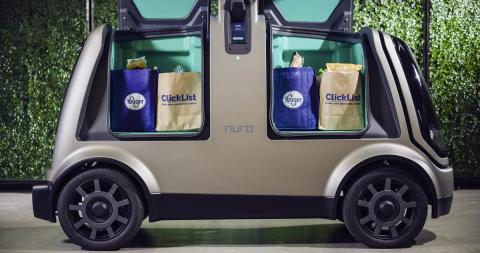
Kroger, Nuro team for autonomous grocery delivery
No time to go to the store? Grocery giant Kroger and Silicon Valley company Nuro have announced a pilot program for a fully autonomous grocery delivery service.
The companies say that customers can place same-day delivery orders through Kroger’s ClickList system and Nuro’s app, and the orders will then be brought to the doorstep by a Nuro autonomous vehicle.
The pilot market will be announced soon, with deliveries expected to begin this fall. Kroger has 2,800 stores in 35 states.
From Unmanned Systems Magazine: Nvidia brings artificial intelligence to automobiles
Imagine cars so fully autonomous that the interiors have no steering wheels, pedals, or rear-view mirrors. Imagine them being able to carry passengers safely along any route in any weather, in any traffic conditions — skillfully spotting, assessing and avoiding hazards even more reliably than human drivers.
It’s a vision that would require immense artificial intelligence computing power to realize. And that is what deep-learning innovator Nvidia says its Drive PX Pegasus provides.
In announcing Pegasus in October, Nvidia billed it as the “world’s first AI computer to make (fully autonomous) robotaxis a reality.” Pegasus is scheduled for distribution to auto manufacturers and other customers in the second half of 2018.
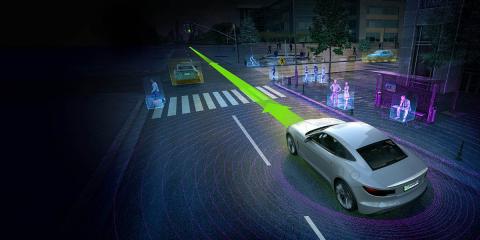
Drive.ai launching self-driving pilot program in Frisco, Texas in July
Drive.ai has announced that it is launching a pilot program to bring an on-demand self-driving car service to Frisco, Texas starting in July 2018.
Drive.ai describes this program as a “milestone for the State of Texas,” as it will be the first time that members of the public will have access to an on-demand self-driving car service on public roads.
“Self-driving cars are here, and can improve the way we live right now,” says Sameep Tandon, co-founder and CEO of Drive.ai.
“Our technology is safe, smart, and adaptive, and we are ready to work with governments and businesses to solve their transportation needs.”

University of Florida study seeks to ensure autonomous cars meet needs of the blind
A University of Florida researcher named Julian Brinkley has developed a program called “Atlas” to figure out the specific needs blind people have using self-driving cars, and using his software to solve problems.
Brinkley uses data he collects from users and others through collaboration with the Florida Center for the Blind in Ocala, Florida.
“If I’m a visually impaired person and I don’t have the ability to verify visually that I’m at the appropriate location, how do I know that it’s not dropping me off in a field somewhere?” Brinkley says via the Gainesville Sun.
NVIDIA introduces cloud-based system for testing autonomous vehicles
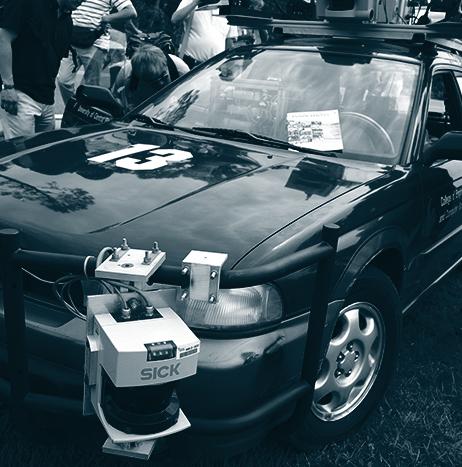
During the opening keynote of the GPU Technology Conference, NVIDIA founder and CEO Jensen Huang announced NVIDIA DRIVE Constellation, which is a computing platform based on two different servers.
The first server runs NVIDIA DRIVE Sim software to simulate a self-driving vehicle’s sensors, such as cameras, lidar and radar, while the second server contains an NVIDIA DRIVE Pegasus AI car computer that runs the “complete autonomous vehicle software stack and processes the simulated data as if it were coming from the sensors of a car driving on the road.”
NVIDIA says that the cloud-based system for testing autonomous vehicles using “photorealistic simulation” is a “safer, more scalable method” for bringing self-driving cars to the roads.
Jaguar Land Rover and Waymo partner to develop world's first premium self-driving electric vehicle
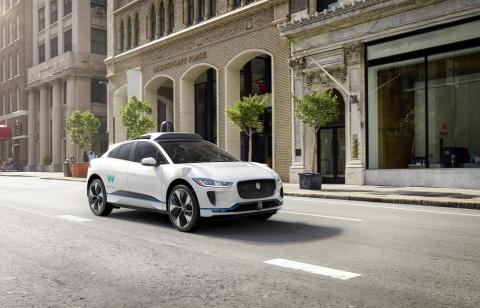
Jaguar Land Rover and Waymo have announced a long-term strategic partnership to further their shared goals of making cars safer, freeing up people’s time, and improving mobility for everyone.
As part of their collaboration, Jaguar Land Rover and Waymo will develop the “world’s first premium self-driving electric vehicle” for Waymo’s driverless transportation service.
Together, the companies will design and engineer self-driving Jaguar I-PACE vehicles. The Jaguar I-PACE, which is Jaguar’s first full-electric SUV, was launched in March. All-new from the ground up, the Jaguar I-PACE is a “no compromise, desirable and practical electric performance car.”
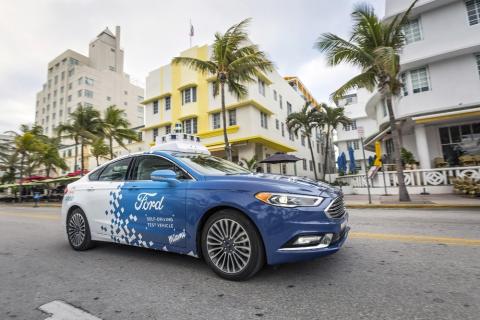
Ford testing its self-driving vehicle service in Miami
Ford has announced that it will test its self-driving vehicle service in Florida, on the streets of Miami and Miami Beach.
Ford will do this with the help of Miami-Dade County, whose mayor, Carlos A. Giménez, is on the “forefront of thinking about the future of transportation,” according to Sherif Marakby, Ford Vice President, Autonomous Vehicles and Electrification, via a post on Medium.com.