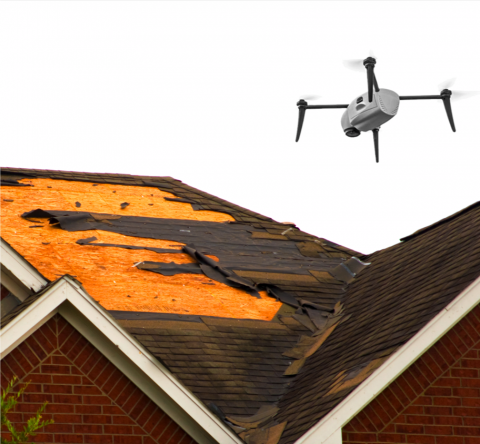
Grinnell Mutual, a property casualty insurance company and the nation’s largest primary reinsurer of farm mutual companies, is using Kespry’s UAS and aerial intelligence platform for residential and commercial property roof inspections.
Using Kespry’s technology, Grinnell Mutual takes detailed, high-resolution photos that are rapidly blended into single, composite 3-D images of roofs. Combined with aerial intelligence and machine learning-based algorithmic assessments made in the Kespry Cloud, the images help Grinnell Mutual’s adjusters determine storm-related damage so that they can make the most accurate claims decisions possible.
Software
Software
OneSky begins live flight testing with AGI OneSky UTM platform
In collaboration with Northeast UAS Airspace Integration Research (NUAIR) and Griffiss International Airport in Rome, New York, OneSky, a business unit of Analytical Graphics Inc. (AGI), recently began live flight testing with the AGI OneSky UAS Traffic Management (UTM) platform.
The tests are being conducted as part of NASA’s ongoing UTM initiative, which is designed to enable civilian low-altitude airspace and UAS operations, and validating requirements for UAS Service Suppliers (USS).

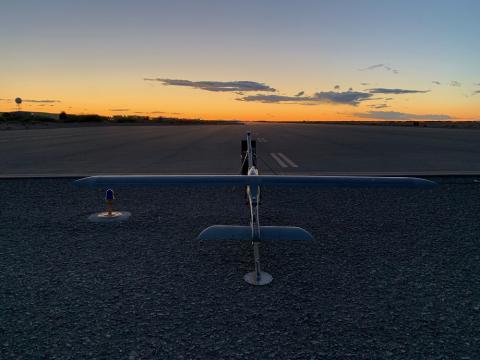
Silent Falcon introduces Silent Falcon Extended Endurance UAS
Silent Falcon UAS Technologies has introduced its new Silent Falcon Extended Endurance (EE) UAS.
Equipped with the newest technological innovations in solar panels, battery and solar power conversion, the Silent Falcon EE UAS can stay aloft for up to eight hours during the day, and four hours at night.
The communications capabilities of the Silent Falcon EE have also been upgraded, thanks to the inclusion of three MIMO MANET radios at the Ground Control Station with the SF TriAntenna configuration. Not only does this configuration greatly increase connectivity, bandwidth and reliability, but it also allows one of the radios to be used to connect a remote site, such as a command center to the radio network.
UAVOS introduces new ground control station to monitor and control UAS
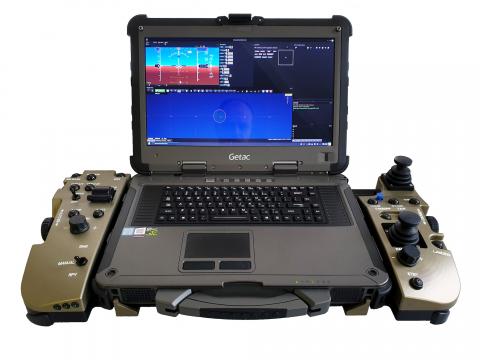
UAVOS has introduced its new Portable Ground Control Station (PGCS 3), which is “implemented as a console with controls collected on the ergonomic control panel,” the company says.
In its basic configuration, PGCS 3 comes with a military-grade rugged Getac X500 laptop. Thanks to the ability to integrate different 15-inch laptop computer models, the PGCS 3 is an “even more” versatile platform to use, UAVOS notes.
Described as a “detachable computer and a console with additional controls,” the PGCS 3 is fully compatible with UAVOS autopilot. Console joysticks, push-buttons and switches are all industrial water-proofed units, and the panel is equipped with a quick-release mechanism for docking the laptop.
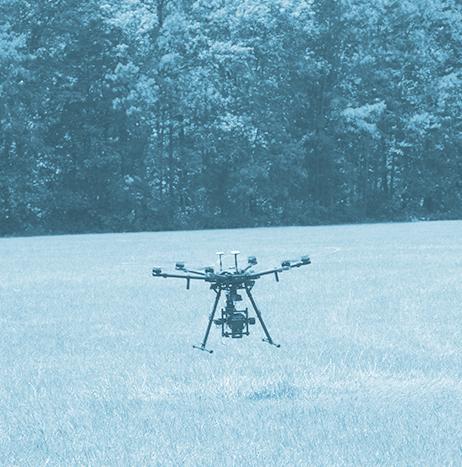
South Carolina's Oconee County Sheriff's Office purchases UAS
The Oconee County Sheriff’s Office in South Carolina has purchased a new UAS.
The UAS will be used in conjunction with the sheriff's office’s helicopter for various operations such as search and rescue missions, locating the elderly as a part of Project Life Saver, and locating potentially dangerous fleeing suspects.
The sheriff’s office says that UAS offer capabilities that helicopters do not for certain missions. UAS take less time to deploy, and they can also help find subjects that are located in areas where an extended aerial view may be limited.
DJI equipping new consumer drones with airplane and helicopter detectors
As part of a 10-point plan to “ensure the world’s skies remain safe in the drone era,” DJI has announced that it will install airplane and helicopter detectors in new consumer drones.
AirSense technology, which receives ADS-B signals from nearby airplanes and helicopters and warns UAS pilots if they appear to be on a collision course, will be integrated into all new DJI drone models released after January 1, 2020 that weigh more than 250 grams. According to DJI, this will be the largest single deployment of ADS-B collision awareness technology to date, and will set a new standard by putting professional-grade aviation safety technology in drones available to everyone.
Sonardyne acquires maritime software and equipment specialist EIVA
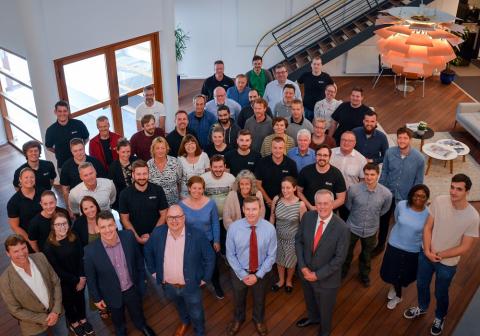
Sonardyne International Ltd. has announced that it has acquired maritime software and equipment specialist EIVA A/S, marking the latest step in the company’s long-term growth strategy.
“We are committed to a sustainable future for Sonardyne, which includes investing in complementary technologies and enterprises that supplement our core expertise in underwater communications, navigation, monitoring and imaging systems,” says Simon Partridge, Sonardyne’s strategy director.
RE2 Robotics to develop dexterous, underwater robotic hand for U.S. Navy
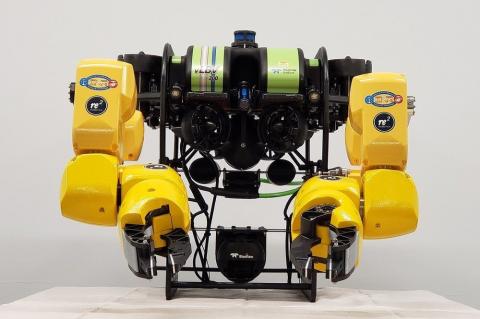
RE2 Robotics has announced that it has received $3 million in funding to develop a dexterous, underwater robotic hand with tactile feedback for the U.S. Navy.
Known as Strong Tactile mARitime hand for Feeling, Inspecting, Sensing and Handing (STARFISH), the program will create an “advanced end-effector for mine countermeasures (MCM) and explosive ordnance disposal (EOD) missions” for U.S. Naval expeditionary forces.
Drive.ai uses external communication panels to talk to public
With no driver at the helm, self-driving vehicles are posed with the challenge of effectively communicating with their surroundings.
Drive.ai has addressed that challenge head-on, equipping its self-driving vehicles with external communication panels that convey a variety of messages to properly communicate with drivers, pedestrians, cyclists, and everyone else on the road.
“Our external communication panels are intended to mimic what an interaction with a human driver would look like. Normally, you’d make eye contact, wave someone along, or otherwise signal your intentions,” Drive.ai CEO Bijit Halder tells AUVSI via email.

Embry-Riddle professor develops counter-UAS tech that safely grounds unauthorized UAS
Embry-Riddle Aeronautical University and Drone Defense Systems LLC have announced a licensing agreement to commercialize new technology that detects and commandeers unauthorized UAS, and guides them to a safe landing.
Developed by Embry-Riddle faculty member Dr. Houbing Song, the technology suggests a “safe, affordable” way to neutralize rogue UAS without having to shoot them down or force them to crash-land. The technology allows for this to be done even in civilian settings such as large outdoor entertainment arenas and airports.
According to Dr. Stephanie A. Miller, executive director of technology transfer for Embry-Riddle’s Research Park, Drone Defense Systems has received exclusive rights to commercialize the technology under the licensing agreement.