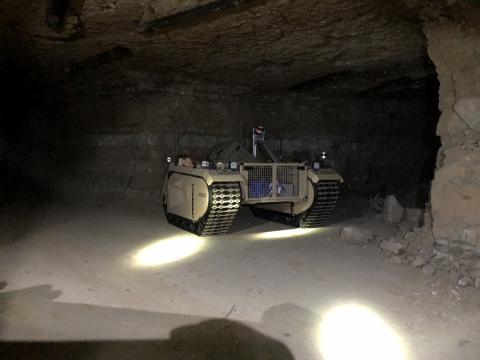
Milrem Robotics has announced that an energy company in Estonia called Enefit used its Multiscope UGV to determine the condition of the pillars in a mine in which mining ended ten years ago.
Equipped with 3D lidars, the Multiscope UGV was used in the Estonia Mine in closed underground locations. People are no longer allowed to enter these areas being that the anchor structure used to support the ceiling is being removed following the end of mining operations.
“An unmanned vehicle is an excellent solution for conducting surveys in an area which may be unsafe or prohibited for people to enter,” says Veljo Aleksandrov, development project director at Enefit.
Software
Software
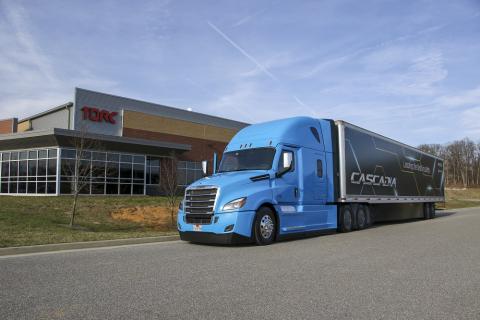
Daimler Trucks acquires majority stake in Torc Robotics in an effort to commercialize highly automated trucks
In an effort to commercialize highly automated trucks (SAE Level 4) on U.S. roads, Daimler AG’s subsidiary Daimler Trucks and Buses Holding Inc. is acquiring a majority stake in Torc Robotics.
Torc Robotics' team and Daimler Trucks’ developers, specifically the Research & Development team of Daimler Trucks North America (DTNA), will work together closely as part of the overall agreements.
Sony, NTT DOCOMO to test conceptual driverless vehicle that uses 5G mobile tech
Sony Corporation and NTT DOCOMO Inc. have announced that they will test Sony's conceptual driverless vehicle, the New Concept Cart SC-1, which utilizes 5G mobile technologies for a number of different remotely controlled functions.
The test will be conducted using the trial network in DOCOMO 5G Open Lab GUAM, providing DOCOMO-constructed test facilities and an outdoor verification environment, which will be operated by DOCOMO PACIFIC Inc., a wholly owned subsidiary of DOCOMO.

From Unmanned Systems Magazine: Simulations spur self-driving cars
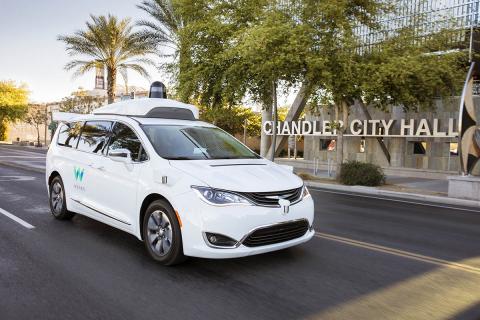
Self-driving cars often grab headlines because of their on-road activity, such as when Alphabet’s Waymo recently launched its Waymo One taxi service in the Phoenix area, or when a Volvo serving as an Uber test vehicle struck and killed a pedestrian in Tempe, Arizona, last year. But much of the effort to turn driverless cars into reality takes place out of public view, in the virtual world.
RE2 Robotics uses its RADR robotic applique kit to preform robotic disaster cleanup in Florida
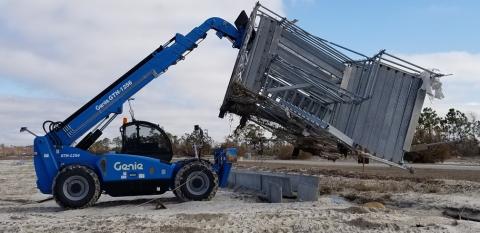
RE2 Robotics has announced that a commercially available telehandler equipped with its Rapid Airfield Damage Recovery (RADR) robotic applique kit performed teleoperated disaster clean-up at the Air Force Civil Engineering Center (AFCEC) in Florida.
Located at Tyndall Air Force Base, AFCEC was badly damaged during Hurricane Michael in October 2018.
“Tyndall Air Force Base sustained catastrophic damage during Hurricane Michael,” says Jorgen Pedersen, president and CEO of RE2 Robotics.
“When we were asked to use the Air Force-funded RADR robotic retrofit kit technology to assist with the clean-up efforts, we deployed our team without hesitation.”
L3 Technologies and Sonardyne equip AUVs with 6G capability
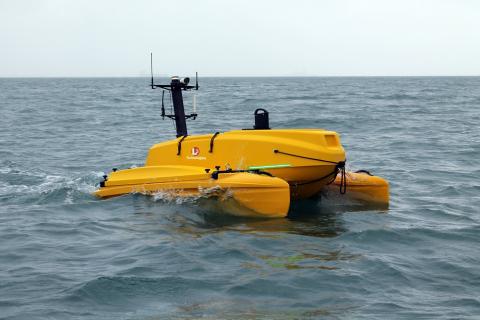
L3 Technologies has announced that its commercial autonomous vessel product range will be equipped with 6G capability, thanks to a collaboration with Sonardyne International Ltd.
L3 says that its C-Stat 2 and C-Cat 3 autonomous vessels will be equipped with Sonardyne’s 6G range of Ranger 2 Ultra-Short BaseLine (USBL) tracking and communications systems.
According to L3, these distinctive platforms and sensor combinations have shown themselves capable of delivering optimized options for data gathering and subsea positioning tasks during inshore and offshore operational scenarios.
PrecisionHawk uses drone technology to hunt for buried treasure in the Philippines
Buried treasure is often the stuff of legend, but that didn’t stop PrecisionHawk from recently traveling more than 7,000 miles to hunt for buried treasure in the Philippines left by the Japanese during World War II.
Working alongside the History Channel on a show called Lost Gold of World War II, a production company called Ample Entertainment approached PrecisionHawk in June 2018 because it needed a partner that could use lidar-equipped drones to penetrate the deep vegetation in order to map ancient trade paths across more than 70 acres of rainforest in the Philippines.
Mississippi State University researchers use UAS to help NOAA forecasters refine forecasts
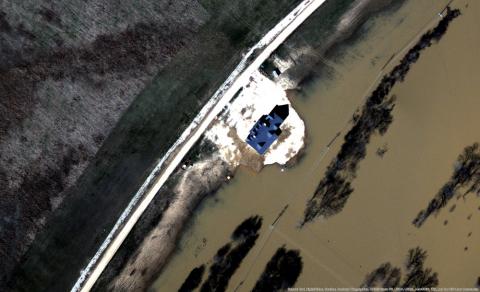
Scientists from Mississippi State University’s (MSU) Northern Gulf Institute recently used a small UAS to take high-resolution images of rising waters during a major rainstorm in late February.
The images were beamed back in real time to National Oceanic and Atmospheric Administration (NOAA) weather forecasters.
“We were able to see the water as it rose over the course of two days, which helped our office confirm when the crest had been reached,” says Dr. Suzanne Van Cooten, hydrologist-in-charge at the NOAA National Weather Service Lower Mississippi River Forecast Center in Slidell, Louisiana.
BAE Systems awarded contract to continue developing autonomy software to improve resiliency of air mission planning for military
BAE Systems has been awarded a Phase 3 contract worth $3.1 million from the Defense Advanced Research Projects Agency (DARPA) to further the development of autonomy software, in an effort to improve the resiliency of air mission planning for the military.
The goal of the Resilient Synchronized Planning and Assessment for the Contested Environment (RSPACE) program is to develop human-centered software decision aids that can help air operators better control daily operations in a complex battlespace. As part of the RSPACE program, BAE Systems has created software called the Distributed, Interactive, Command-and-Control Tool (DIRECT) to improve air battlespace awareness.
Sea Machines Robotics opens new advanced technology center in Boston
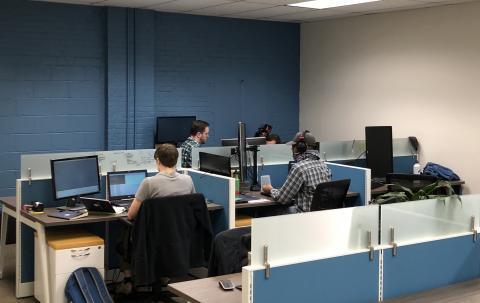
Sea Machines Robotics has opened a new advanced technology center in Boston that will be used to accelerate product development and accommodate the company’s growing team.
Located adjacent to Sea Machine’s headquarters and vessel testing sites in East Boston’s shipyard, the fully renovated workspace provides a collaborative, open working environment, as well as expansive conference and meeting areas. The technology center is also near local restaurants, Logan International Airport and Boston’s public transit system.