
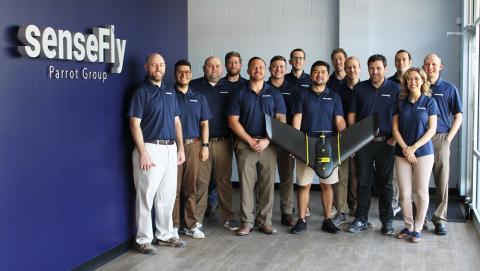
SenseFly has announced that it is moving its North American operations to Raleigh, North Carolina.
SenseFly says that its new office will “accommodate its rapid growth.” Additionally, the new office will host senseFly's North American shipping & logistics operation, its customer service & satisfaction function, and its sales and marketing teams.
“Our move to Raleigh reflects our dedication to meeting our customers’ needs through innovation,” says senseFly CEO Gilles Labossière.
Software
Software
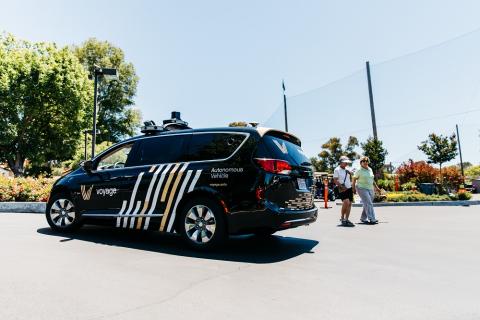
Voyage selects Renovo's AWare as platform for developing its autonomous driving technology
Voyage has announced that it has selected Renovo’s AWare as the platform for developing its autonomous driving technology.
Built from the ground-up with Level 4, driverless applications in mind, AWare allows Voyage to focus on building autonomous driving technology for its communities, thanks to AWare’s features, from “real-time execution of safety-critical operations, to a growing ecosystem of drop-in partner integrations.”
“Renovo shares our belief that the future of autonomy requires the ability to easily and safely integrate the best functionality on the market,” Voyage says on its website.
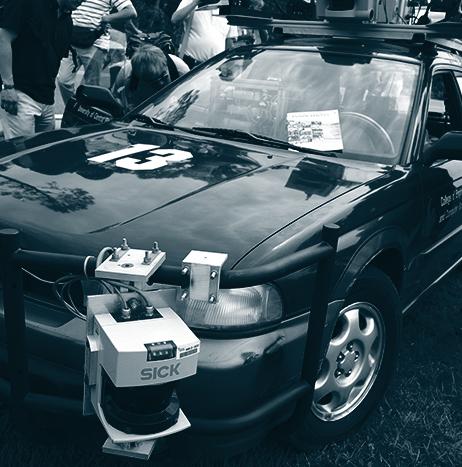
ST Engineering and SafeRide Technologies partner to provide cybersecurity protection for autonomous vehicles
Global technology, defense and engineering group ST Engineering has announced a strategic partnership with SafeRide Technologies to integrate SafeRide’s “vSentry” software cybersecurity suite with ST Engineering’s Connected Electric Vehicles and Autonomous Vehicles (AV) platforms.
A “specialist” in automotive cybersecurity, SafeRide Technologies offers “anomaly uncovering” and cyber threat prevention for connected and autonomous vehicles.
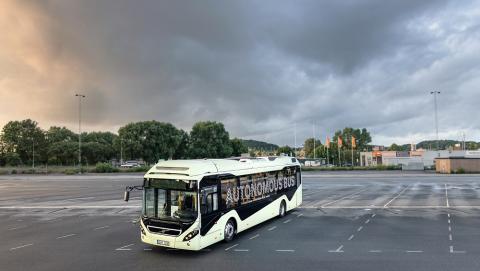
Volvo showcasing its autonomous bus during Volvo Ocean Race competition
Volvo is showcasing its autonomous bus to specially invited guests during the Volvo Ocean Race competition in Gothenburg, Sweden.
Based on Volvo's commercially produced electric city bus, the prototype has been modified for autonomous operation.
Volvo says that at the demo event, there will be presentations to demonstrate how this technology can contribute to “safer and more comfortable travel,” as well as more efficient handling of vehicles in the depot.
Weekend Roundup
This Week in the Unmanned Systems and Robotics World
During a pilot project in October, an autonomous vehicle will be tested in Edmonton, Alberta, Canada, on a segregated roadway, separated from other traffic. During the pilot project, Edmonton residents will get the chance to experience the technology for free, and provide feedback to the city. (The Star Edmonton)

K2 Unmanned Systems and Robotic Skies partner to provide 'complete customer service experience'
K2 Unmanned Systems, which recently released what it calls the first American made Law Enforcement tactical drone, Knight Hawk, has partnered with Robotic Skies to provide its customers with a “complete customer service experience.”
Robotic Skies has a global network of more than 150 independently-owned and operated repair stations across 35 countries. Each service center in the network is equipped with the aviation expertise and factory training to ensure the mission readiness of commercial unmanned systems.
Additionally, Robotic Skies, like K2, offers its customers “turnkey field service programs designed to keep their UAS flying safely, efficiently and affordably.”
AirMap, ENAIRE and everis demonstrate integrated ATM-UTM system
During the 2018 GUTMA Annual Conference, AirMap collaborated with Spain’s official Air Navigation Service Provider, ENAIRE, and an international leader in aerospace and defense, everis, to demonstrate an integrated air traffic management (ATM)-UTM system in controlled airspace and urban environment.
Hosted by ENAIRE and everis, the demonstration saw an everis UAS and a DJI UAS fly at the same time within shared airspace. Both UAS were connected to AirMap’s platform via open AirMap API integrations, which allowed for real-time sharing of the UAS’ telemetry data to publish to the AirMap platform.
Boeing announces investment in UAS software company Kittyhawk
Boeing has announced an investment in Kittyhawk, a company that is offering a “unified approach” to the safe operation of commercial UAS.
According to Boeing, Kittyhawk’s technology will support the development of a UAS Traffic Management System (UTM), which will allow both piloted and autonomous air vehicles to safely coexist in the airspace.
Founded in 2015, Kittyhawk has developed enterprise software and mobile-based apps that integrate “real-time UAS flight operations and management solutions” all in one platform. The company’s customer base has grown over the last three years to include industry leaders from a variety of fields, including media, rail transportation, and fire and emergency management agencies that rely on it for end-to-end UAS operations.
NEVS and Phantom Auto partner to safely deploy electronic autonomous vehicles
In an effort to ensure “safe deployment of electric autonomous vehicles,” Swedish electric vehicle manufacturer NEVS has announced a collaboration with Phantom Auto, which provides teleoperation safety technology for autonomous vehicles (AVs).
Formerly Saab Automobile, NEVS will utilize Phantom Auto’s teleoperation safety technology to ensure the “optimally safe and efficient deployment” of its electric AVs across the globe.
“Our AVs must be able to drive from any point A to any point B, which means driving through all edge cases they experience on the road, such as inclement weather, road work, and any other road obstructions,” explains Stefan Tilk, CEO of NEVS.
SeeByte's Area Breakdown Tool helps increase efficiency of unmanned maritime systems operators planning complex MCM missions
SeeByte has launched the Area Breakdown Tool (ABT), which is designed to increase the efficiency of unmanned maritime systems (UMS) operators as they plan complex Mine Countermeasure (MCM) missions.
ABT has been designed to help operators divide large Operational Areas into smaller sections that can then be assigned to unmanned systems. These areas can be customized for the platform type, the duration of the mission, or the number of vehicles in the squad.
The result is that ABT helps the operator efficiently prepare a “set of sortie plans,” and quickly evaluate alternatives for a complex mission involving multiple unmanned maritime vehicles.