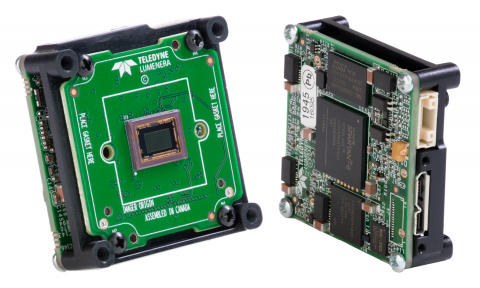
Teledyne Lumenera’s Lt Series Board Level Cameras offer a smaller, lighter, and lower cost imaging solution. Equipped with the latest rolling shutter Starvis™ CMOS sensors and global shutter Pregius™ CMOS sensors from Sony®, the cameras range in resolution from 2-12 megapixels, and provide the flexibility to meet the requirements of a wide variety of imaging systems.
UAV
UAV
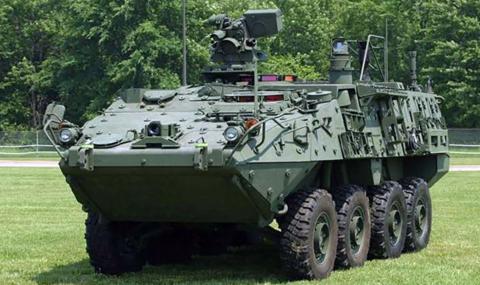
FLIR Systems awarded $26 million contract modification in support of NBCRV SSU program for U.S. Army
In support of the Nuclear, Biological and Chemical Reconnaissance Vehicle Sensor Suite Upgrade (NBCRV SSU) program for the U.S. Army, FLIR Systems has been awarded a $26 million contract modification.
As a follow-on to a $48 million contract announced in April 2019, the Other Transaction Authority (OTA) agreement was awarded through the Joint Program Executive Office for Chemical, Biological, Radiological, and Nuclear Defense (JPEO-CBRND).
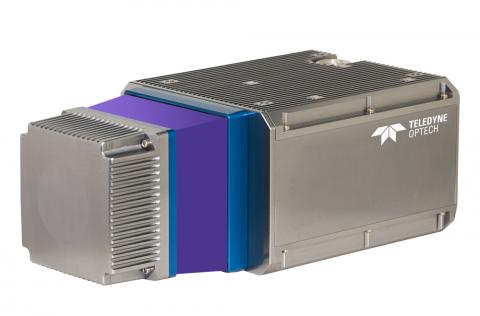
Teledyne Optech's CL-360 serves as building block for next gen, best-in-class UAVs
Teledyne Optech’s CL-360 is a survey grade 360-degree laser scanner that enables OEM hardware manufacturers and integrators to develop the next generation of best-in-class UAV, mobile, and terrestrial scanning solutions for various surveying applications.
Being a survey grade lidar scanner means that the resulting 3D points derived from the CL-360 are suitable for applications such as surveying or inspections. More specifically, the accuracy and precision (repeatability) of the points is greater than those obtained by lower performance lidar sensors or other methods such as photogrammetry, according to Mark Treiber, Product Manager, Compact Lidar.
VP Racing Fuels leverages specialty fuel technology experience to keep UAVs up and running
Fuel is something that people tend to take for granted until a critical failure occurs.
In the unmanned industry, UAV operators can’t afford to have fuel issues happen, or else they risk having a potential disaster on their hands that could result in the loss of very valuable technology.
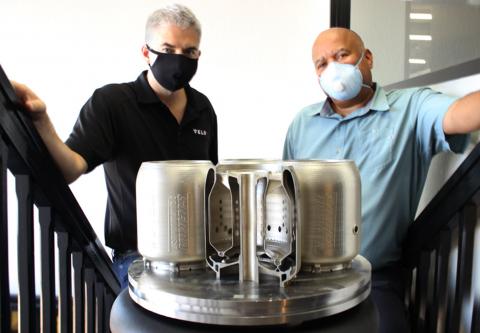
Sierra Turbines discusses its case study on microturbines
A new microturbine venture called Sierra Turbines is seeking to revolutionize UAV engines with 3D printing. Using the metal additive manufacturing (AM) technology from manufacturer VELO3D, Sierra Turbines reduced part count in a critical component from 61 to 1 and saw a variety of important performance gains as well.
Sierra Turbines has published a case study on its work with VELO3D. Sierra Turbines CEO Roger Smith also took some time to speak with AUVSI about the case study and the benefits of its microturbine, Aurelius Mk1.
Can you start off by providing our audience with some background information on Sierra Turbines and what you all are seeking to achieve within the UAV industry?
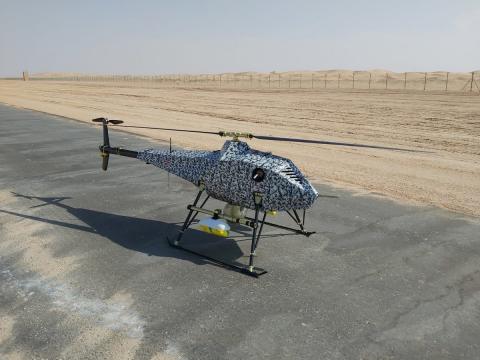
UAVOS to demonstrate unmanned helicopter for search and rescue maritime missions
During UMEX 2020, UAVOS and its partner ISR Unmanned Technology will conduct search and rescue maritime missions using their joint ISR350-5 unmanned helicopter.
Designed for civilian and security missions, the ISR350-5 UAS will perform rescue tasks, including dropping a life jacket into the water. In preparation for these exercises, UAVOS has modified the lifejacket by fitting it with a water anchor.
The demonstration flights will seek to prove the advantages of using an unmanned helicopter for maritime patrolling, especially when the aircraft is equipped with multiple sensors.
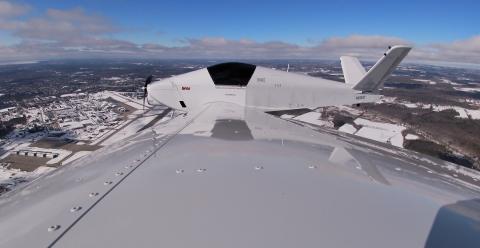
NASC successfully completes test flight of NASC TEROS UAV; UAV featured in Super Bowl commercial
Navmar Applied Sciences Corporation (NASC) successfully completed a test flight of the NASC TEROS UAV, Technology Demonstrator at the NASC Unmanned Aerial Systems Flight Operations and Training Center at the Griffiss International Airport in Rome, New York.
During the flight, the UAV flew for approximately an hour and a half in both manual and autonomous flight profiles, which successfully tested the aircraft systems / avionics suite.
“Today’s successful flight is a huge step toward reaching our ultimate goal of TEROS approval for integration into the National Airspace,” says Richard Leverich, senior program engineer, Navmar Applied Sciences Corporation.
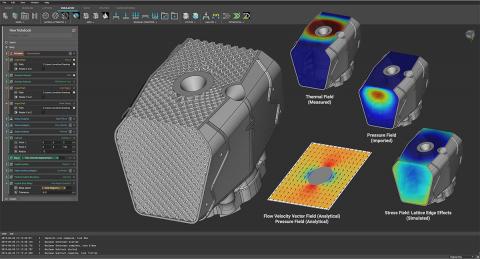
Printing the future: Cobra Aero rethinks designing for additive manufacturing with nTopology
By Lynn Manning
When a fast-growing company designs and manufactures some 2,000 small engines per year, it likes to stay abreast of the latest digital-engineering tools. Yet Sean Hilbert, president of Cobra Aero, is also adamant that the final proof of the integrity of every power and propulsion product he creates for his drone and motorcycle customers is always the test bench.
“In my experience with moving back and forth between the computer-aided engineering and the testing realms, honing in on that final design always requires a real-world check,” Hilbert says. “You need those digital-to-physical iterative loops in order to calibrate your models and make a great design.”