
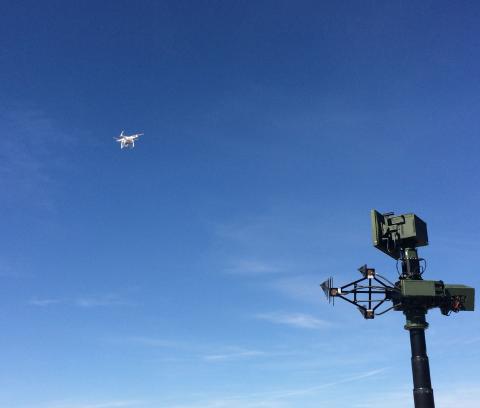
Counter-small unmanned aircraft systems technology has emerged as one of the most prominent growth areas in the defense and security markets in recent years, as governments seek to not only defend critical infrastructure from violent extremist organizations and near-peer adversaries, but also from errant hobbyists.
Threats across the contemporary operating environment stretch from the employment of airborne improvised explosive devices (ABIEDs) by the likes of the self-proclaimed Islamic State in Iraq and Syria, to the breaching of national airspace at major airports by commercially available air frames.
UAV
UAV
AeroVironment’s new project slated to fly over Mars
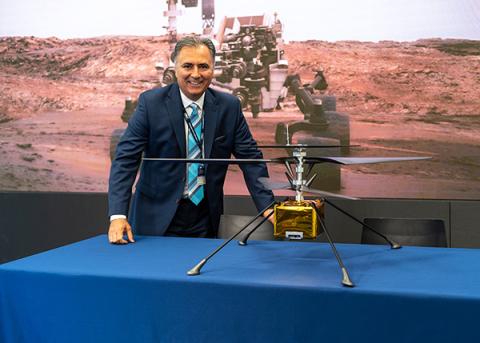
Monrovia, California-based AeroVironment, which has built everything from a hummingbird-sized drone to high-flying solar aircraft, has built components for a new drone helicopter intended to fly much further afield: across the surface of Mars.
AV is working with NASA’s Jet Propulsion Laboratory in Pasadena to build the helicopter recently selected by the Mars Exploration Program, which is planned to fly across the Red Planet in less than three years.
“AeroVironment’s deep, rich and diverse history of innovation, combined with our experience with near-space aircraft like Pathfinder and Helios make us uniquely suited to collaborate with NASA and JPL on this historic, interplanetary venture,” says Wahid Nawabi, AeroVironment’s president and CEO.
Alta Devices' solar technology selected to help power Hybrid Tiger UAV
The U.S. Naval Research Laboratory (NRL) will use Alta Devices’ “highly efficient, flexible, and light-weight” solar technology to help power the “breakthrough” Hybrid Tiger UAV.
The Hybrid Tiger is a project designed to create a Group-2 UAV that will stay aloft for at least three and a half days, and Alta Devices says that technologies developed for the project will be applicable to other unmanned vehicles.

UAVOS introduces new VTOL UAV
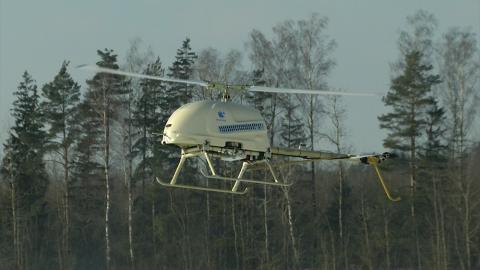
During the UMEX conference in Abu Dhabi, UAVOS Inc. is introducing “«SURVEYOR-H» Unmanned Aerial System with «UVH-290E» drone vertical takeoff/landing.”
In the “tractor” modification, the new unmanned helicopter has a takeoff weight of 192 pounds. UAVOS says that the UAV is designed so that parameters such as durability, extended operation life, ease of use and serviceability have a priority over flight time and load capacity of UAVs.
Locust USA and U.S. Army to collaborate on development of technology for UAVs
Through its wholly-owned subsidiary UAV Turbines, Inc. (UAVT), Locust USA, Inc has entered into a $19 million Technology Investment Agreement (TIA) with the U.S. Army to collaborate on the development of an “efficient and reliable/durable small turboprop gas turbine engine” for propulsion in the UAV space.
The development goals surround engine capabilities beneficial to both military and commercial markets. This initiative is part of the Army’s “Reliable Advanced Small Power Systems (RASPS) Technology Demonstration” program. The goal of the program is to design, manufacture and test a “200 shp class advanced technology engine to technical readiness level (TRL) 6.”
RIEGL receives MAPPS Geospatial Excellence Award for its LiDAR sensor for unmanned laser scanning
RIEGL, which provides cutting edge technology in airborne, mobile, terrestrial, industrial and unmanned laser scanning platforms, has announced that it is the recipient of the 2017 MAPPS Geospatial Products and Services Excellence Award.
RIEGL received the award for its RIEGL miniVUX-1UAV miniaturized LiDAR sensor for unmanned laser scanning, in the Technology Innovation category at the 2018 MAPPS Winter Conference. RIEGL says that it is “thrilled to be the winner of the MAPPS Geospatial Excellence Award!”
According to the company, the RIEGL miniVUX-1UAV is a “user-friendly and cost-efficient device to acquire survey-grade measurement data” by use of remotely piloted multi-rotor, rotary-wing, or fixed-wing UAVs, for different applications.
Using UAV Imagery and Deep Learning for Wind Turbine Inspection
When it comes to using a UAV to collect imagery for wind turbine inspections, maneuvering a drone around a huge turbine isn’t the only challenge involved. There’s also the issue of capturing extra positional information so images can be projected onto a plane, which is necessary since the camera is not positioned to look directly down as in most UAV imagery applications. Then there’s ensuring the quality of the capture while in the field to avoid the costs associated with having to re-fly a job. Finally, there is the time and rigor required to analyze all that data to identify and locate damage and other abnormalities on turbine blades.

Boeing plans to use its new CAV prototype to test and evolve its autonomy technology
Boeing has unveiled a new unmanned electric vertical-takeoff-and-landing (eVTOL) cargo air vehicle (CAV) prototype. The CAV prototype will be used to “test and evolve Boeing's autonomy technology for future aerospace vehicles.”
Powered by an environmentally-friendly electric propulsion system, and outfitted with eight counter rotating blades that allow for vertical flight, the CAV prototype is designed to transport a payload up to 500 pounds for possible future cargo and logistics applications.

UAVOS converts manned aircraft into UAVs
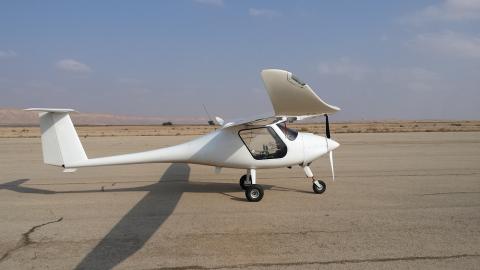
UAVOS Inc. has developed an unmanned aerial complex based on Pipistrel’s Sinus light aircraft.
UAVOS converted three Pipistrel Sinus aircraft into UAVs, and modified the wings of the original aircraft for the installation of hangers for payload. In addition to that, the wiring was changed, and the company integrated its UAVOS automatic control system into the aircraft.
Vadim Tarasov, UAVOS investor and Board member, says that converting manned aircraft into UAVs is a much simpler process than building a heavy UAV from scratch.
Cyient to host India's first UAV hackathon
A company called Cyient, which provides engineering, manufacturing, geospatial, network, and operations management services to global industry leaders, has announced that it will host India’s first UAV hackathon, Hackadrone 2018.
Hackadrone 2018, which is being organized by Cyient and DJI, in sponsorship with Microsoft and the Government of Telangana, is open to tech students, independent software programmers, developers and start-ups who are interested in developing innovative commercial and industrial technologies using the latest UAV technology.