
Just a few weeks before Christmas on Dec. 7, 2017, audio/visual and journalism students at Pflugerville High School in Pflugerville, Texas received a DJI Mavic Pro UAS and accessories.
The UAS was a gift from an anonymous donor, who presented it to the Pflugerville Education Foundation specifically for use by PHS. A source close to the donor says that the donation came about “partly because of the impressive work done by PHS A/V and journalism students over the years.”
Equipped with a 12-megapixel camera that can stream video at full high-definition, a guidance system that allows it to avoid flying into obstacles, and a tripod mode for precision usage, the Mavic Pro UAS is meant to “give the program a leg up.”
Technology
Technology
Weekend Roundup
This Week in the Unmanned Systems and Robotics World
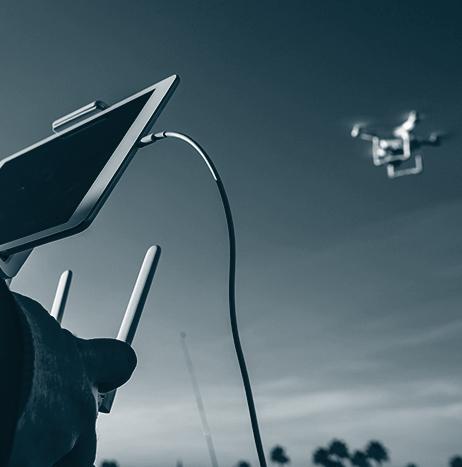
New Jersey state legislators have approved a ban on operating UAS while inebriated. Under the approved legislation, drunk or high pilots would be punished with up to six months in prison or a $1,000 fine. (Gizmodo)

Little Ripper UAS helps save swimmers in Australia
In Lennox Head, New South Wales, Australia, lifeguards from the Australian Lifeguard Service were preparing for a training session to familiarize themselves with UAS equipment when a call came in about two distressed swimmers.
Approximately a kilometer north of the patrolled area, two men were swimming in powerful surf conditions, when someone noticed that they were having difficulty in the three meter swell.
At the time, lifeguard Supervisor Jai Sheridan was piloting a Westpac Little Ripper UAS, so he immediately responded, and within minutes of the initial alert, located the swimmers.
BlackBerry unveils software cybersecurity product that can be used in connected and autonomous vehicles
During a keynote address at the North American International Automotive Show (NAIAS), BlackBerry Limited Executive Chairman and CEO, John Chen, unveiled a “transformational software cybersecurity product” called BlackBerry Jarvis, which is built on BlackBerry’s decades of cybersecurity expertise and proprietary technology.
BlackBerry Jarvis has many potential uses; chief among them, in connected and autonomous vehicles.
Described as a “one-of-its-kind cloud-based static binary code scanning solution that identifies vulnerabilities in software used in automobiles,” Jarvis, in just minutes, scans and delivers deep actionable insights. If done manually, the scanning process would take large numbers of experts and an “impractical amount of time,” according to BlackBerry.
Drone Delivery Canada expanding its testing program to the United States
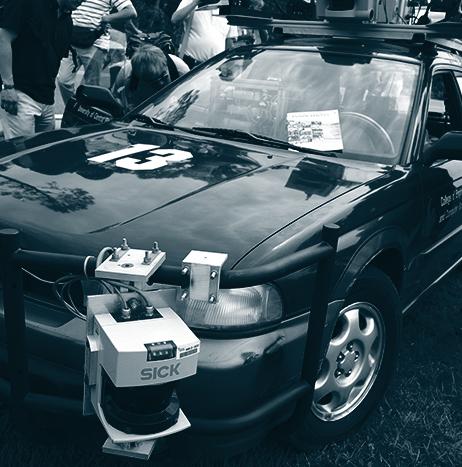
Drone Delivery Canada (DDC) has announced that it is expanding its commercial testing program to the United States.
DDC is bringing its testing program to the Griffiss International Airport UAS Test Site in Rome, New York during Q1 of this year, and the company anticipates that the program will run through the “balance of the year.”
“We have very strong interest from multiple commercial customers in the USA that not only want to test our drone delivery platform in Canada, but also in their own Country as well,” says Tony Di Benedetto, CEO.
Persistent Systems' technology provides value for the UGV market
Founded just over a decade ago in 2007 by Herbert B. Rubens, CEO, and David Holmer, CTO, Persistent Systems is a leader in mobile ad hoc network (MANET) technology, and the company claims to have the most advanced, scalable and efficient MANET radio in the world, in its MPU5 (Man Portable Unit 5) radio system.
MANET effectively allows users to bring their access points with them, which allows every node — whether UGV, UAV, or something else — to be totally independent, and have the ability to relay for other nodes automatically. This provides a major benefit to users in the field, according to Louis Sutherland, vice president of business development at Persistent Systems.
Saab to demonstrate acoustic target for U.S. Navy
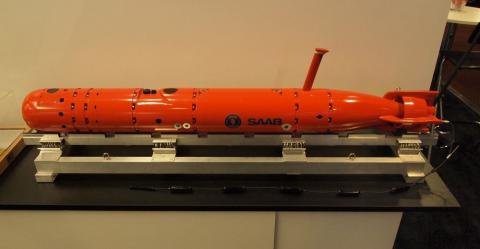
Saab has announced that it will demonstrate its anti-submarine warfare (ASW) training system, the AUV62-AT (acoustic target), for the U.S. Navy this summer.
The AUV62-AT, an artificial acoustic system that mimics a submarine, will be evaluated by the Navy against Naval systems through the Foreign Comparative Testing (FCT) Program. The AUV62-AT will be operated by Navy personnel, with Saab engineers there to support it if there is any maintenance required.
“With submarine usage on the rise, anti-submarine warfare training is more crucial than ever,” says Görgen Johansson, senior vice president and head of Saab´s Business Area Dynamics.
Production CUSV to gain new sonars, begin testing and demonstration
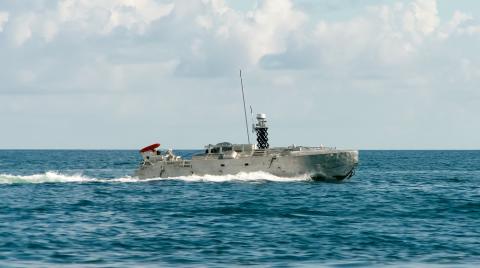
Textron’s Common Unmanned Surface Vehicle program will see two production vehicles built this year, with new side scan sonars being integrated and testing and demonstration to continue through 2019.
Textron began its CUSV program in 2008, after migrating its core competency — command and control for automated systems — from the air domain to the maritime.
Weekend Roundup
This Week in the Unmanned Systems and Robotics World
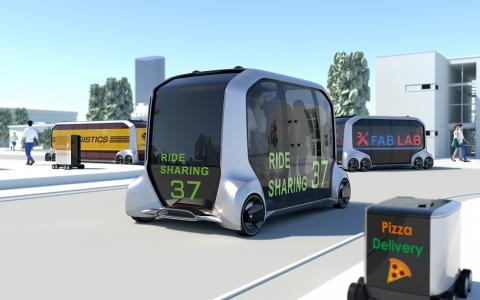
In an effort to “meet the demands of future multi-mode transportation and business applications,” Toyota Motor Corporation President Akio Toyoda announced a new mobility service business alliance and e-Palette Concept Vehicle during CES 2018. The new e-Palette Alliance will utilize Toyota’s proprietary Mobility Services Platform (MSPF) to create a suite of connected mobility technologies and a flexible, purpose-built vehicle. (Toyota)
Boeing plans to use its new CAV prototype to test and evolve its autonomy technology
Boeing has unveiled a new unmanned electric vertical-takeoff-and-landing (eVTOL) cargo air vehicle (CAV) prototype. The CAV prototype will be used to “test and evolve Boeing's autonomy technology for future aerospace vehicles.”
Powered by an environmentally-friendly electric propulsion system, and outfitted with eight counter rotating blades that allow for vertical flight, the CAV prototype is designed to transport a payload up to 500 pounds for possible future cargo and logistics applications.
