
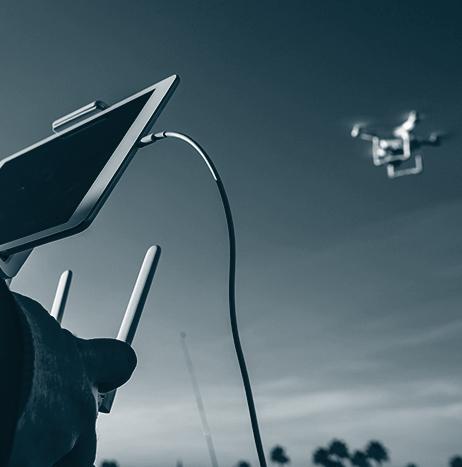
On Jan 10., New York Governor Andrew M. Cuomo announced the launch of the new State Police Unmanned Aerial System program, which will be used to support a variety of law enforcement and public safety missions in New York.
Expected to be deployed in multiple locations across the state, the UAS, which will be operated by State Police members who are FAA certified and have undergone 32 hours of hands-on training with the systems, are expected to reduce response times and make operations more efficient and cost-effective.
Among many potential uses, the UAS can be used in dangerous situations and environments, such as natural disasters, to help keep State Troopers out of harm's way.
Technology
Technology
Robomart unveils its 'self-driving bodega on wheels'
In an effort to bring online produce shopping to people’s front door, a Santa Clara, California-based startup company called Robomart has developed a “self-driving bodega on wheels,” according to Engadget. The vehicle made its debut this week during CES 2018 in Las Vegas.
As part of NVIDIA's deep learning/AI “Inception Program,” Robomart developed this concept, which relies on a Sprinter Van-sized delivery vehicle equipped with a variety of technologies, including a CAN motion control system, and enough route planning and obstacle avoidance software—including LiDAR, radar, and cameras—for it to reach the highest level of autonomy, Level 5.

Kittyhawk adds new features to its Flight Deck platform for UAS
During CES 2018, commercial UAS operations software provider Kittyhawk announced new features to its Flight Deck platform, including the addition of an automated flight system to Flight Deck, which will work in conjunction with the company's recently released secure live streaming feature.
Using the new automation features, operators can plan missions in the Kittyhawk mobile application, and then execute the entire flight, from takeoff to landing, with unlimited waypoints.
Insitu demonstrates its ground-based UAS airspace situational awareness system
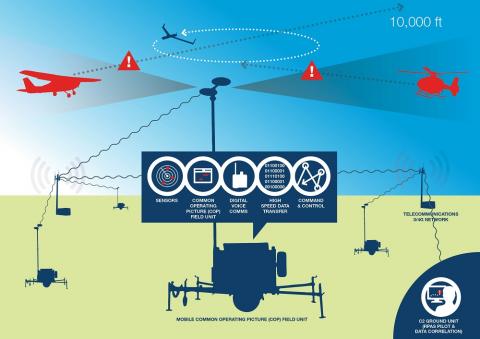
Insitu has announced the successful completion of a flight demonstration for its ground-based UAS airspace situational awareness system.
Under a program sponsored by the Queensland Government, Insitu, along with Boeing Phantom Works International, designed, developed, and tested the airspace situational awareness system in Australia.
The system is designed as one of the optional “layers” of safety to allow broad-area, beyond visual line of sight (BVLOS) capability for commercial UAS operations, by providing UAS operators with airspace situational awareness, specifically to help detect and avoid so called “non-cooperative” traffic.
Samsung introduces DRVLINE platform for autonomous driving market
During CES 2018 in Las Vegas, Samsung Electronics Co., Ltd. introduced its new Samsung DRVLINE platform, which is an “open, modular, and scalable hardware and software-based platform” for the autonomous driving market.
Samsung says that the DRVLINE platform is a valuable technology for automakers because it can “integrate best-in-class technology into new vehicles, while also building a foundation for fleets of the future.”
DARPA selects Raytheon for Phase 3 of its CODE program for UAS
DARPA’s Collaborative Operations in Denied Environment (CODE) program seeks to extend the capability of the U.S. military’s existing UAS to conduct “dynamic, long-distance engagements of highly mobile ground and maritime targets in contested or denied battlespaces.”
With this in mind, DARPA has selected the Raytheon Company to complete the development of the CODE software during Phase 3.
Up to this point, the CODE program has conducted Phase 2 flight test series with teams led by Lockheed Martin and Raytheon, and the software open architecture and test-support framework has been validated. The teams completed several flight tests at Naval Air Weapons Station China Lake in California.
AEye announces AE100, a 'leading-edge robotic perception system for autonomous vehicles'
AEye, which develops advanced vision hardware, software and algorithms that serve as the eyes and visual cortex of autonomous vehicles, has announced the AE100, which the company calls a “leading-edge robotic perception system for autonomous vehicle, ADAS, and mobility markets.”
The AE100 is a "solid state, cost-optimized system" that is based on AEye’s Intelligent Detection and Ranging (iDAR) technology, which is a “new form of intelligent data collection that enables rapid, dynamic perception and enhanced path planning.”
AEE and SELFLY Camera develop UAS-smartphone-case called AEE SELFLY
AEE Aviation Technology Inc. and SELFLY Camera LLC have introduced AEE SELFLY, which is a smartphone case with an embedded UAS.
Considered the first device of its kind and the first of its class, AEE SELFLY gives smartphone users the ability to capture photos of themselves—commonly known as “selfies”—at a whole new level of quality and precision, for basically any event, from any location, and from heights and distances that were once considered impossible.
“More photographs are being taken now on smartphones than ever before because the best camera is the one you can always have with you,” says Mike Kahn, AEE's Chief Marketing Officer.
Weekend Roundup
This Week in the Unmanned Systems and Robotics World
Week of 12-25-2017
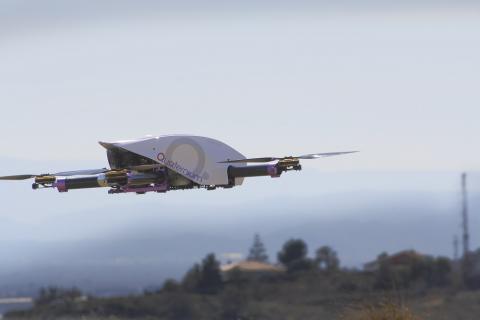
A UAS company called Quaternium is claiming a new world record for the endurance of a multi-rotor UAS. Quaternium says that on Dec. 24, 2017, its HYBRiX.20 fuel-electric quadcopter UAS flew for four hours and 40 minutes in Valencia, Spain. (Unmanned Aerial)
Finalists for Innovation Challenge at AUVSI USDPS announced
Overwatch Imaging, Ghost Robotics, Planck Aerosystems, SubUAS LLC and CVEDIA are the five finalists for the inaugural Innovation Challenge at AUVSI Unmanned Systems—Defense. Protection. Security. (USDPS).
These companies were selected from a field of more than 30 startups that applied, and cover the gamut of unmanned systems, including air, ground and maritime.
Overwatch Imaging specializes in precision aerial photography from small- and medium-sized UAS, with a focus on intelligent multi-band mapping and auto-detection on long endurance UAS.
Ghost Robotics develops legged robotics that can be used in various settings, including unstructured and vertical terrain, and harsh environments.