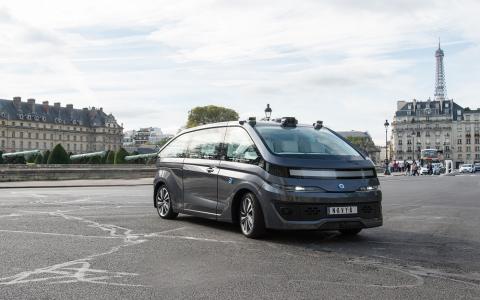
According to the West Australian, the Royal Automobile Club of Western Australia (RAC), in partnership with Navya, will test driverless passenger vehicles as a part of a trial expected to begin next year.
Several of Navya’s driverless passenger Autonom vehicles will be tested during the trial. The vehicles are designed to operate as an on-demand shared mobility service that can be booked through a smartphone app.
The trial will take place in Perth, Western Australia, which is one of three cities in the world selected for the trial of these vehicles.
Technology
Technology
University of Hawai'i at Hilo offering certificate in UAS
The University of Hawaiʻi at Hilo (UH Hilo) has launched four new courses to establish a certificate in UAS, which is a first step in the university’s long-planned aeronautical science program.
UH Hilo students who complete the four courses, along with three upper-level geography classes in data interpretation, remote sensing and information systems, will receive a certificate in UAS.
“Unmanned aircraft are becoming more and more popular, with the potential being recognized by new industries every day,” says Arthur Cunningham, coordinator of the UH Hilo aeronautical science program.

GEBCO-NF Alumni Team completes Technology Readiness Tests of its AUV-USV concept
On Nov. 23, the GEBCO-NF Alumni Team completed Technology Readiness Tests of its AUV-USV concept and “associated combination of communications hardware and software” to process and transmit data remotely.
One of 19 semi-finalist teams competing in the $7 Million Shell Ocean Discovery XPRIZE competition, the GEBCO-NF Alumni Team received support from KONGSBERG experts and technology during the test event, which was held on the fjord outside KONGSBERG's factory in Horten, Norway.

Lyft receives permit to test autonomous vehicles in California
According to Reuters, U.S. ride-hailing firm Lyft has obtained a permit to test autonomous vehicles in the state of California.
The permit comes two months after Lyft announced plans to offer a self-driving car as a ride option in the San Francisco Bay Area, which is where the company is headquartered.
In an effort to advance its self-driving strategy, Lyft has formed partnerships with several autonomous car companies.
Earlier this year, Lyft struck a research collaboration with Alphabet unit Waymo.

NASA drone race pits artificial intelligence against professional human pilot
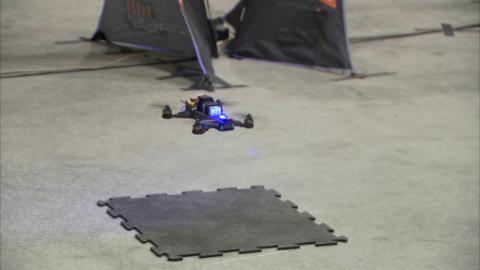
On Oct. 12, researchers at NASA's Jet Propulsion Laboratory (JPL) in Pasadena, California conducted a drone race in which they timed laps through a twisting obstacle course as they raced UAS controlled by artificial intelligence (A.I.) against a world-class drone pilot named Ken Loo.
The race capped off two years of research into UAS autonomy funded by Google. Google was interested in JPL's work with vision-based navigation for spacecraft, which are technologies that can also be utilized by UAS. To showcase the team’s progress, a timed trial between JPL’s A.I. and Loo was set up.
From Unmanned Systems magazine: Market Report Part 2: Legacy geographies point to new growth in radio frequency UAS sensors
Airborne synthetic aperture radars, or SARs, process radar returns as if they were collected by an antenna as much as several hundred meters long.
This “synthetic” antenna aperture is created by the movement of the aircraft itself — which is why airships do not make good SAR platforms — and allows a “parallax view” of the ground similar to a stereoscopic optical image. SARs were developed during the Cold War for their radio frequency ability to provide ground reconnaissance through the clouds and bad weather in Europe, unlike visual, infrared, and even hyperspectral sensors, and for ground moving target indication, which measures the displacement of vehicles and other objects during the radar scan.

Intel and Cyberhawk use UAS to inspect gas terminal in Scotland
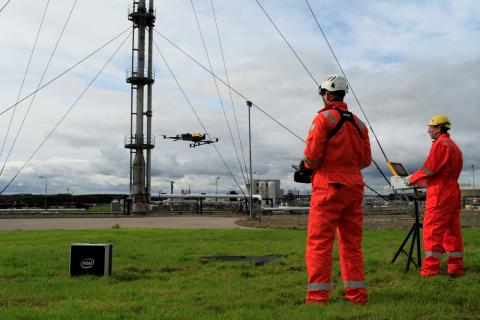
Intel and Cyberhawk have announced that they successfully inspected a gas terminal in St Fergus, Scotland using an Intel Falcon 8+ UAS.
The companies say that traditional inspections of this scale require facility shutdowns, which could take days to weeks to bring the plant offline and make accessible for workers. Once these plants are offline, the workers rely on harnesses and cable equipment to hang midair while manually collecting information on a structure, which can be both dangerous and time consuming.
FAA evaluating prototype UAS Airspace Authorization System
The FAA is evaluating a prototype system that is designed to automatically approve most requests to operate UAS in specific areas of airspace below designated altitudes.
The expectation is that this type of system will ultimately provide “near real-time processing of airspace authorization requests” for UAS operations across the United States.
US Navy deploys UUVs to help in search for Argentine navy's submarine
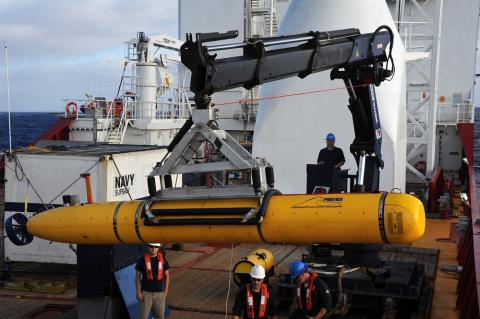
Following a request for international assistance to locate the Argentine navy's missing submarine, the A.R.A. San Juan, and its crew, the U.S. Navy has deployed one Bluefin 12D (Deep) UUV and three Iver 580 UUVs to assist in the search, which is taking place in South Atlantic waters.
The UUVs are operated by the U.S. Navy's Unmanned Undersea Vehicle Squadron 1 (UUVRON), which was established back in September, and is based in Pearl Harbor, Hawaii.
Capable of deploying quickly, the UUVs use a system called Side Scan Sonar, which is used to “efficiently create an image of large areas of the sea floor,” to search wide areas of the ocean.