This Week in the Unmanned Systems and Robotics World
Tesla has unveiled its fully electric semitruck, which is expected to go into production in 2019. The semitruck is equipped with Enhanced Autopilot, the second generation of Tesla's semiautonomous technology, giving it several autonomous capabilities, including automatic braking, lane keeping, and lane departure warnings. (Wired)
Technology
Technology

Geomni says UAS can help solve tree coverage imagery problem
Details of residential and commercial structures can be obscured by overreaching tree canopies when satellite and aerial imagery are used to document property values and evaluate roof damage, but using UAS to collect aerial images of rooftops could solve this issue according to Geomni, a Verisk business.
Geomni, which provides information about residential and commercial structures by utilizing remote sensing and machine learning technologies, says that since UAS can operate in close proximity to the subject, they can provide extremely detailed images, and “deliver superior sub-centimeter resolution for more accurate and detailed data.”

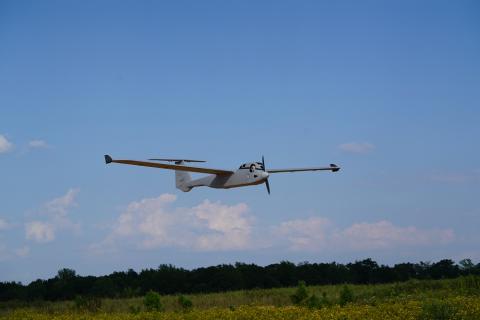
PAE ISR's Resolute Eagle UAS completes first commercial airspace flight
On Nov. 8, PAE ISR’s Resolute Eagle UAS completed its first commercial airspace flight.
The flight took place at the Pan-Pacific UAS Test Range—located at Pendleton Airport in Oregon—operating under a FAA Certificate of Waiver or Authorization.
“This event signifies PAE ISR’s ability to successfully fulfill U.S. commercial and civilian requirements in addition to U.S. military missions,” says Chico Moline, President of PAE ISR.
“We are excited by this achievement as it represents our ability to offer our dynamic platform to a broader customer set.”
Lewis University uses UAS to deliver acceptance letters to local high school students
Students often wait anxiously for college admissions acceptance letters, but one university in Illinois has used a drone to give that process a modern twist.
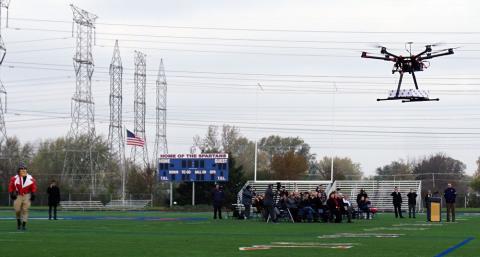
On Monday, Nov. 13, Romeoville, Illinois’ Lewis University used a UAS from its unmanned aircraft systems program to deliver college admissions acceptance letters to eight students at Romeoville High School.
The delivery, which used a Spreading Wings S900 UAS, is believed to be the first of its kind in the United States.
Engine updates allow Lockheed's Fury UAS to stay in the air for 15 continuous hours
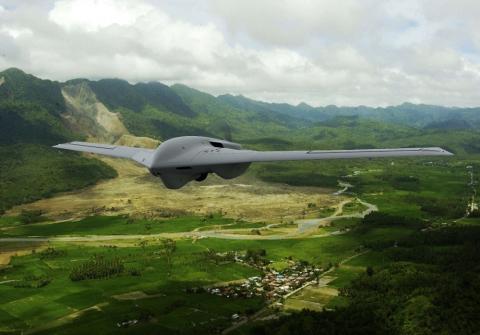
Lockheed Martin says it has conducted engineering tests that indicate that its Fury UAS will be able to stay in the air for 15 continuous hours—making it one of the highest endurance unmanned systems in its class—following the integration of the 1803 engine into the aircraft.
An expeditionary, runway-independent UAS, Fury is adaptable and reconfigurable, making it useful for a host of military missions such as intelligence, surveillance, reconnaissance, and cyber-electronic warfare.
UAVOS uses UAV to inspect oil refinery in Kazakhstan
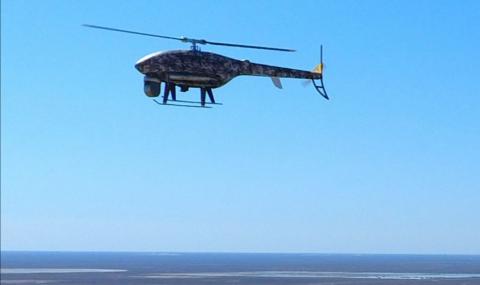
UAVOS Inc. has announced that it completed an aerial inspection of the refinery production infrastructure in Kazakhstan—located in Eastern Europe—using an unmanned complex based on the UVH-29E gasoline-powered helicopter.
Equipped with a gyro-stabilized platform with a FullHD day camera, the UAV completed all of its objectives, including the monitoring task with a simultaneous real time video image transmitting, and it also performed a survey of the flare units.
“It is one of our first projects in Eastern Europe to replace traditional methods of inspection in the oil and gas and energy sectors with robotic technologies,” says Vadim Tarasov.
GA-ASI's MQ-9 successfully used during U.S. Naval exercise
General Atomics Aeronautical Systems, Inc.’s (GA-ASI) MQ-9 Predator B Remotely Piloted Aircraft (RPA) was used to successfully demonstrate the remote detection and tracking of submerged contacts, such as submarines, during an Oct. 12 U.S. Naval exercise.
GA-ASI participated in the successful demonstration of new maritime patrol capabilities, which included anti-submarine warfare, during the flight that took place over the Southern California Offshore Range (SCORE) west of San Clemente Island.
Weekend Roundup
This Week in the Unmanned Systems and Robotics World
Uber and NASA will work together to develop software that Uber hopes to use to manage “flying taxi” routes, which could work in a similar fashion as the company’s current ground-based ride-hailing service that is used across the world. Uber says that it was the first formal services contract by NASA covering low-altitude airspace instead of outer space. (Reuters)
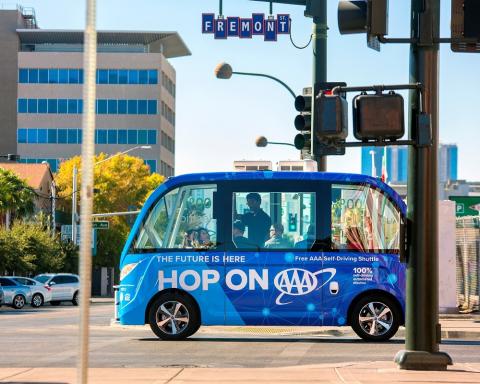
Las Vegas launches first self-driving shuttle pilot project in the United States
On Wednesday, Nov. 8, the nation’s first self-driving shuttle pilot project designed specifically for the public was launched in Las Vegas, Nevada. The pilot project will utilize an autonomous shuttle from Navya.
The goal of the one-year pilot project, which is a result of a partnership between AAA Northern California, Nevada & Utah (AAA), the city of Las Vegas, the Regional Transportation Commission of Southern Nevada (RTC) and Keolis North America (Keolis), is to provide Las Vegas residents and visitors with a first-hand experience of autonomous vehicle (AV) technology, providing many people with their first hands-on experience with the technology.
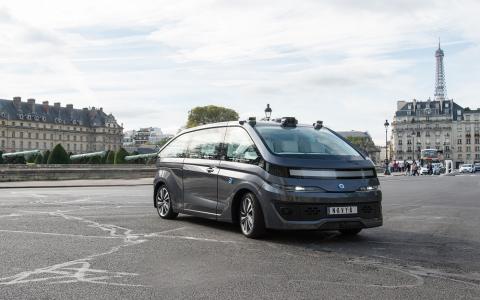
NAVYA unveils AUTONOM CAB, the company's fully autonomous taxi
Navya has unveiled its AUTONOM CAB, which is an autonomous, personalized and shared vehicle designed to address the “major challenges urban populations face traveling in and around cities.”
The AUTONOM CAB is equipped with extremely sophisticated multi-sensor technology, with no fewer than 10 Lidar sensors, six cameras, four radars, two GNSS antennae and one inertial measurement unit (IMU). Navya says that these sensors provide “at least a triple redundancy across all functions,” which guarantees exceptional reliability.