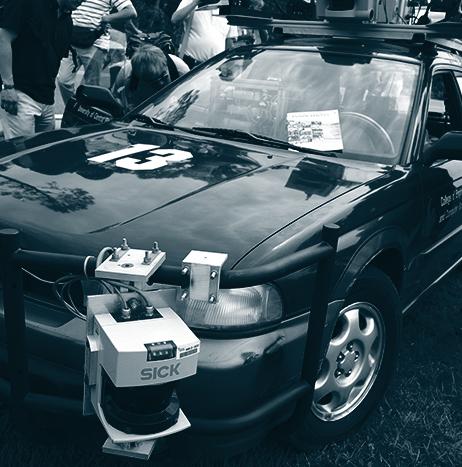
Starting in May, students trying to get to the University of Florida campus will have a new option of transportation in the form of the Gainesville Autonomous Transit Shuttle (GAToRS).
The city of Gainesville will have three of these shuttles, which will be funded by a state grant of $2.6 million.
According to the University of Florida’s Transportation Institute, the shuttle, which will carry 12 people each and run in a loop every 10 to 20 minutes, is expected to provide a number of benefits; chief among them, lowering the number of crashes and pollution, while simultaneously increasing mobility for the public and improving traffic flows.
Technology
Technology
Wisconsin's Eau Claire Police Department benefits from UAS
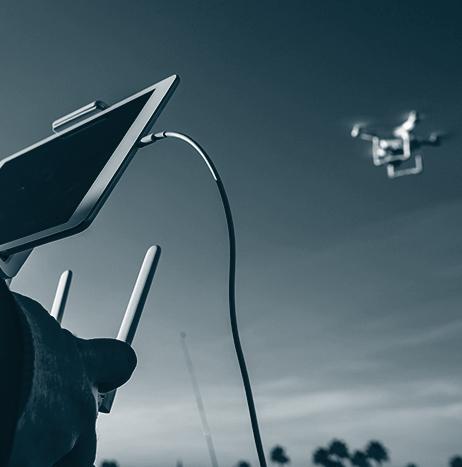
After investing nearly $4,000 in a UAS earlier this year, the Eau Claire Police Department in Eau Claire, Wisconsin has used its unmanned system to help with multiple search and rescue missions over the last few months. Currently, the department has eight officers that are trained to fly the UAS.
According to Deputy Chief Chad Hoyord, the UAS is beneficial because it provides investigators with a unique perspective, while keeping officers out of harm’s way.
“We have used it two times to do a search and rescue of the river bank and the rivers. It allowed us to look at the area and look without having to put someone in the water,” Hoyord says via WEAU.

Embry-Riddle UAV Storm Chaser team completes first Remote Controlled flight
Kicking off a series of tests for its capstone project, the UAV Storm Chaser team at Embry–Riddle Aeronautical University completed its first Remote Controlled (RC) flight of a UAV on Nov. 17.
Considered a “huge success,” the RC fight was used to demonstrate “all of the communication components of the UAV linking together properly, to calibrate the motors and motor controller, to get flight time, and to go through the process of setting up all of the parameters in mission planner.”
Media Advisory: Webinar on Drones for Geospatial Technology, Dec. 6
FOR IMMEDIATE RELEASE: Dec. 5, 2017
Contact: Tom McMahon, tmcmahon@auvsi.org, (571) 255-7786
University of Nevada, Reno students spend Thanksgiving Eve flying UAS
Two classes of graduate students at the University of Nevada, Reno spent the Wednesday before Thanksgiving getting hands-on experience flying UAS as a tool for research at the university’s UAS testing field in South Reno.
The students were led by Geology department professor Scott Tyler, and department chair and professor Wendy Calvin.
Washington's Walla Walla County introduces UAS
According to the Union-Bulletin, UAS will now be a part of the operations of Walla Walla County, Washington.
In its debut, the county's new UAS, which is constructed mostly of “high-tech Styrofoam” and has a wingspan of approximately five feet, was used to perform an aerial survey of Whitman Drive for a planned bike-pedestrian pathway.
Malawian students successfully build and test UAS under guidance from Virginia Tech engineers
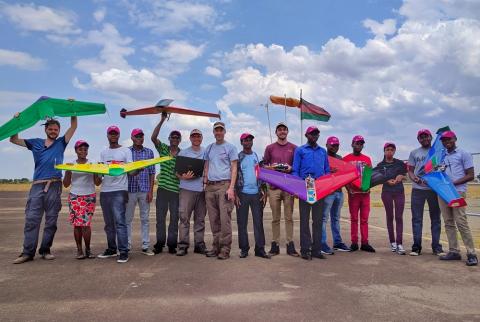
In November, Virginia Tech and Malawian teams used a fully autonomous UAS to conduct tests at the UNICEF drone testing corridor in Kasungu, Malawi, which opened back in July.
Virginia Tech says that “the flights by a fully autonomous aircraft designed in mechanical engineering’s Unmanned Systems Lab set several records in Malawi,” including the longest cross-country UAS flight, the first flight of an aircraft created by Malawians, and the first delivery of a payload from a health clinic.
Weekend Roundup
This Week in the Unmanned Systems and Robotics World
Week of 11/20/17
Intelsat General has successfully demonstrated beam switching capabilities of an in-flight UAS operating on the Intelsat 29e satellite. According to Intelsat, the tests validated the compatibility of the Intelsat EpicNG platform with the GA-ASI Block 5 Predator B/MQ-9’s newly developed beam switching capability. (Intelsat)

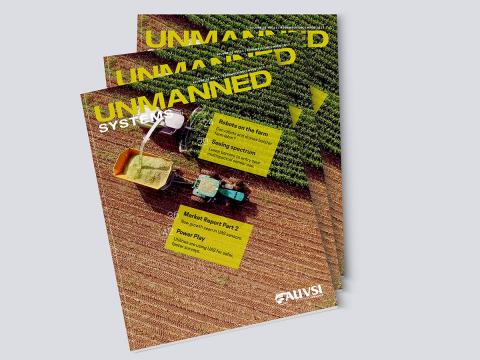
Inside the November-December issue of Unmanned Systems magazine
The November-December issue of Unmanned Systems looks at robots on the farm, which can do everything from pick strawberries to use multispectral imaging from the air; the second part of a market review for UAS sensors and the factors driving new growth; and a story about how utilities are using unmanned systems to quickly recover from damaging storms. That and much more, including our popular Viewfinder aerial photo gallery and a look at a recent meeting of the International Civil Aviation Organization about establishing an air traffic management system for drones.
Lockheed Martin's Autonomous Mobility Applique System logs more than 55,000 testing miles
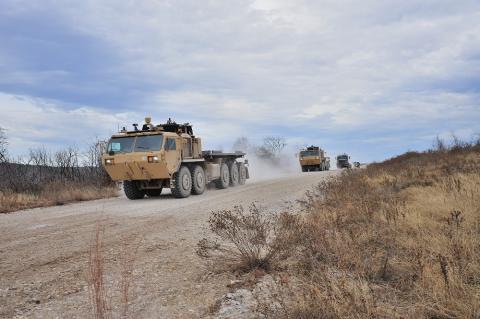
Lockheed Martin has announced that during the U.S. Army Extended Warfighter Experiment (EWE) at Fort Leonard Wood, Missouri, and Fort Bliss, Texas, its Autonomous Mobility Applique System (AMAS)—which is an “applique kit” that is made up of sensors, actuators and controls— logged more than 55,000 testing miles.
Testing of the AMAS system, which can be installed on just about any military tactical wheeled vehicle, included using Palletized Loading System vehicle convoys where a soldier drove the lead vehicle, while the following vehicles (three to four) followed robotically.