
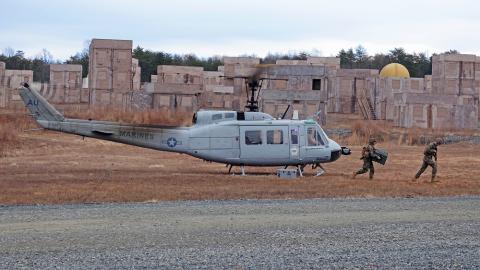
On Dec. 13, Aurora Flight Sciences conducted a successful demonstration of its autonomous helicopter system, which was developed under the Office of Naval Research’s (ONR) Autonomous Aerial Cargo Utility System (AACUS) program.
Over the course of several flights at Marine Corps Base Quantico’s Urban Training Center in Quantico, Virginia, the AACUS-Enabled UH-1H (AEH-1) demonstrated its ability to “autonomously execute resupply missions in relevant and austere settings.”
AACUS, which is an “aircraft-agnostic hardware and software suite,” allows a Marine on the ground to use a handheld tablet to request a supply delivery via helicopter. No advanced training is required to operate the system.
Autonomous Vehicles
Autonomous Vehicles
Minnesota Department of Transportation begins testing autonomous shuttle bus
On Dec. 12, an EasyMile-manufactured autonomous shuttle bus made its debut on the road in Minnesota, as a part of the Minnesota Department of Transportation's (MnDOT) autonomous shuttle bus pilot project.
The vehicle operated in light snow, which is productive for the overall goal of the pilot project, which is to test and analyze how autonomous vehicles operate in cold weather.
“I can't think of a better day in Minnesota to show off and test this autonomous technology,” says MnDOT Commissioner Charles Zelle, via the Star Tribune. “We have just the right amount of snowflakes, a little ice on the road.”

LiDAR sensor developer Ouster announces $27 million series A fundraise
A company called Ouster that is developing LiDAR sensors for autonomous vehicles has announced a $27 million series A fundraise led by Cox Enterprises.
Ouster would like to provide an affordable alternative to more expensive LiDAR sensors, so the company has developed its first product, a 64-channel LiDAR sensor called OS1, which will be priced at $12,000.
Ouster says that besides being a more affordable option in comparison to its competition, OS1 is also “dramatically lighter, smaller, and uses less power than other competitors.”
Weekend Roundup
This Week in the Unmanned Systems and Robotics World
The State of Nevada has completed the first step for applying to participate in the FAA’s UAS Integration Pilot Program (IPP). The Governor’s Office of Economic Development (GOED) filed the notice of intent, so it will serve as Nevada’s lead applicant for the program. (Nevada Institute for Autonomous Systems)
Nissan and DeNA unveil mobility service featuring autonomous driving technology
Nissan Motor Co., Ltd. and DeNA Co., Ltd. have unveiled their Easy Ride mobility service that will utilize autonomous driving technology.
Easy Ride’s concept is “more freedom of mobility,” and it is “envisioned as a service for anyone who wants to travel freely to their destination of choice in a robo-vehicle.”
For Easy Ride customers, the goal is for them to be able to complete the entire process— from setting destinations and summoning vehicles to paying the fare—through a dedicated mobile app.
Customers will also be able to select recommended local destinations and sightseeing routes depending on their objectives.

Automated Vehicles Symposium 2019
The Automated Vehicles Symposium convenes industry, government, and academia from around the world to address complex technology, operations, and policy issues. 1,500 thought leaders meet over 3 days to move us toward safe, automated mobility. The symposium is produced in partnership with the Transportation Research Board (TRB).
www.automatedvehiclessymposium.org
Automated Vehicles Symposium 2018
The Automated Vehicles Symposium convenes industry, government, and academia from around the world to address complex technology, operations, and policy issues. 1,500 thought leaders meet over 3 days to move us toward safe, automated mobility. The symposium is produced in partnership with the Transportation Research Board (TRB).
www.automatedvehiclessymposium.org
AUVSI XPONENTIAL 2020
Join more than 8,500 technologists, regulators and users at AUVSI XPONENTIAL 2020 – the world’s largest conference for unmanned and autonomous technology.
Gainesville Autonomous Transit Shuttle to launch in Gainesville, Florida next May
Starting in May, students trying to get to the University of Florida campus will have a new option of transportation in the form of the Gainesville Autonomous Transit Shuttle (GAToRS).
The city of Gainesville will have three of these shuttles, which will be funded by a state grant of $2.6 million.
According to the University of Florida’s Transportation Institute, the shuttle, which will carry 12 people each and run in a loop every 10 to 20 minutes, is expected to provide a number of benefits; chief among them, lowering the number of crashes and pollution, while simultaneously increasing mobility for the public and improving traffic flows.