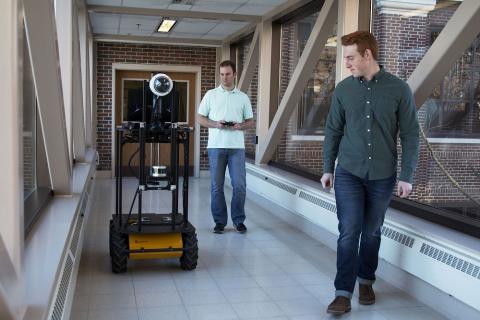
Researchers at Purdue University's School of Electrical and Computer Engineering are developing integrative language and vision software that could potentially enable an autonomous robot to not only interact with people in different environments, but also accomplish navigational goals.
Led by Associate Professor Jeffrey Mark Siskind, the research team—which also includes Doctoral candidates Thomas Ilyevsky and Jared Johansen—is developing a robot named Hosh that can integrate graphic and language data into its navigational process in order to locate a specific place or person.
Hosh is being developed thanks to a grant funded by the National Science Foundation’s National Robotics Initiative.
Autonomy
Autonomy
Apollo Robotics announces early access to its Apollo Development Partner Program
Apollo Robotics has announced the immediate availability of early access to its Apollo Development Partner Program, which is designed to deliver a fully automated, autonomous surveying UAS for professionals.
Apollo Robotics says that it can quickly digitize and reconstruct any worksite into a “highly accurate and instantly actionable” 3D model from a single scan by combining multi-sensoring LiDAR, HD and thermal cameras with artificial intelligence.

Ford and Michigan State renew and expand research partnership that covers autonomous technology
Ford Motor Company and Michigan State University (MSU) recently announced the renewal and expansion of their collaborative research alliance, which will facilitate continued collaboration between the two entities in a variety of fields, including autonomous technology and mobility.
Ford and MSU say that by strengthening their research and development partnership, they will be able to develop a broad range of innovations, with a focus on the aforementioned autonomous technology and mobility, as well as sensors and lightweight materials.
Over the course of their four-year partnership thus far, Ford and MSU have worked together on several successful projects, including collaborations in advanced engines, composite materials and information technology.
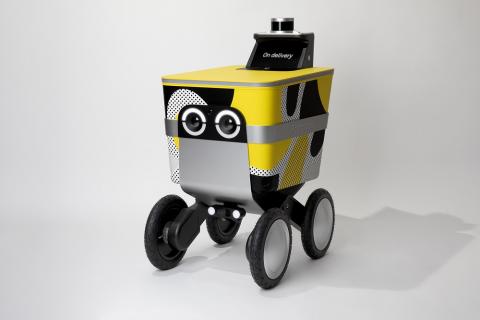
Postmates introduces Serve, its robotic delivery device that it built from the ground up
On-demand delivery company Postmates has introduced the newest member of its fleet, Serve, which the company claims is the first robotic delivery device created from the ground up by an on-demand delivery company.
Postmates says that after seven years and hundreds of millions of deliveries, it realized that it was in a unique position to create its very own autonomous delivery vehicle, which combines a patented Socially-Aware-Navigation system with the company’s proprietary Postmates software.
Brain Corp to use NVIDIA Jetson platform for autonomous commercial vacuum cleaner
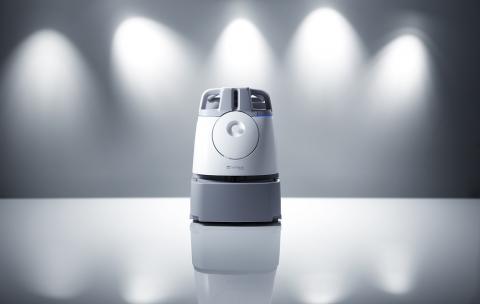
For its latest initiative—an autonomous commercial vacuum cleaner known as “Whiz” from SoftBank Robotics—Brain Corp will use the NVIDIA Jetson platform, the company has announced.
Whiz will be powered by Brain Corp's proprietary operating system, BrainOS, which provides machines with autonomous navigation and data collection capabilities, all tied into a cloud-based reporting system.
Whiz is designed specifically for commercial spaces such as retail and office environments. It will be sold to the Japanese market starting next year.
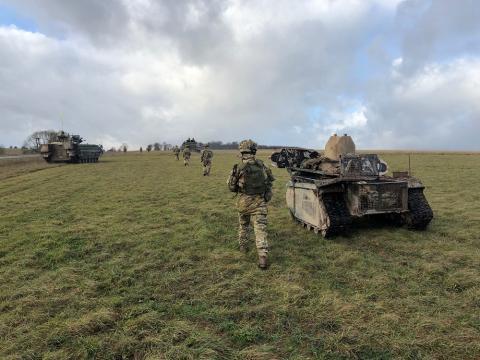
Milrem Robotics' UGVs tested during Army Warfighting Experiment 2018
During the Army Warfighting Experiment 2018 (AWE18) - Autonomous Warrior (Land), British troops thoroughly tested four Milrem Robotics’ and QinetiQ Titan UGVs.
Milrem Robotics was the most represented UGV manufacturer in the exercise with its four vehicles.
“The main goal of the experiment, which concluded last week, was to determine how new unmanned technologies can enhance soldier's survivability and effectiveness on the modern battlefield,” says Juri Pajuste, program director at Milrem Robotics, who took part in the exercises.
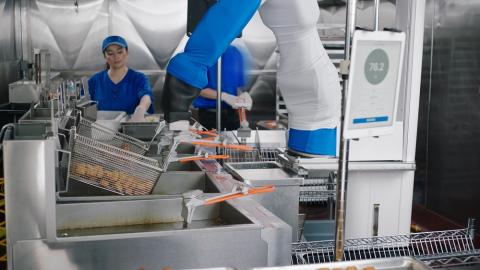
AI robotic arm gets experience cooking fried chicken and tater tots
Robotics and artificial intelligence technology company Miso Robotics has announced that its cloud-connected Miso AI platform now enables its autonomous robotic kitchen assistants to perform fry cooking tasks.
Additionally, NSF International has issued full certification to Miso Robotics’ kitchen assistant product line for meeting sanitation standards for commercial kitchen equipment, and the line has also secured an ETL Listed Mark by Intertek for meeting UL electrical safety standards.
Since July 30, Miso Robotics has been piloting Flippy, the world’s first autonomous robotic kitchen assistant, as a frying assistant at the Chick ‘n Tots stand in Dodger Stadium, home to Major League Baseball’s Los Angeles Dodgers.
DARPA demonstrates highly autonomous UAS during test series
DARPA’s Collaborative Operations in Denied Environment (CODE) program recently demonstrated the ability of CODE-equipped UAS to adapt and respond to unexpected threats in an anti-access area denial (A2AD) environment.
During the test series at Yuma Proving Ground in Arizona, the UAS successfully completed a number of tasks, including efficiently sharing information, cooperatively planning and allocating mission objectives, making coordinated tactical decisions, and collaboratively reacting to a dynamic, high-threat environment with minimal communication.
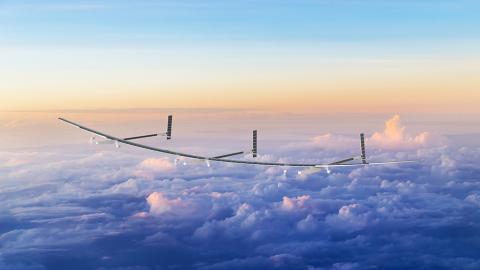
Aurora reveals autonomous aircraft Odysseus
Aurora Flight Sciences has revealed what it claims is the world’s most capable solar-powered autonomous aircraft, Odysseus, which is powered only by the sun.
Described as an “ultra-long endurance, high-altitude platform built for groundbreaking persistence,” Odysseus can effectively fly indefinitely, Aurora says, thanks its utilization of advanced solar cells, and its design, as it is built with lightweight materials.
“Odysseus offers persistence like no other solar aircraft of its kind, which is why it is such a capable and necessary platform for researchers,” says Aurora President and CEO John Langford.