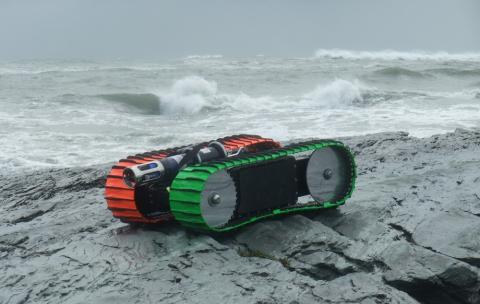
WiBotic, which provides wireless charging and power optimization platforms for the robotics industry, has announced a new wireless power system for the DJI Matrice 200 (M200) and DJI Matrice 210 (M210) drones.
The WiBotic wireless power system enables fully autonomous charging of UAS, allowing UAS to be on constant standby, or fly repeatedly without the need for human or mechanical battery swapping.
The WiBotic wireless power system for the DJI M200 and M210 includes both ground-based transmitter components and onboard charging components. For companies that want a “completely turnkey solution,” the system is also compatible with the (additional) WiBotic PowerPad.
Autonomy
Autonomy
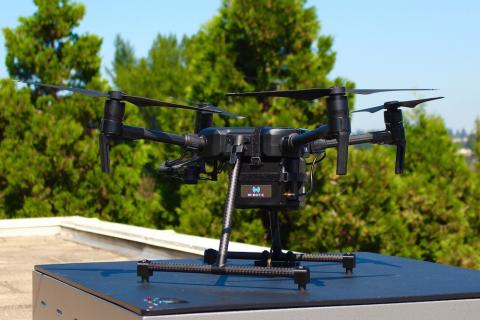
Echodyne receives FCC certification for its EchoFlight radar for UAS
Echodyne has received FCC certification for its EchoFlight radar, which is an airborne detect and avoid radar designed to be integrated into a wide-variety of UAS platforms, and also provides “unprecedented combination of C-SWaP, range, and accuracy.”
According to Echodyne, the EchoFlight radar is a “significant step forward for UAS mission safety,” especially for organizations seeking authorization to operate beyond visual line of sight (BVLOS) or autonomously.
“Echodyne is excited to receive authorization from the FCC and to make EchoFlight available to the many interested UAS partners in the US,” says Eben Frankenberg, CEO of Echodyne.

Embry-Riddle alumnus turns doodle drawing into award-winning autonomous robotic fish
A recent graduate of Embry-Riddle Aeronautical University named Jefferson Talbot has turned one of his doodle drawings into an autonomous robotic fish created with 3D printing technology, which he hopes can be used in the pet fish industry, and to help researchers who need a close-up view of underwater ecosystems.
Back in 2016, Talbot started drawing a skeleton of a fish in the margins of his notebook during class. Last summer, after watching his roommate “carefully lug” around his fish and bowl whenever leaving the dorm for a few days so the fish would stay healthy, Talbot came up with the idea of a robotic fish, as he thought that a robotic fish would be a lot easier to take care of.
Boeing completes synchronized UAS flight tests using new technology
Boeing has successfully completed the first suite of synchronized UAS flight tests using new on-board autonomous command and control technology developed by Boeing Australia.
During the test flights, which were conducted at a regional Queensland airfield, five UAS test beds equipped with Boeing’s new on-board system safely completed “in-air programmed missions” as a team without input from a human pilot.
The milestone comes six months after the establishment of Boeing's largest international autonomous systems development program in Queensland.
Alert Innovation's Alphabot system designed to augment Walmart's online grocery service
Walmart, in collaboration with a startup company called Alert Innovation, is set to launch a pilot using “first-of-its-kind automation” to help associates fill online grocery orders “faster than ever before.”
Walmart will use Alert Innovation's Alphabot system to augment its online grocery service, which allows customers to quickly and conveniently order groceries online, select a pickup time and have those groceries delivered to their car in minutes.
Alphabot will work behind the scenes to make this process even easier by automatically bringing items from storage to associates, who will then consolidate the items in the order.
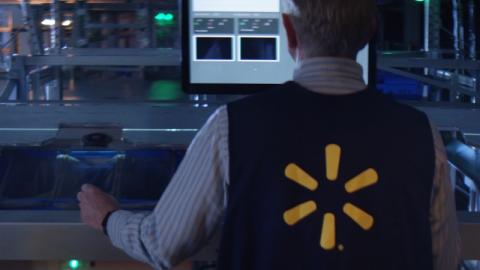
Xwing developing software stack that enables pilotless flight of small passenger aircraft
An autonomous-aviation startup called Xwing recently secured $4 million in funding.
The company is reportedly focused on the software stack that will enable pilotless flight of small passenger aircraft.
In an interview with TechCrunch, Xwing’s CEO Marc Piette says that while he was pursuing his pilot’s license, he saw restraint when it comes to smaller aircraft, but he also saw potential.
“It became pretty apparent that there were major issues with the general aviation industry with smaller aircraft,” Piette said.
“And yet it had enormous potential to change the way people moved around.”
The Automated Vehicles Symposium moves to Orlando in 2019
The Automated Vehicles Symposium takes the show on the road in 2019 and heads to Orlando, Florida. The event takes place July 15-18, 2019 at the Orlando World Center Marriott.

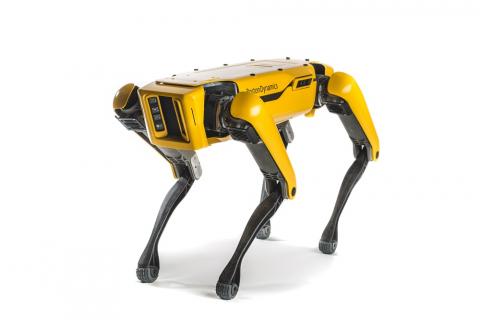
Boston Dynamics to start selling its headless robotic SpotMini in 2019
Starting in 2019, Boston Dynamics will begin selling its headless robotic SpotMini, according to Marc Raibert, the company’s founder.
During a robotics conference in California, Raibert said that SpotMini is currently in pre-production, and is scheduled for large-scale production and general availability “from middle of 2019.”
Weighing approximately 66 pounds, the SpotMini is capable of operating up to 90 minutes between charges, but it can also be driven semi-autonomously. Using its series of cameras, it can even navigate fully autonomously.
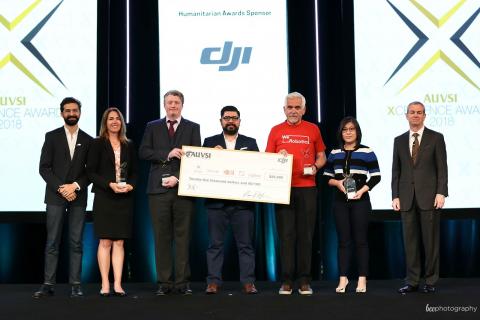
Keynote speakers for closing day of Xponential tout 'Unmanned for Good' stories
Keynote speakers at Xponential's "Unmanned for Good" session stressed the benefits of unmanned aerial systems for the humanitarian and public safety communities and the responders who risk their lives to make everyone safer.
UAS and the data they provide are becoming so effective for tasks like fighting fires that it is becoming unethical not to use them, said Robin Murphy, professor of computer science and engineering at Texas A&M University.
This, said AUVSI President and CEO Brian Wynne, is "extremely meaningful."
"We have an obligation" to provide technology, said Commander Tom Madigan of the Alameda, California, County Sheriff’s Office.
Survae's digital asset management platform now connected to C-2i Innovations' autonomous amphibious robot
Survae and autonomous amphibious robots' developer C-2i Innovations have announced that Survae’s digital asset management platform is now connected to C-2i’s Sea Otter device, which is used for all-weather inspection, sampling and mapping of shore and water regions, from oceans and harbors to rivers, estuaries, marshes and tailing ponds.
The Sea Otter, which is portable and deployable from beaches and small boats, provides persistent sensing where UUVs and ROVs cannot, the companies say. Operating up to 10 miles from shore, the Sea Otter is highly maneuverable, and in a single deployment it can cover multiple stations, providing versatile station keeping for up to five months in all weather/all season situations.