
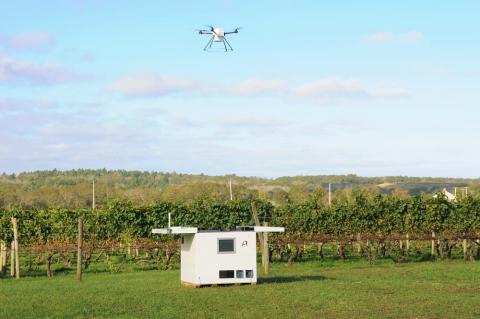
An industrial UAS developer called American Robotics has unveiled its flagship product, Scout, which is a self-charging, self-managing UAS platform capable of autonomously conducting daily scouting missions in the field of precision farming.
Specializing in agricultural automation, American Robotics says that traditional scouting techniques are “inadequate at detecting plant stress early enough to offset the billions of dollars of lost yields.” A lot of the times, these methods, which can include first-generation and consumer UAS, are time-consuming, complicated, and not financially prudent.
Autonomy
Autonomy
Lockheed Martin's Autonomous Mobility Applique System logs more than 55,000 testing miles
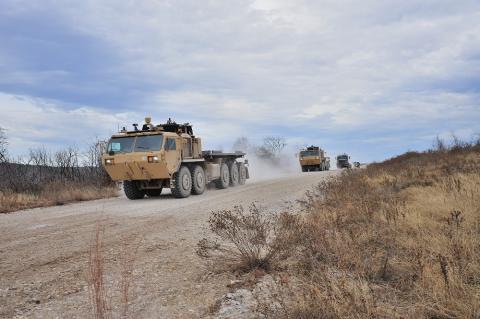
Lockheed Martin has announced that during the U.S. Army Extended Warfighter Experiment (EWE) at Fort Leonard Wood, Missouri, and Fort Bliss, Texas, its Autonomous Mobility Applique System (AMAS)—which is an “applique kit” that is made up of sensors, actuators and controls— logged more than 55,000 testing miles.
Testing of the AMAS system, which can be installed on just about any military tactical wheeled vehicle, included using Palletized Loading System vehicle convoys where a soldier drove the lead vehicle, while the following vehicles (three to four) followed robotically.
Autonomous truck technology company TuSimple raises $55 million
According to Fortune.com, TuSimple, which is a China-based startup that is developing driverless commercial trucks, has raised $55 million in a Series C funding round, which was led by Composite Capital, and included contributions from existing investors Sina and ZP Capital.
TuSimple will use the funding for a variety of tasks, including scaling up its testing to two full truck fleets in China and the U.S.
The funds will also be used to hire production engineers in Tucson, Arizona; the location where TuSimple established a test facility back in August. And, some funds will also be put towards the company’s research centers in San Diego, California and Beijing, China.

University of Pennsylvania researchers to develop teams of robots for U.S. military
Thanks to a five-year, $27 million government grant from a United States Army Research Laboratory program that seeks to advance robotic technology, researchers from the University of Pennsylvania will develop a team of autonomous, specialized and resilient robots for the United States military.
One of the researchers for this project, Electrical and Systems Engineering Chair George Pappas, says that this research is unique because its focus will be on specialized teams of robots, instead of individual robots.
These robots will also be able to learn from one another in unknown environments.
NOVUS Unmanned to feature 'best of the best'
AUVSI’s NOVUS Unmanned, held in conjunction with Investorfest, will bring together carefully curated companies with innovative technology and investors who are helping drive the unmanned systems industry.
“What we are seeing now is that automated and unmanned vehicles are migrating from government and military to the mainstream, so a lot of innovation is happening,” says Gopan Madathil, an entrepreneurial marketer and fund-raising coach who is president of Investorfest.
The industry has now reached the point where it needs support services, such as traffic management or detection services, Madathil says, and NOVUS Unmanned plans to present a variety of companies with promising technology to present them to investors.
U.S. Navy selects RE2 Robotics to develop an autonomous robotic cargo handling system
Being that personnel are still responsible for manually loading and unloading cargo from an air vehicle for cargo missions today, the U.S. Navy has tasked RE2 Robotics with developing an Autonomous Robotic Cargo Handling (ARCH) system.
This system will be demonstrated in concurrence with the Autonomous Aerial Cargo Utility System (AACUS) equipped UH-1H Optionally Piloted Aircraft (OPA), which will provide the ability to deliver supplies autonomously.
WiBotic unveils its autonomous wireless charging pad for UAS
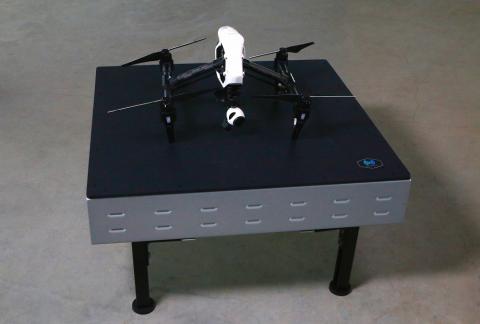
WiBotic has unveiled its “completely integrated wireless charging pad” for UAS, WiBotic PowerPad, which is designed for UAS operators who don’t want to develop their own wireless charging pad.
In one ready-to-go unit, the wireless charging pad includes the WiBotic transmitter circuit, transmitter antenna and power supply. The current version of the charging pad, which is three feet by three feet, can support a wide variety of today’s UAS, from smaller commercial and enterprise UAS, to large industrial UAS.
WiBotic PowerPad can be easily mounted on a variety of things, including rooftops and inside warehouses and factories. Those that use UAS for security, oil and gas, and in warehouses, could find WiBotic PowerPad extremely beneficial.
Special AUVSI San Diego - Royal Navy Event: Marine Autonomy - Building Capability through UK / US Collaboration
Join us at Coleman University for an evening of networking, panel discussion on building maritime capability through international collaboration, and an opportunity to meet some of the UK’s government’s marine autonomy subject matter experts, and researchers from the UK’s National Oceanography Centre.
Boeing announces plans to acquire Aurora Flight Sciences
In an effort to advance its autonomous technology capabilities, Boeing has announced that it will acquire Aurora Flight Sciences Corporation, a company that specializes in autonomous systems technologies to “enable advanced robotic aircraft for future aerospace applications and vehicles.”
Once it is officially acquired, Aurora, which is headquartered in Manassas, Virginia, will be a subsidiary under Boeing Engineering, Test & Technology, and will be known as Aurora Flight Sciences, A Boeing Company.
Through this acquisition, Aurora will keep an independent operating model, while taking advantage of the resources provided by Boeing.