
When Canada’s Aeryon Labs decided to set up a separate defense-focused company so it could work with the U.S. military on unmanned systems programs, it quickly settled on Colorado — and specifically Denver — as home for the new Aeryon Defense, which just launched on Feb. 1.
Tom Jackson, a retired U.S. Marine Corps officer and AH-1W Super Cobra pilot who is the company’s vice president and general manager, was already in the area, as were other employees who formed the nucleus of the new venture.
Beyond that, however, the state and city offered some unique attributes. Colorado is very centrally located, so it’s easier for the company to support multiple time zones and for company officials to travel to defense facilities around the country.
Maritime
Maritime

Maritime leadership pushing for unmanned systems, speakers say
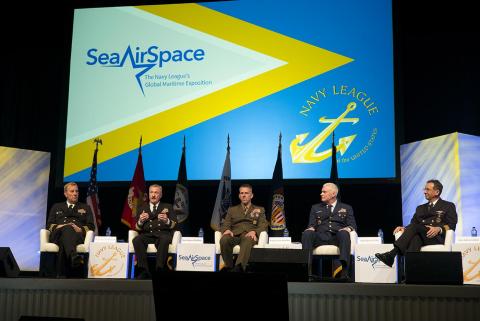
Senior leadership at the U.S. Navy, Marine Corps and Coast Guard are pushing to get unmanned and autonomous technology into the field quickly, panelists said Wednesday at the Navy League’s Sea-Air-Space conference in Maryland.
“We have an imperative from our senior leadership to move quickly,” said Brig. Gen. Christian Wortman, the vice chief of naval research and commander of the Marine Corps Warfighting Lab.
Rear Adm. Mark Darrah, program executive officer for unmanned aviation and strike weapons, agreed, noting the Navy is flying the Fire Scout unmanned helicopter alongside manned aircraft every day at Naval Air Station Patuxent River.
“At the upper levels, we have that covered,” he said.
Wilhelmsen and Kongsberg establish Massterly, the 'world's first autonomous shipping company'
Wilhelmsen, which is a global maritime industry group, and Kongsberg have announced the establishment of the “world's first autonomous shipping company,” Massterly.
Wilhelmsen and Kongsberg say that by joining forces to establish Massterly, they are taking the next step in autonomous shipping by offering a “complete value chain for autonomous ships, from design and development, to control systems, logistics services and vessel operations.”
The companies say that Massterly will benefit from the combined 360 years of experience between them, as Kongsberg brings its “unique technological expertise and solutions” to the table, while Wilhelmsen brings its “world-leading experience in logistics and ship management operations” to the table.

Riptide releases second generation micro UUV
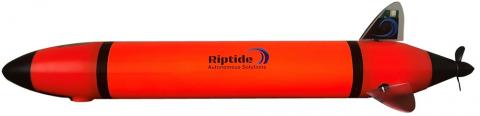
Riptide Autonomous Solutions launched its second generation “micro” UUV product during Oceanology International 2018 in London.
Riptide says that the MK II product offers “significant improvements” over the MK I µUUV.
With a focus on performance and manufacturability improvements, the new MKII µUUV has undergone a “near-total redesign of internal electronics.” As a result, it offers a “nearly 70% reduction” in hotel load power to 3.5 Watts, which extends vehicle endurance across the vehicle speed regime.
New manufacturing approaches—including increased use of molded parts instead of 3-D printed parts—allows for “expanded depth ratings, faster production times and improved quality assurance.”
ASV Global to supply University of Southern Mississippi with its C-Worker 5 USV
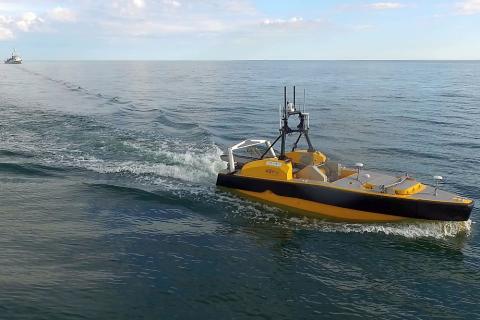
ASV Global will supply the University of Southern Mississippi (USM) with its state-of-the-art C-Worker 5 USV, after USM awarded a contract to the USV company.
The C-Worker 5 USV will reportedly be used for “testing, training, and establishing procedures and protocols” for use of the system by NOAA on future hydrographic programs.
“We are delighted to be working with the USM,” says Thomas Chance, CEO ASV Global.
“The C-Worker 5 is the ideal platform for survey work; to date, more than 11,000 km of hydrographic surveys have been performed with C-Worker 5 USVs, far more than any other diesel powered USV worldwide.”
Oceans Unmanned's freeFLY program uses UAS for large whale entanglement response efforts
In partnership with NOAA Hawaiian Islands Humpback Whale National Marine Sanctuary (HIHWNMS), Oceans Unmanned, Inc. has launched the freeFLY Program, which is a new initiative that uses small UAS to provide aerial support for large whale entanglement response efforts off of Maui, Hawaii.
The freeFLY Program provides training, equipment, and management oversight to a network of local, Maui-based volunteer UAS operators that are available to support the Hawaiian Islands Entanglement Response Network, led by HIHWNMS.
The goals of the Network are to safely free endangered humpback whales and other marine animals from life threatening entanglements, while also collecting crucial information that will lower entanglement threats in the future.
Boaty McBoatface AUV successfully completes first under-ice Antarctic mission
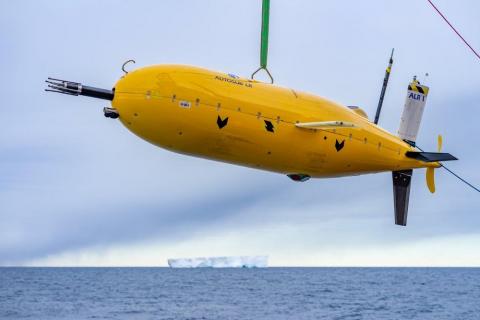
Last week, the National Oceanography Centre’s (NOC) Autosub Long Range (ALR) AUV —popularly known around the world as ‘Boaty McBoatface’—was successfully recovered following its first under-ice mission beneath the Filchner Ice Shelf in West Antarctica.
The AUV was deployed in the southern Weddell Sea from January to February 2018 during RV Polarstern cruise PS111, as part of the Filchner Ice Shelf System (FISS) Project, which is a collaboration that involves several leading UK research institutions, including the NOC.
The AUV plays an important role in the project that aims to investigate and describe the “current state of the complex atmosphere-ice-ocean system.”
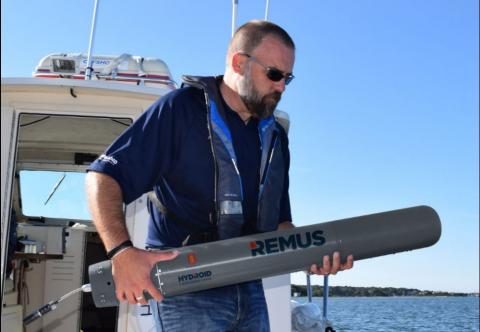
Hydroid releases compact, one-man portable REMUS M3V AUV
Hydroid Inc. has announced the release of the REMUS M3V, a compact, one-man portable AUV that is low cost and ready to use right out of the box.
Capable of diving up to 300 meters in depth, the REMUS M3V can be used to support a variety of applications, including search and survey; intelligence, surveillance and reconnaissance (ISR); marine research; and multi-vehicle missions.
Considered a “true A-size (36" x 4.875") vehicle,” the micro AUV has no fins or appendages outside the A-size envelope, and can be used for multi-domain deployments.
Xprize announces finalists for Shell Ocean Discovery Xprize
Xprize, a leader in “designing and managing incentive competitions to solve humanity’s grand challenges,” has announced the nine finalist teams advancing in the $7 million Shell Ocean Discovery Xprize.
The Shell Ocean Discovery Xprize is a three-year global competition that challenges teams to advance ocean technologies for “rapid, unmanned and high-resolution ocean exploration.”
The finalists, chosen from a field of 19 semifinalists by an independent judging panel of seven experts, are Arggonauts; Blue Devil Ocean Engineering – Duke University; CFIS, GEBCO-NF Alumni; Kuroshio, Pisces, Team Tao, Texas A&M Ocean Engineering and Virginia Deep-X.
Boeing partners with Queensland Government to establish autonomous systems development program in Australia
Boeing has announced a new partnership agreement with the Queensland Government in Australia, which will result in Australia being home to Boeing’s largest autonomous systems development program outside of the U.S.
Over the next three years, Boeing will use the rapid innovation program to develop “next-generation autonomous systems capability” in Australia, in an effort to increase the independent operation of air and sea vehicles.
According to Chris Raymond, Boeing vice president and general manager, Autonomous Systems, the Queensland program formed part of Boeing’s global growth strategy to “accelerate game-changing autonomous technology for commercial and defence systems.”