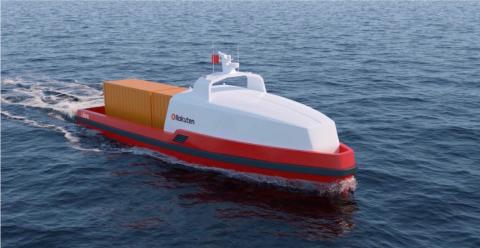
The International Maritime Organization (IMO), a United Nations agency that sets global rules for shipping, is undertaking a “scoping exercise” to explore whether any of its regulations should be changed to accommodate the expected advent of autonomous ships.
The research effort will first review IMO rules to see whether they apply to Maritime Autonomous Surface Ships (MASS) and would preclude MASS operations. The exercise will then “determine the most appropriate way of addressing MASS operations,” says IMO spokeswoman Natasha Brown.
Regulatory
Regulatory
Going to the TOP with AUVSI's Trusted Operator Program
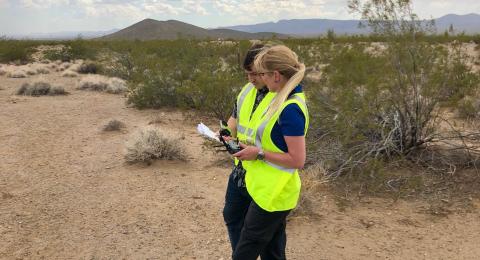
AUVSI is about to give unmanned aircraft systems operators a way to increase their safety and boost their standing in a burgeoning marketplace, through the new Trusted Operator Program (TOP).
Becoming a commercial drone pilot and operating a UAS represents an exciting and rewarding career in a dynamic and emerging industry, but from a regulatory perspective, there is little required for the commercial drone operator to demonstrate competency or proficiency in his or her operations. There are training courses available to the prospective drone pilot, however, so far there has been no industry unification with respect to remote pilot competency training or testing programs.
Hill Day speakers tout benefits of UAS; AUVSI's Lamb provides TOP overview
During AUVSI’s Hill Day luncheon, speakers touted the benefits of UAS, especially after major events such as Hurricane Florence.
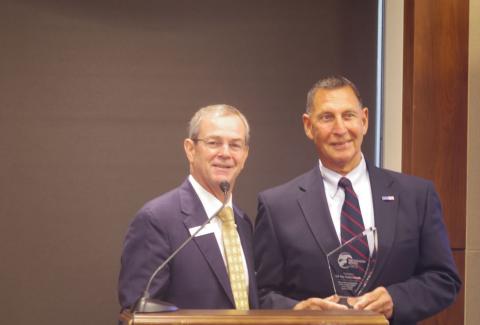
“We’re going to see a lot more of this,” said Rep. Frank LoBiondo, who represents New Jersey's 2nd congressional district.
Over the last 24 years, LoBiondo has represented the FAA’s Technical Center— which he says is “really the heart and soul of aviation in the country.” LoBiondo credits AUVSI for helping the FAA realize the benefits of UAS technology.
“AUVSI has been a leader in helping me understand the economic opportunities that were being held back for so many years,” LoBiondo said.
For his 24 years of service, LoBiondo was presented with AUVSI’s Distinguished Service Award from Brian Wynne, AUVSI’s President and CEO.
New reports shed light on automated vehicle future
Two recent reports highlight the way that industry and government are seeing the automated vehicle market shaping up.
The Governors Highway Safety Association, made up of state and territory highway safety officials, released “Preparing for Automated Vehicles: Traffic Safety Issues for States,” funded by insurance giant State Farm and drawing on research, survey findings, government documents and other sources.

An automated future requires industry to be proactive, speakers say
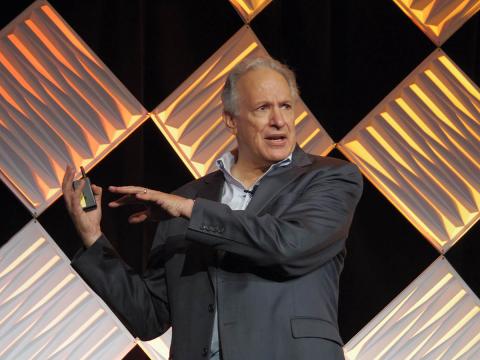
Automated car developers and regulators need to be proactive to deal with the issues facing the industry, from public education to safety to employment dislocations to city planning, said speakers at the second full day of the Automated Vehicles Symposium in San Francisco.
The arrival of automated vehicles will inevitably lead to changes in employment, said Erica L. Groshen, a visiting senior scholar at Cornell University’s School of Industrial Labor Relations.
“Innovation is not new,” she said. “Let’s learn from the past.”
Her team has studied past technology-driven dislocations dating back to the industrial revolution and found that even when jobs are lost, eventually full employment returns.
June UAS flight with no chase plane points to future, NASA and GA-ASI say
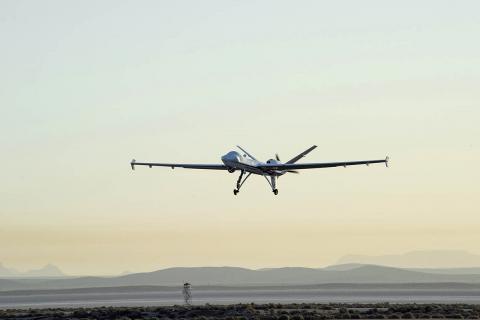
The June flight of a large unmanned aircraft in the National Airspace System without the use of a chase plane took “thousands of hours” and a tightly integrated detect and avoid system, NASA and industry officials said on Thursday.
“This historic flight moves the United States one step closer to normalizing unmanned aircraft operations across the U.S.,” NASA said in a press release announcing a press teleconference held Thursday afternoon to discuss the historic flight.
On June 12, NASA and partners General Atomics Aeronautical Systems (GA-ASI), Honeywell and the Federal Aviation Administration conducted the demonstration, a 2.5-hour flight not far from Los Angeles.
'Purpose-built legislation' being developed in Australia for automated vehicles
In Australia, “purpose-built legislation” will be developed to allow an automated driving system (ADS) to drive more automated motor vehicles in place of a human.
National Transport Commission (NTC) Chief Executive Paul Retter says that a new national law—expected to be in place by 2020—would bring certainty to manufacturers and operators that want to bring more automated vehicle technology to the country.

From Unmanned Systems Magazine: UNMANNED SYSTEMS AND EXPORT CONTROLS: WHAT YOUR COMPANY NEEDS TO KNOW
Companies that export unmanned systems or related components to customers abroad; who collaborate with overseas companies in the development or production process; or who share technical data with foreign nationals in the United States need to be aware of the potential impact of export control laws and regulations.
Export controls restrict the cross-border flow of strategic technologies and can even restrict the release of certain technical information within the United States. These restrictions can apply to unmanned systems and their related components and technical data.
This article provides an overview of U.S. commercial and military export controls, assesses how export controls apply to unmanned systems and provides compliance tips.
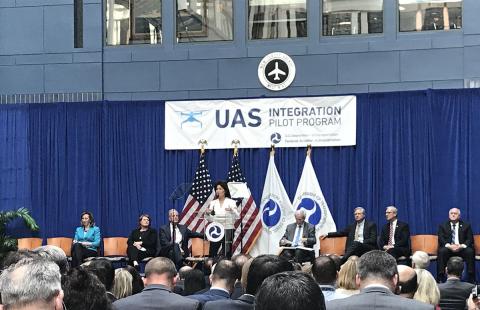
DOT Secretary Chao announces UAS IPP selectees
Ten state, tribal or local governments have been tapped to help expand the flight envelope of unmanned aircraft in the National Airspace System, the U.S. Department of Transportation announced Wednesday.
The selections for the UAS Integration Pilot Program are Choctaw Nation of Oklahoma; the city of San Diego; Virginia Tech – the Center for Innovative Technology; the Kansas Department of Transportation; the Lee County Mosquito Control District of Ft. Myers, Florida; the Memphis-Shelby County Airport Authority of Tennessee; the North Carolina Department of Transportation; the North Dakota Department of Transportation; the city of Reno, Nevada; and the University of Alaska-Fairbanks.