
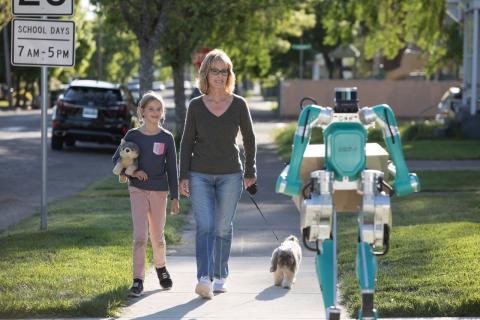
Ford has partnered with Agility Robotics to help self-driving vehicles complete the final step of getting a delivery from the car to a customer’s door using robotics.
Through its pilot programs, Ford has learned that it’s not always convenient for people to leave their homes to retrieve deliveries or for businesses to run their own delivery services.
Robotics
Robotics
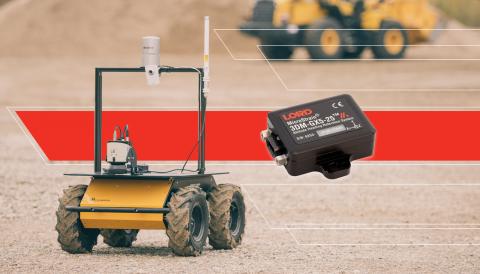
LORD equipping Clearpath research robot platform with inertial sensors through new partnership
LORD Corp. has partnered with Clearpath Robotics to equip the Clearpath research robot platform with LORD’s inertial sensors.
LORD inertial sensors enhance the autonomous capabilities of Clearpath’s robots, helping provide them with precise navigation in applications such as 3-D mapping in difficult terrain.
MIT, U.S. Air Force launching program to advance artificial intelligence
In an effort to make “fundamental advances” in artificial intelligence (AI) that could improve Air Force operations, while also addressing broader societal needs, MIT and the U.S. Air Force have signed an agreement to launch a new program called the MIT-Air Force AI Accelerator.
Leveraging the expertise and resources of MIT and the Air Force, the effort will be used to conduct fundamental research directed at “enabling rapid prototyping, scaling, and application of AI algorithms and systems.”
Building off of its five-decade relationship with MIT, the Air Force plans to invest approximately $15 million per year in the effort.

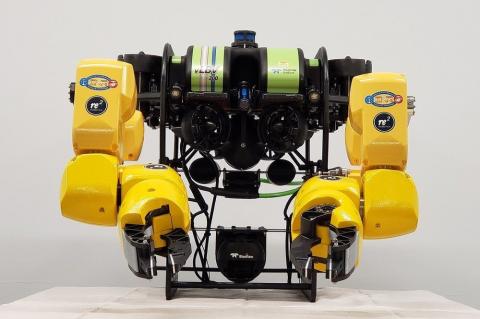
RE2 Robotics to develop dexterous, underwater robotic hand for U.S. Navy
RE2 Robotics has announced that it has received $3 million in funding to develop a dexterous, underwater robotic hand with tactile feedback for the U.S. Navy.
Known as Strong Tactile mARitime hand for Feeling, Inspecting, Sensing and Handing (STARFISH), the program will create an “advanced end-effector for mine countermeasures (MCM) and explosive ordnance disposal (EOD) missions” for U.S. Naval expeditionary forces.
NextStep Robotics, developer of robotic therapy to help treat foot drop, receives $600,000 in funding
NextStep Robotics Inc., the developer of a personalized robotic therapy to help treat foot drop in recovering stroke patients, has announced that it received $600,000 during its second funding round.
With this round of funding, NextStep says that it will be able to move from prototyping and development to manufacturing and sales.
NextStep Robotics is based on intellectual property licensed from the University of Maryland, Baltimore (UMB). With more than a decade of research behind it, the robotic therapy is the “first effective treatment option for foot drop,” the company says, as it helps stroke survivors and others regain mobility using clinically proven rehabilitation training.
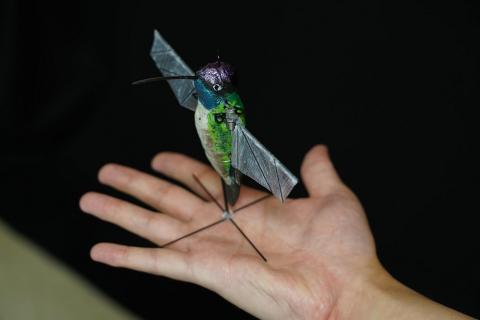
Purdue University researchers develop flying robots that emulate hummingbirds
Purdue University researchers have engineered flying robots that behave like hummingbirds, and could ultimately go to places where UAS can't.
The robots are trained by machine learning algorithms based on various techniques the bird uses naturally every day, meaning that after the robot learns from a situation, it “knows” how to move around on its own like a hummingbird would, such as knowing when to perform an escape maneuver.
The robot can also teach itself new tricks, thanks to the combination of artificial intelligence with flexible flapping wings. For example, the robot can’t see as of right now, but it senses by touching surfaces. Each touch alters an electrical current, which the researchers realized they could track.
AMP Robotics launches dual-robot system for recycling industry
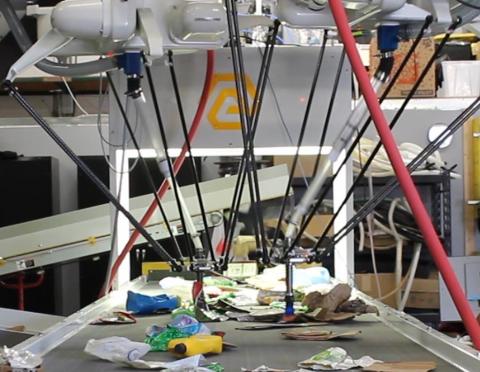
AMP Robotics Corp. (AMP), a developer of artificial intelligence (AI) and robotics for the recycling industry, has launched its new AMP Cortex dual-robot system (DRS), which focuses on material recovery in Municipal Solid Waste (MSW), Electronic Waste (E-waste), and Construction and Demolition (C&D).
Expanding on AMP’s existing product line of high-speed recycling robotics, the AMP Cortex DRS uses two high-performance robots that quickly sort, pick, and place materials at a speed of 160 pieces per minute, which creates optimum productivity, AMP says.
Invert Robotics looks to increase global footprint of its climbing robot
Robotics company Invert Robotics has closed an $8.8 million round of financing. The company will use the strategic investment to scale its team, open a U.S. office and expand its technology platform and industry-specific technologies.
Headquartered in New Zealand, Invert Robotics’ goal is to increase the global footprint of its climbing robot, which is the first robot specifically designed to inspect the integrity and safety of non-magnetic, hazardous environments, according to the company.
“Our climbing robots go where other robots cannot and people should not,” says Invert Robotics Managing Director Neil Fletcher.
Ford's 'Survival' robot delivers parts to keep production going around company's plant
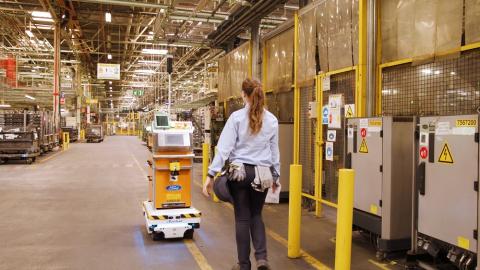
Ford is actively working on autonomous vehicles, but the company has thrown its hat into the robotics arena with the introduction of its self‑driving robot, nicknamed ‘Survival.’
Developed entirely by Ford engineers, Survival earned its nickname because of its ability to adapt to its environment. It can dodge unforeseen objects, change its route if obstructed, and stop whenever necessary.
Survival is currently being tested in one of Ford’s manufacturing plants in Europe, delivering spare parts around the plant. The company notes that it is the first of its kind to be used in a Ford facility in Europe.
Locus Robotics raises $26 million in Series C funding
Locus Robotics, a developer of autonomous mobile robots for warehouses, has raised $26 million in Series C funding.
Locus will use the funding to scale production of its multi-bot platform for warehouse fulfillment. The funding will also be used to expand Locus' sales and marketing efforts, both in North America, and internationally.
“We have seen a massive uptick in demand for the flexible automation incorporated into Locus’s multi-bot solution, which is uniquely suited to address these challenges,” says Rick Faulk, CEO of Locus Robotics.