
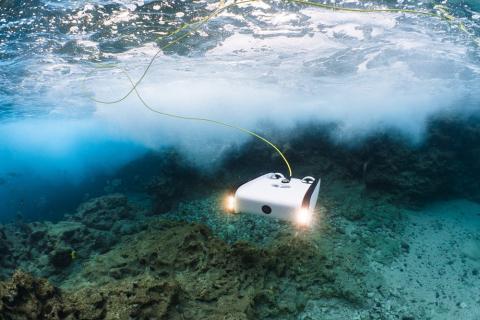
Ocean data startup Spoondrift and underwater drone developer OpenROV have announced that they have merged to form Sofar Ocean Technologies.
Sofar brings together two teams who have experience developing and scaling tools for distributed ocean sensing and monitoring, as the newly formed company notes that the world's oceans remain “largely unexplored, misunderstood, and tragically under-utilized.”
Robotics
Robotics
Gatwick Airport partners with Stanley Robotics to test robotic valet parking service
Stanley Robotics has signed a framework contract with Gatwick Airport that will result in Gatwick becoming the first airport in the United Kingdom to test robots that valet park passengers’ cars.
During the trial, which is expected to run from the second half of 2019 to early 2020, passengers will leave their cars in a ‘parking station’ close to the South Terminal entrance. A driverless robot will gently lift up the car and store it in a secure car park, all without passengers having to hand over their keys.
The system will be connected to real-time flight information so the robot simply returns the vehicle to the parking station. The user will receive a message that the vehicle is ready and waiting for their arrival.

FarmWise, Roush collaborating to develop autonomous vegetable weeders
FarmWise, a developer of adaptive robots for agriculture, has announced a collaboration with Roush, a full-service product development supplier, to develop and test autonomous vegetable weeders in Michigan.
As part of the initial contract between the two, FarmWise and Roush will develop a dozen prototypes of the self-driving robots this year, with plans to scale to additional units in 2020.
“These are many of the key ingredients we need to manufacture and test our machines,” says Thomas Palomares, co-founder and chief technology officer of FarmWise.
RE2 Robotics uses its RADR robotic applique kit to preform robotic disaster cleanup in Florida
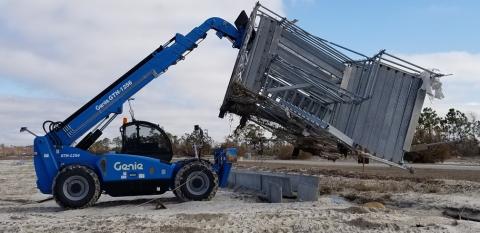
RE2 Robotics has announced that a commercially available telehandler equipped with its Rapid Airfield Damage Recovery (RADR) robotic applique kit performed teleoperated disaster clean-up at the Air Force Civil Engineering Center (AFCEC) in Florida.
Located at Tyndall Air Force Base, AFCEC was badly damaged during Hurricane Michael in October 2018.
“Tyndall Air Force Base sustained catastrophic damage during Hurricane Michael,” says Jorgen Pedersen, president and CEO of RE2 Robotics.
“When we were asked to use the Air Force-funded RADR robotic retrofit kit technology to assist with the clean-up efforts, we deployed our team without hesitation.”
Winnipeg Richardson International Airport launches first autonomous airport snowplow in North America
Canada’s Winnipeg Richardson International Airport recently launched the first autonomous airport snowplow in North America.
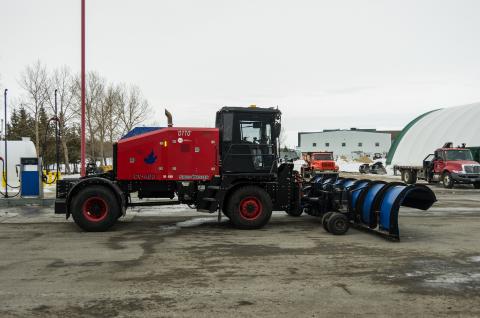
A product of Manitoba, Canada companies Northstar Robotics Inc. and Airport Technologies Inc. (ATI), the snowplow, known as Otto, is a specially designed ATI Snow Mauler built to operate autonomously using technology from Northstar Robotics. Otto follows predetermined routes and controls the plow blade at specific locations to conduct its snow clearing duties.
According to Winnipeg Richardson International Airport, Otto is now capable of operating autonomously in low-risk areas of the airport. The next step is for Otto to operate in other areas of the airport.
QinetiQ North America wins U.S. Army's Common Robotic System-Individual program
QinetiQ North America (QNA) has announced that it has won the competition for the U.S. Army’s Common Robotic System-Individual (CRS(I)) program.
Valued up to more than $164 million, the seven-year Indefinite Delivery Indefinite Quantity (IDIQ) contract is for the delivery of small ground robots, and includes a Low Rate Initial Production (LRIP) phase worth approximately $20 million over one-to-two years, which will be followed by a series of annual production releases.
As part of the LRIP phase, QNA has been awarded a $4,051,837 initial order.
RSE launches unmanned undersea robot designed to control population of invasive lionfish
A non-profit called Robots in Service of the Environment (RSE) has unveiled the RSE Guardian LF1, Mark 3 prototype, which RSE describes as an affordable unmanned undersea robot designed to control the population of invasive lionfish in the Western Atlantic.
According to RSE, the robot accelerates the capture of lionfish at the critical action breeding depth below safe diver depth.
“The Lionfish are destroying the coral reef and decimating fish populations in the Atlantic. The latest innovations incorporated into the RSE Guardian LF1, enable the undersea robotic solution to go deeper, fish longer and pull in a larger haul,” explains Colin Angle, co-founder and executive chairman of RSE.
University of Washington's robotic system can feed people who need assistance eating
Researchers at the University of Washington are working on a robotic system that can feed people who need someone to help them eat.
The robot identifies different foods on a plate, and then strategizes how to use a fork to pick up and deliver the desired bite to a person’s mouth.
“Being dependent on a caregiver to feed every bite every day takes away a person’s sense of independence,” says Siddhartha Srinivasa, the Boeing Endowed Professor in the UW’s Paul G. Allen School of Computer Science & Engineering. Srinivasa is a corresponding author in a series of papers that the researchers published their results in.

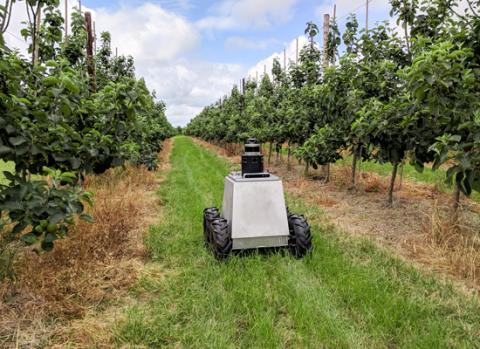
Cambridge Consultants unveils Mamut autonomous robot for agriculture
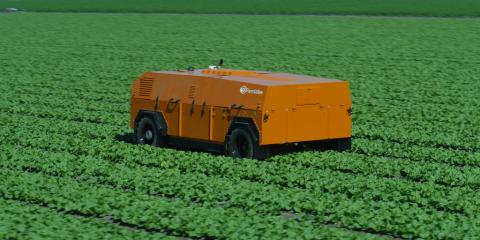
Cambridge Consultants has unveiled its autonomous robot, Mamut, which is built to explore crop fields, and capture data on health and yield at the level of individual plants on a large scale.
According to Cambridge Consultants, Mamut automates data capture, providing growers with regular, precise and actionable information on their crops, which allows them to predict and optimize yields.
Powered by artificial intelligence, Mamut is equipped with a wide range of sensors, and can map and navigate its surroundings without GPS or a fixed radio infrastructure. Its cameras capture detailed crop data at the plant level as it makes its way through rows of a field, orchard or vineyard, allowing for accurate predictions of yield and crop health.
Exyn Technologies' Advanced Autonomous Aerial Robot designed for data collection in GPS-denied environments
Exyn Technologies Inc. has announced that its Advanced Autonomous Aerial Robot (A3R) is now available commercially.
Driven by the company’s exynAI proprietary software, the Exyn A3R is the first and most advanced fully autonomous aerial system for data collection in GPS-denied environments, according to Exyn.
The vehicle has already proven beneficial to customers, as a Canadian-based international mining company called Dundee Precious Metals (DPM) selected Exyn as its technology partner, in an effort to advance its initiative for digitization and automation of its underground gold mining operations.