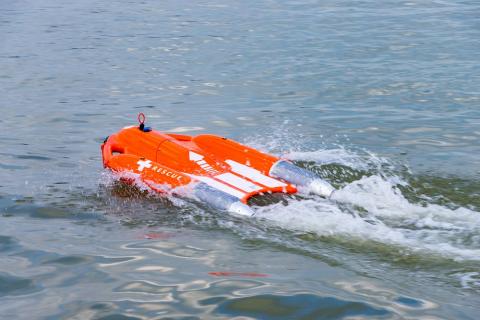
This week during CES 2019, USV company OceanAlpha unveiled its new Smart Jetboard FF I USV, which the company says can serve as both a lifebuoy and a jetboard.
Described as a “three-segment board,” the Smart Jetboard FF I is approximately one meter long, 0.8 meters wide, and weighs 13 kilograms. It utilizes a dual-jet pump with a battery life of 30 minutes and a maximum speed of five meters per second.
For use as a water entertainment device, the Smart Jetboard is equipped with direction and speed buttons that allows a user to lie comfortably and safely on the board, and navigate with ease.
Software
Software
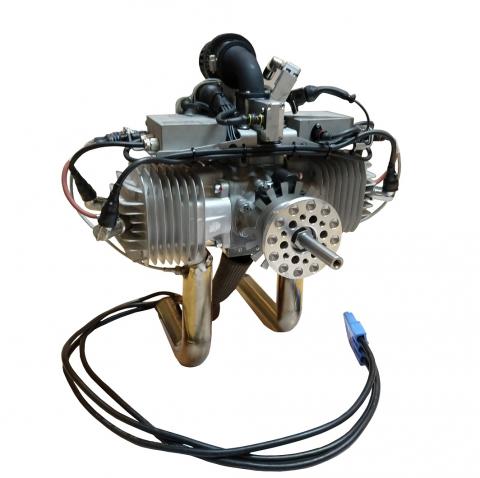
Sky Power GmbH unveils newly developed 2-stroke engine
Sky Power GmbH, which manufactures 2-stroke combustion- and Wankel engines for UAS and hybrid applications, has unveiled its newly developed 2-stroke engine, the SP-210 FI TS.
Based on the same engine concept as the company’s SP-110 FI TS, the SP-210 FI TS has a “max. 8,2 kW at 5000 rpm,” Sky Power says.
The SP-210 FI TS has a system carrier just like the SP-110 FI TS—although it is optionally offered without a system carrier as well—which is mounted above the cylinders with the two electronic systems of the HKZ215 ignition, as well as the engine injection system.
The injection system and the system carrier are screwed firmly together with the engine.
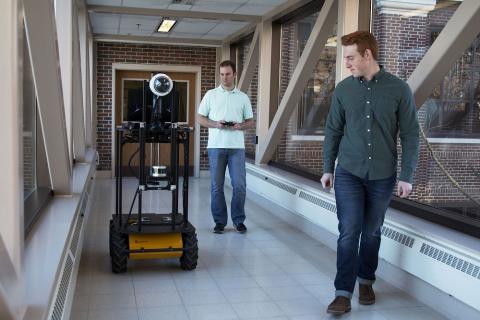
Purdue University researchers developing autonomous robot capable of interacting with humans
Researchers at Purdue University's School of Electrical and Computer Engineering are developing integrative language and vision software that could potentially enable an autonomous robot to not only interact with people in different environments, but also accomplish navigational goals.
Led by Associate Professor Jeffrey Mark Siskind, the research team—which also includes Doctoral candidates Thomas Ilyevsky and Jared Johansen—is developing a robot named Hosh that can integrate graphic and language data into its navigational process in order to locate a specific place or person.
Hosh is being developed thanks to a grant funded by the National Science Foundation’s National Robotics Initiative.
Sea Machines Robotics establishes new dealer program to further reach of its autonomous vessel control technology
Sea Machines Robotics has established a new dealer program that will be used to support the global sales of the company’s autonomous vessel control technology across key commercial marine markets.
The program includes several strategic partners who are authorized to sell, install and service Sea Machines’ line of intelligent command and control systems for workboats.
The Sea Machines dealer network includes several initial builders and specialists such as Marine Group Boat Works in San Diego, California, Pinpoint Electronics in Plymouth, United Kingdom, and Technology Ventures in the United Arab Emirates.

Project RACHEL's fuel cell powered UAS completes 70-minute flight
With a goal of developing a hydrogen fuel cell powered multi-rotor UAS, Project RACHEL recently eclipsed its original test flight target of 60 minutes with a five-kilogram payload, as the purpose-built fuel cell powered UAS flew for an uninterrupted 70 minutes carrying a five-kilogram payload.
The flight was completed using a UAS that had less than a 20-kilogram maximum take-off mass, using a six-liter cylinder containing hydrogen gas compressed to 300 bar.
Supported by Innovate UK, Project RACHEL is led by Productiv, a venture engineering company, on behalf of BATCAM, a UAS filming specialist based in the United Kingdom.
Transdev and Torc Robotics partner to work on fully autonomous shuttle platform
During CES 2019 in Las Vegas, Transdev and Torc Robotics announced that they will work together on a fully autonomous shuttle platform, as the companies believe that shuttles and smaller vehicles will provide complementary mobility to existing public transportation networks across the globe.
Transdev and Torc will integrate Torc’s L4 Asimov self-driving software into the embedded intelligence system of the i-Cristal autonomous shuttle, which was unveiled in September 2018 by Transdev and French industrial company Lohr.
Apollo Robotics announces early access to its Apollo Development Partner Program
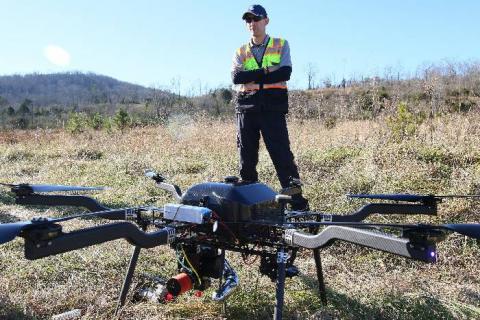
Apollo Robotics has announced the immediate availability of early access to its Apollo Development Partner Program, which is designed to deliver a fully automated, autonomous surveying UAS for professionals.
Apollo Robotics says that it can quickly digitize and reconstruct any worksite into a “highly accurate and instantly actionable” 3D model from a single scan by combining multi-sensoring LiDAR, HD and thermal cameras with artificial intelligence.
Baraja to use latest funding to scale production of tech for autonomous vehicles
Known for developing Spectrum-Scan LiDAR for autonomous vehicles, a company called Baraja has announced a Series A investment of $32 million that it will use to scale production, hire talent and continue its mission to enable safer autonomous driving.
Headquartered in Sydney, Australia, and with plans to grow its offices in San Francisco and Shanghai, Baraja recently launched a novel LiDAR system that creates powerful eyes for self-driving vehicles using prism-like optics and shifting wavelengths of light.
Baraja says that since bringing its Spectrum-Scan LiDAR to market, it has worked with the world’s top autonomous technology companies.
TomTom and DENSO work together on software platform for autonomous vehicles
TomTom, which specializes in location technology, has announced that it will work with DENSO—a global automotive components manufacturer— on its software platform for autonomous vehicles.
The companies will develop a complete autonomous driving system by combing TomTom's High Definition (HD) Map with DENSO in-vehicle sensors such as cameras and radars to power the localization, perception and path planning functions for the system.
“This collaboration proves the value of the TomTom HD Map and TomTom AutoStream as critical components for autonomous vehicles,” says Harold Goddijn, CEO, TomTom.