
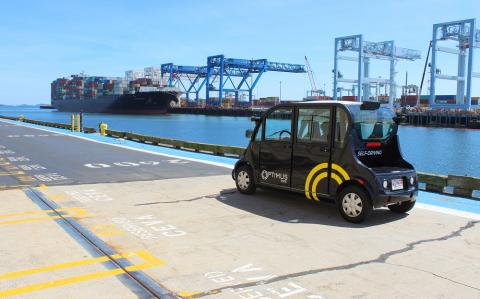
Self-driving vehicle tech company Optimus Ride has announced that it will equip its autonomous vehicle fleet with the NVIDIA DRIVE AGX Xavier computing platform, which is capable of delivering 30 trillion operations per second using new deep learning and computer vision accelerators.
The company says that the NVIDIA DRIVE platform will deliver “unprecedented computational performance and safety” to its self-driving vehicles.
“Building on NVIDIA DRIVE ensures our vehicles are equipped with the highest performance and most efficient processing power available,” says Optimus Ride CEO and Co-Founder Ryan Chin.
Software
Software
Kratos opens new UAS production facility in Oklahoma City
Kratos Defense & Security Solutions Inc. recently cut the ribbon on its new 100,000 square foot UAS production facility, which is located in the Will Rogers Business Park in Oklahoma City, Oklahoma.
According to Kratos, the new facility will be used to accommodate existing and expected increased demand for its newest line of high performance, jet powered unmanned aerial tactical and target UAS.
Kratos says that over the next five years, it plans to hire at least 350 employees in Oklahoma. Kratos says that these employees will fill the “high-skilled engineering, design, and manufacturing functions” that will be needed to support the production contracts for these aircraft.

U.S. Army awards Raytheon $191 million contract for its counter-UAS radar
The U.S. Army has awarded Raytheon a $191 million contract for Ku-band radio frequency radars (KuRFS).
Described as an “advanced electronically scanned array system,” KuRFS fills an immediate operational need of the U.S. Army for a counter-UAS radar.
KuRFS, which is already deployed, not only delivers precision fire control, but it also provides a “sense and warn” capability for a variety of missions including detection of rocket, artillery, mortar and swarming UAS threats.
UAVOS completes development of USV
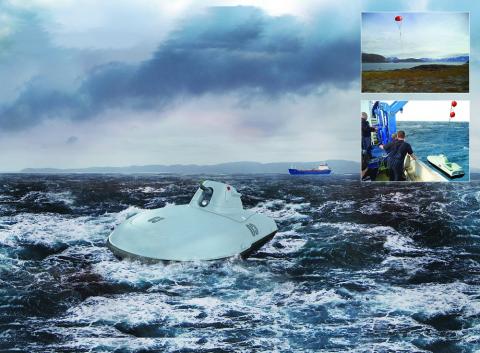
UAVOS has completed the development of a USV. The towing vehicle is designed to deliver a refueling hose to the land in remote and offshore locations beyond inhabited areas.
The USV will serve as an alternative to manned boats, which often times can’t come near the coast due to strong waves or other natural factors, UAVOS notes. UAVOS says that its USV is built to address the issue of delivering fuel or cargo to hard-to-reach coastal areas.
Volvo Cars and Baidu partner to develop and manufacture autonomous vehicles for China
Volvo Cars and Baidu have agreed to jointly develop electric and fully autonomous drive-compatible cars, with a mind towards mass producing these vehicles for the largest car market in the world, China.
Through their partnership, Volvo Cars and Baidu will develop and sell these vehicles to potential Chinese customers, which underlines Volvo Cars’ desire to be the supplier of choice for mobility companies across the world.
MBIE and Airbus partner to develop New Zealand's capability in UAS and space data technology
New Zealand’s Ministry of Business, Innovation and Employment (MBIE) has signed an agreement with Airbus to collaborate on the development of New Zealand’s capability in the UAS and space data technology sectors.
Enabled through MBIE’s Innovative Partnerships program, the Letter of Intent “sets out a commitment to seek opportunities for Airbus to test and trial its UA technologies in New Zealand, and to work together to support the development and adoption of new and innovative space data technologies and applications,” according to MBIE.
Delair acquires key assets of Airware to enhance standing in commercial UAS industry
Delair has announced that it is acquiring the “key assets” of Airware, which develops “innovative software analytics tools” for UAS-based data.
Delair says that the acquisition will result in it getting “leading edge technology assets,” including a proven software offering, a highly skilled engineering and customer success team in Paris, and an installed base of customers and dealers across the world.
Ultimately, Delair’s acquisition will not only accelerate its global growth, but it will also broaden its end-to-end technology for the commercial UAS market, according to the company.
Insitu equipping its line of UAS with Persistent Systems' Wave Relay MANET technology
Persistent Systems has entered into a five-year agreement with Insitu that will result in Insitu equipping its line of UAS with Persistent’s Wave Relay mobile ad hoc network (MANET) technology.
By incorporating Persistent’s MANET radios on its line of UAS, Insitu will now be a member of the Wave Relay Ecosystem, which is an “alliance of industry-leading companies using Wave Relay MANET radios in their products,” Persistent says.
As a member of the Wave Relay Ecosystem, Insitu’s platforms will work seamlessly with all other Wave Relay MANET-enabled products.
Lyft boosts its self-driving efforts with acquisition of Blue Vision Labs
With a mind towards revolutionizing transportation, Lyft has acquired Blue Vision Labs, an Augmented Reality (AR) company that is enabling the next-generation of AR and robotics.
Thanks to the acquisition, Blue Vision Labs will be the first Lyft office in London, and will become part of Lyft’s Level 5 division to build technology for the ride-hailing service’s self-driving efforts.
“We are very excited to be working with Lyft to contribute to their efforts in enabling the future of autonomous mobility,” Blue Vision Labs says in a company blog post.
RTI's Connext 6 includes first connectivity software designed to accelerate development and deployment of highly autonomous systems
On Oct. 16, industrial internet of things (IIoT) connectivity company Real-Time Innovations (RTI) announced the newest release of its Connext product suite, Connext 6, which includes the first connectivity software designed to accelerate the development and deployment of highly autonomous systems.
With Connext 6, autonomous vehicle developers are provided with the advanced technology necessary to address the complex data distribution challenges of Level 4 and Level 5 autonomy.