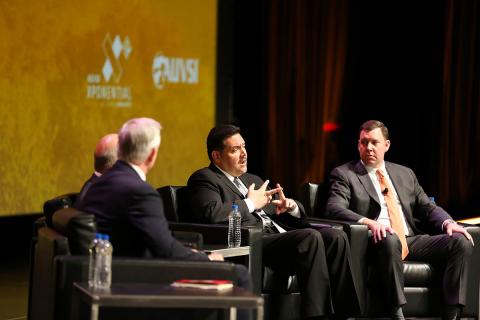
The Blue Ribbon Task Force of UAS Mitigation at Airports, announced at AUVSI's Xponential trade show this year, has released an interim report on its work and says the remote identification of drones is a critical first step to airport security.
Policy
Policy
Florida Governor Ron DeSantis signs autonomous vehicle bill
On Thursday, June 13, Florida Governor Ron DeSantis signed a bill that “removes unnecessary obstacles that hinder the development of autonomous vehicle technology.”
The bill, CS/HB 311: Autonomous Vehicles, removes barriers to the advancement of autonomous vehicles, and establishes a statewide statutory framework.
“Signing this legislation paves the way for Florida to continue as a national leader in transportation innovation and technological advancement,” Governor DeSantis says.

Xponential's final keynote highlights drones for good, counter rogue drone efforts, urban air mobility
Unmanned systems can be used for good, for environmental protection, humanitarian relief and other positive uses, but the good they do can be undone by nefarious operators, an issue that must be dealt with as the technology progresses.
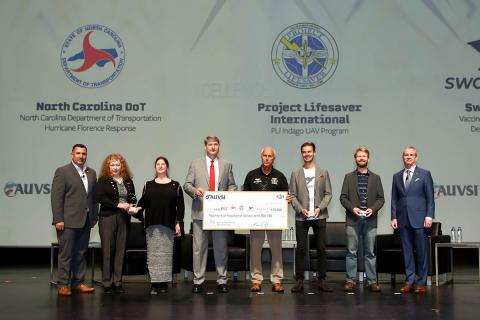
Those were among the themes of the final keynote address of Xponential on Thursday, as AUVSI and DJI presented Humanitarian Awards to five organizations.
FAA moves forward with rulemaking on UAS flights over people, safety, traffic management
In a move that could further accelerate the unmanned aircraft systems industry, the U.S. Federal Aviation Administration today announced a notice of proposed rulemaking for the operation of small UAS over people, as well as another about the safe and secure operations of drones.
In addition, it announced three contracts for UAS test sites to develop an unmanned traffic management (UTM) program that will be separate from the existing air traffic management system but is expected to complement it.
Canada's new UAS rules set to go into effect on June 1
On Jan. 9, Canada’s Minister of Transport, Marc Garneau, announced Canada’s new rules for UAS, which will go into effect on June 1, 2019.
The rules will apply to all UAS pilots flying UAS between 250 grams and 25 kilograms (.55 pounds to 55 pounds) that are operated within the pilot’s visual-line-of-sight, regardless of whether the UAS is flown for fun, work or research.
Transport Canada says that the new simplified rules reflect a great amount of consultation with Canadians and the industry, with the final regulations introducing two main categories of UAS operation—basic and advanced—that are based on distance from bystanders and airspace rules.
Meet the IPP Sites: KDOT focusing on infrastructure inspections, precision ag for UAS pilot program
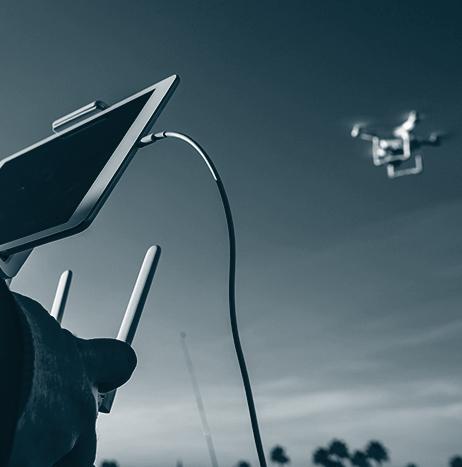
More than 70 percent of the world's general aviation fleet is manufactured in Kansas, so needless to say, aviation is the state’s primary industry.
With unmanned aircraft being the newest edition to the aviation industry, Kansas has a strong interest in making sure this technology is integrated safely into the airspace. The state is an ideal location for this technology to be tested during the UAS Integration Pilot Program over the next few years, especially considering Kansas is home to 140,000 miles of public roads — many in rural areas — and the Kansas Department of Transportation maintains 10,000 miles of highway and over 5,000 bridges.

Meet the IPP Sites: Reno, Flirtey hope to make medical device delivery more efficient
When sudden cardiac arrests happen, minutes count. There are almost 420,000 out-of-hospital cardiac arrests in the United States each year, according to the American Heart Association, and most of them are fatal.
Delivering CPR and using an automated external defibrillator (AED) as soon as possible after an attack starts can more than double a victim’s chance of survival, the AHA says; in fact, a victim’s chances of survival decreases by 7 to 10 percent for each minute that passes without defibrillation.

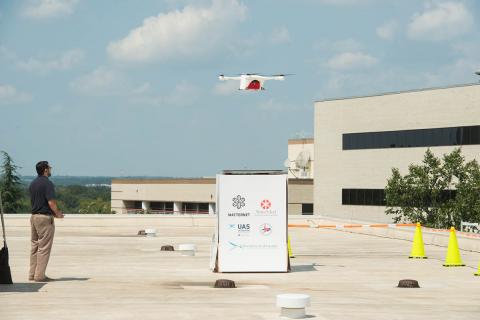
Meet the IPP Sites: North Carolina Department of Transportation and partners using UAS to deliver medical supplies in North Carolina
During AUVSI’s Xponential conference and exhibition in Denver, the North Carolina Department of Transportation was informed that it had been selected as one of the 10 participants for the FAA’s UAS Integration Pilot Program (IPP).
The main focus of NCDOT’s proposal for the UAS IPP is working with global drone delivery companies to establish a network of medical distribution centers that can use drones to make medical deliveries, says Basil Yap, the head of NCDOT’s UAS program and lead on the IPP work.
Currently, couriers are the primary form of transport of blood and other supplies to hospitals and testing facilities, but NCDOT believes that UAS could get these supplies and test results to medical providers much faster.