
For Immediate Release: August 17, 2018
Contact: Tom McMahon, tmcmahon@auvsi.org, (571) 255-7786
Policy
Policy
An automated future requires industry to be proactive, speakers say
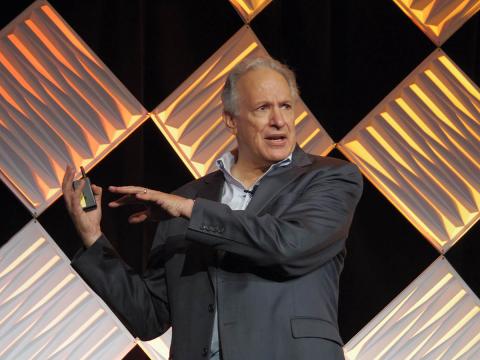
Automated car developers and regulators need to be proactive to deal with the issues facing the industry, from public education to safety to employment dislocations to city planning, said speakers at the second full day of the Automated Vehicles Symposium in San Francisco.
The arrival of automated vehicles will inevitably lead to changes in employment, said Erica L. Groshen, a visiting senior scholar at Cornell University’s School of Industrial Labor Relations.
“Innovation is not new,” she said. “Let’s learn from the past.”
Her team has studied past technology-driven dislocations dating back to the industrial revolution and found that even when jobs are lost, eventually full employment returns.
DOT chief Chao urges AV community to educate the public
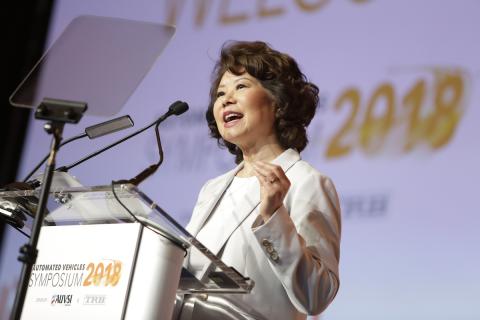
The “quite brilliant” engineers and technologists who are developing automated vehicles need to “step up and educate the public about this new technology” to boost confidence, U.S. Department of Transportation Secretary Elaine Chao said Tuesday.
“Without public acceptance, automated technology will never reach its full potential,” Chao said in her keynote address at the Automated Vehicles Symposium’s first full day. “Consumer acceptance will frame the limitations to growth of this technology, so we all need to work together to get it right.”
The DOT held a “listening session” in March to get input on the autonomous revolution, covering topics including accessibility, public safety, insurance and liability, jobs, cybersecurity and public outreach.
June UAS flight with no chase plane points to future, NASA and GA-ASI say
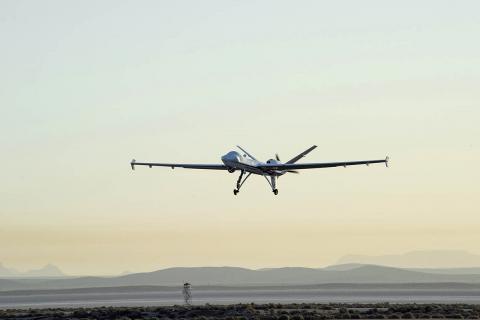
The June flight of a large unmanned aircraft in the National Airspace System without the use of a chase plane took “thousands of hours” and a tightly integrated detect and avoid system, NASA and industry officials said on Thursday.
“This historic flight moves the United States one step closer to normalizing unmanned aircraft operations across the U.S.,” NASA said in a press release announcing a press teleconference held Thursday afternoon to discuss the historic flight.
On June 12, NASA and partners General Atomics Aeronautical Systems (GA-ASI), Honeywell and the Federal Aviation Administration conducted the demonstration, a 2.5-hour flight not far from Los Angeles.
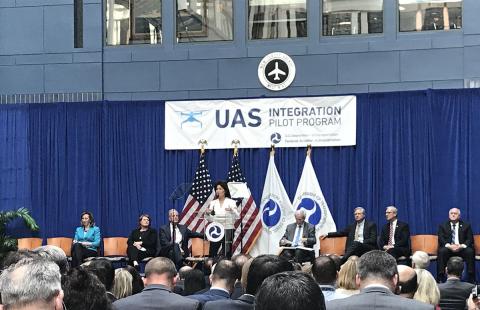
DOT Secretary Chao announces UAS IPP selectees
Ten state, tribal or local governments have been tapped to help expand the flight envelope of unmanned aircraft in the National Airspace System, the U.S. Department of Transportation announced Wednesday.
The selections for the UAS Integration Pilot Program are Choctaw Nation of Oklahoma; the city of San Diego; Virginia Tech – the Center for Innovative Technology; the Kansas Department of Transportation; the Lee County Mosquito Control District of Ft. Myers, Florida; the Memphis-Shelby County Airport Authority of Tennessee; the North Carolina Department of Transportation; the North Dakota Department of Transportation; the city of Reno, Nevada; and the University of Alaska-Fairbanks.
California paves way for testing of truly driverless cars in state
On Feb. 26, the California Department of Motor Vehicles (DMV) announced that the Office of Administrative Law approved regulations governing the driverless testing and public use of autonomous vehicles on California roads.
Before the approval of these regulations, autonomous vehicles could only be tested in California with an approved driver.
“This is a major step forward for autonomous technology in California,” says DMV Director Jean Shiomoto. “Safety is our top concern and we are ready to begin working with manufacturers that are prepared to test fully driverless vehicles in California.”

Media Advisory: Webinar on UAS Regulatory Landscape
FOR IMMEDIATE RELEASE: Feb. 21, 2018
Contact: Tom McMahon, tmcmahon@auvsi.org, (571) 255-7786
Regulatory and Stakeholder Perspectives on the Future of UAS
The number of remote pilots using drones across an array of industries has opened the door for increased efficiency and productivity, but has also ushered in new challenges. Join AUVSI and industry stakeholders for a discussion of the evolving regulatory landscape and what it means for the drone industry.
Frank discussions between regulators and the drone community are important as both groups grapple with the safe integration of our technology into the national airspace. This webinar will provide community members with the opportunity to hear directly from regulators and ask their most pressing questions.
Who Should Attend
UAS Stakeholders to FAA: Use Full Authority to Apprehend and Prosecute Reckless Las Vegas UAS Operator
FOR IMMEDIATE RELEASE: Feb. 6, 2018
Contact: Tom McMahon, tmcmahon@auvsi.org, (571) 255-7786
AUVSI Statement on Video of UAS Near Las Vegas Airport
FOR IMMEDIATE RELEASE: Feb. 2, 2018
Contact: Tom McMahon, tmcmahon@auvsi.org, (571) 255-7786