
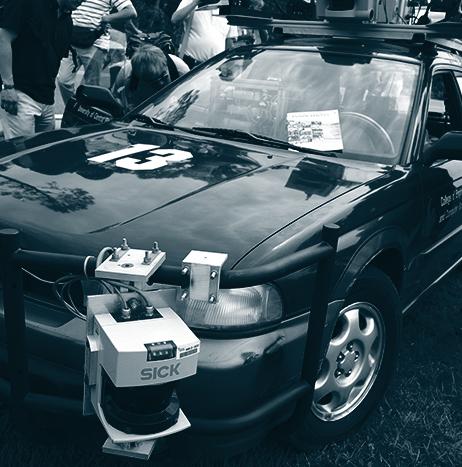
Blacksburg, Virginia-based Torc Robotics has officially announced that it is developing a “complete self-driving system for consumer automobiles.”
The autonomous vehicle technology company, which is a level 4 company in terms of the Society of Automotive Engineers’ (SAE) levels of automated driving, says that vehicles equipped with its self-driving technology, including its end-to-end software stack, can make complex decisions in real life scenarios on the road.
“We’re offering automotive companies a fully autonomous solution that can be implemented in real consumer cars,” says Torc co-founder and Chief Executive Officer Michael Fleming.
Technology
Technology
Weekend Roundup
This Week in the Unmanned Systems and Robotics World
An Oxbotica-developed autonomous vehicle called CargoPod is being used in London to deliver groceries to customers. The vehicle has eight pods on the back of it, and each pod has a crate that can hold three bags of groceries. After the vehicle is filled by human hands from a small distribution center, it sets off following a route to its drop-offs. Once the CargoPod arrives at its destination, the customer is alerted through a smartphone. That customer must then press a button on the vehicle to open the pod door, allowing them to collect their groceries. (MIT Technology Review)

Cell phone network takes Delair-Tech beyond line of sight
Delair-Tech, based in both France and California, announced it has used 3G cell phone connectivity to allow its DT18 drone to fly beyond line of sight to inspect power lines in France.
In early June, the company flew the aircraft for more than 50 kilometers (31 miles) for the company RTE, inspecting power lines between the towns of Samur and Poitiers, using only 3G connections to navigate.
“That’s a major step forward for beyond line of sight flight,” says Benjamin Benharrosh, the company’s cofounder.
French airspace regulators were present for the flight, and Benharrosh said the company would like to present the results to the U.S. Federal Aviation Administration as well.
SUWAVE UAS would use bodies of water as places to recharge
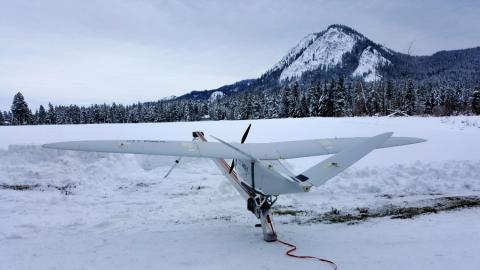
The University of Sherbrooke, which is located in Quebec, Canada, has developed the concept of a waterproof drone that would use bodies of water, such as lakes, as places to recharge.
In theory, a UAS that could recharge in water could have a significantly extended flight time, with the potential to possibly fly for months at a time.
Named the Sherbrooke University Water-Air Vehicle (SUWAVE), the UAS is designed to fly short distances, crash down into a body of water, and then recharge using solar panels that are built into its fixed wings.
Once recharged, the UAS would take off again.

Navy tests Mine Warfare Rapid Assessment Capability system that uses UAS to detect buried and submerged mines
A recent technology demonstration at Marine Corps Base Camp Pendleton tested the new Mine Warfare Rapid Assessment Capability (MIW RAC) system, which is a portable, remote-controlled system that uses a UAS to detect buried and submerged mines.
MIW RAC, which is sponsored by the Office of Naval Research’s (ONR) TechSolutions program, includes a tablet device, and a one-pound quadcopter UAS, which is equipped with “an ultra-sensitive magnetometer sensor system,” that allows the UAS to detect mines, and provide real-time search data to a handheld Android device.
Korea to use UAS to monitor prisons and inmates
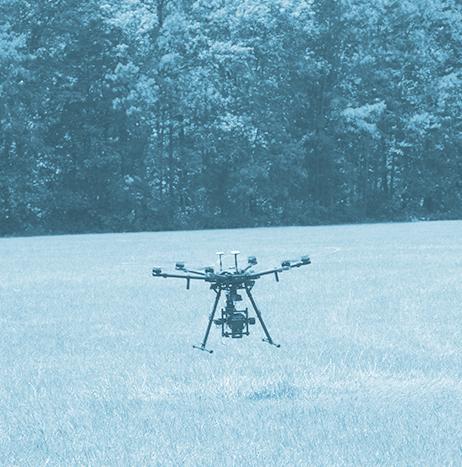
The Ministry of Justice in Korea has announced that the government plans on using UAS to monitor prisoners at three different penitentiaries starting in July, as a part of a six-month test operation of unmanned aerial systems.
The UAS, which will be able to fly at night, and will be equipped with a camera that can send real time videos, will be used for several tasks, such as patrolling the inside and outside of prisons, monitoring the movements of inmates, and tracing fugitives.
“Use of drones will help raise the efficiency of watching prisoners and save costs in personnel,” says a justice ministry official, via the Korea Times.
NIAS and NASA continue testing of NASA's UAS Traffic Management System
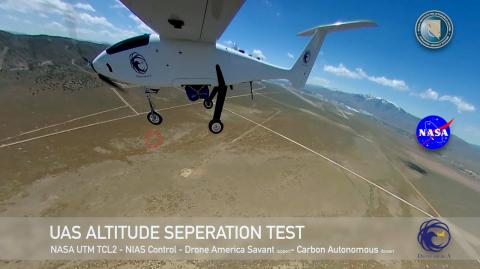
In late May, the Nevada UAS Test Site and its NASA partners used five different UAS to demonstrate several different operational scenarios, including aerial survey operations and parachute initiated emergency supply deliveries.
The UAS were flown as a part of the specific NASA Unmanned Aircraft System (UAS) Traffic Management (UTM) missions, and thanks to “strategically placed visual observers (VO) and sophisticated Command and control (C2), communication, detect, and avoid technologies,” the UAS were also flown beyond the pilot’s visual line of sight.
Drone Delivery Canada becomes first drone delivery company in Canada to complete BVLOS test flights
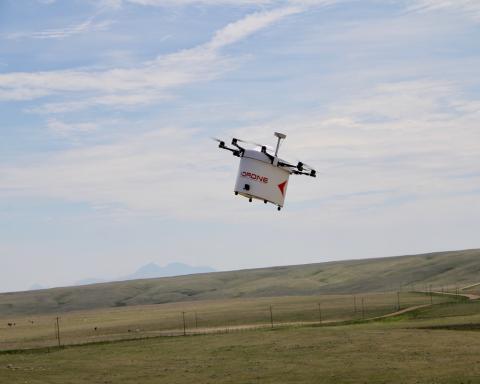
After receiving a Special Flight Operating Certificate from Transport Canada, Drone Delivery Canada (DDC) has become the first and only “pure play drone delivery company” to successfully complete beyond visual line of sight (BVLOS) test flights under the oversight of Transport Canada.
DDC’s Mission Control Centre in Toronto monitored and recorded telemetry for each flight in real time, from 2,500 kilometers away, as the flights took place in Foremost, Alberta.
The main systems tested during the flights were DDC’s proprietary FLYTE management system, its avoidance technology, and communications platform.
Georgia police department receives DJI Phantom 3 Professional UAS from InterDev
As a part of its ongoing program “to thank its municipal clients for engaging InterDev’s to provide IT and/or GIS services,” InterDev, a provider of not only IT and GIS services, but also security services as well, recently donated a DJI Phantom 3 Professional UAS to the Dunwoody police department in Georgia.
According to Dunwoody Police Chief Billy Grogan, the donation will greatly benefit the department’s UAS program, which will positively impact the Dunwoody community in the process.
“The Dunwoody Police Department’s unmanned aerial vehicle program will be enhanced by the generous donation from InterDev of this important technology,” Grogan says.
“It will help our department to continue meeting the service needs of the citizens of Dunwoody.”
Navajo County Sheriff’s Office in Arizona uses UAS to locate missing man
In late May, the Navajo County Sheriff’s Office in Arizona used a UAS to search for a man who went missing in the woods near Clay Springs, Arizona.
It was the first time that the sheriff’s deputies used a UAS during a search and rescue operation.
Deputies requested the help of NCSO’s UAS for the search, and within 45 minutes of arriving on the scene, the UAS pilots located the man, about “a quarter of a mile east and 350 yards north” of where his motorcycle had been found earlier.
The man was described as “disoriented and dehydrated ” when found, but in good health.