
Described as “quite possibly, the best value in a side scan sonar on the market today,” the Scout Mk II Side Scan Sonar, a product of ATLAS North America, is now available.
Small, light and low on power consumption, the Scout Mk II Side Scan Sonar is especially suited for the micro AUV market, but as an advanced side scan sonar, it is built for all AUV applications.
“The Scout Mk II leverages the compact design of the Scout Lite sonar and offers a modular, versatile, and affordable sonar which, with its small size, is easy to integrate into any AUV,” says Sergio Diehl, President of ATLAS North America.
Technology
Technology
Humanitarian UAV Testing Corridor launches in Malawi
On June 29, the Government of Malawi and the United Nations International Children's Emergency Fund (UNICEF) launched an air corridor, known as the Humanitarian UAV Testing Corridor, to test the potential use of UAS for humanitarian efforts.
The Humanitarian UAV Testing Corridor, which will be used to facilitate testing in the areas of imagery, connectivity, and transport, is the first corridor in Africa, and one of the first in the world, that has a specific focus on humanitarian and development use.
“This humanitarian drone testing corridor can significantly improve our efficiency and ability to deliver services to the world's most vulnerable children,” says Christopher Fabian, UNICEF Office of Global Innovation Principal Adviser.
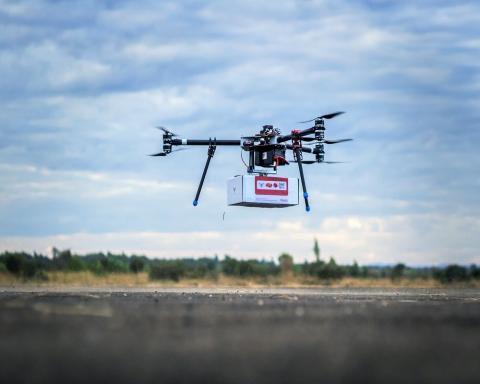
AERTEC Solutions to Present TARSIS UAS at ‘HOMSEC’ International Security Technologies Trade Fair
AERTEC Solutions plans on showcasing its ‘TARSIS’ fixed-wing UAS at the sixth edition of HOMSEC, which is an International Security Technologies Trade Fair that began on March 15 in Spain.
Specifically, AERTEC Solutions will showcase its TARSIS 75 and TARSIS 25 versions, which are built to conduct observation and surveillance missions for the military, as well as civilly.
A real version of the TARSIS 75 light tactical UAS will be displayed on its corporate stand (G01). This UAS has a wingspan of 75 meters, can fly at a maximum speed of 110 km/h, and has a maximum takeoff weight of 12 kg.
With the ability to operate autonomously for 110 hours, the UAS can conduct its missions from both the runway and a catapult, and can land with assistance from a parachute.
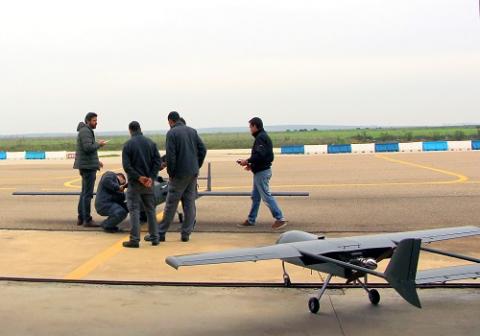
Redkite wide-area sensor completes successful advanced flight testing aboard Integrator UAS
Logos Technologies has announced that it has successfully conducted advanced flight testing of its Redkite wide-area sensor aboard the Insitu Integrator UAS.
Testing confirmed that the Redkite was capable of capturing stabilized, wide-area motion imagery (WAMI), and could successfully stream it to multiple handheld devices on the ground from the payload bay of the UAS.
This latest demonstration, which was the second successful airborne test with the Integrator, took place in Boardman, Oregon.
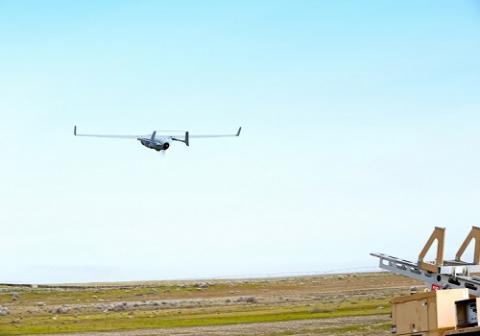
WhiteFox Defense Technologies demonstrates Its DroneFox technology during Xponential
During Xponential 2017, San Luis Obispo, CA-based WhiteFox Defense Technologies, Inc. demonstrated its flagship technology, the DroneFox, which is built to respond to dangerous small UAS.
Designed to detect, identify, and mitigate UAS with a multi-mile range, the DroneFox is a SWaP-C optimized, portable technology, which uses a “master signal” to track and temporarily take control of UAS.
Using the “master signal,” the operator of the DroneFox can choose a course of action from a variety of responses, including land, return to launch, confiscate, and reroute.
The DroneFox is different from jammers and other non-kinetic products because it can select the exact signal it wants to manipulate without interfering with any others signals, even other UAS.

Oklahoma State University students and others use UAS to gather data on weather
About 60 students and staff from Oklahoma State University (OSU), and the universities of Kentucky, Oklahoma and Nebraska, are spending the week of June 26 flying UAS at OSU’s Unmanned Aircraft Flight Station, to collect data on weather.
This is the second year that the universities have come together to test UAS and their ability to improve weather forecasting, and the students seem to enjoy the collaborative environment as they work with students from different universities on a shared challenge.
OTSAW Digital releases security robot equipped with its own drone
A startup company in Singapore called OTSAW Digital has released its four-wheeled security robot, named O-R3, which includes a drone that can be launched after intruders.
Because of its “drone-in-robot design,” the O-R3's range can extend significantly in comparison to the typical ground-based autonomous robot, giving the O-R3 capabilities that ordinary security robots wouldn’t have.
“[If] you have obstacles on the ground, we can launch a drone that has an aerial view of where the intruder is hiding, maybe on the other side of the wall, on the fence, or the gate, stuff like that,” says Ling Ting Ming, CEO of OTSAW Digital and its parent company ActiV Technology, through an article with Mashable.
UC Santa Barbara researchers use UAS and WiFi for 3D through-wall imaging
Researchers at the University of California, Santa Barbara (UCSB) working out of professor Yasamin Mostofi’s lab have conducted a demonstration in which they used two UAS working in tandem, and WiFi, to capture the three-dimensional imaging of objects through walls.
In their experiment, which the results of that and the proposed methodology appeared in the Association for Computing Machinery/Institute of Electrical and Electronics Engineers International Conference on Information Processing in Sensor Networks (IPSN), researchers use two autonomous octocopters to fly outside of an enclosed, four-sided brick house whose interior is foreign to the UAS.
Shadow UAS operators and maintainers of 7th Infantry Division train in Washington State
During the Bayonet Focus (BF) 17-03 exercise, Shadow UAS operators and maintainers of 7th Infantry Division worked on their skillset at the Yakima Training Center in Washington, at a recently built UAS airfield.
Imagery support for units conducting the BF 17-03 exercise was provided by the soldiers, which gave UAS personnel and service members in the field more realistic training.
“This is different than training back at Joint Base Lewis-McChord because we are in a more tactical setting and we move a lot faster,” says Spc. Brysen Borja, a UAS operator with 2-2 Stryker Brigade Combat Team, via DVIDSHub.net.
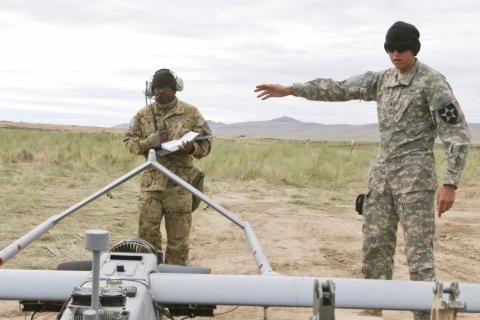
Douglas County Search and Rescue team uses UAS to locate and rescue missing hikers
On June 15, the Douglas County Search and Rescue team in Colorado used a UAS to locate two missing hikers and a dog in the Pike National Forest, after they mistakenly left the Devil's Head trail.
The hikers were able to call 9-1-1 with limited cell service, and the Douglas County Search and Rescue volunteer teams responded to the area. More than two dozen people responded, which included foot searchers, ATVs, a K-9 team, and the UAS team.
About two hours after the teams responded to the area, the UAS team made visual contact with the lost hikers, and shortly after that, a search team on foot made contact with the hikers.
According to Incident Commander Bruce Fosdick, the UAS saved hours of time in searching for the hikers.