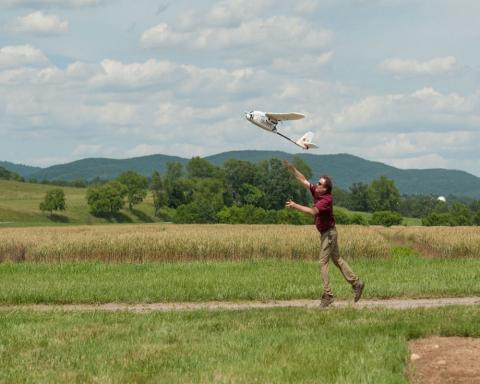
Northrop Grumman has announced that using the high-speed AQS-24B sensor, the company has successfully demonstrated unmanned mine-hunting capabilities during the Belgian Defense Technology and Industry Day trials at the Naval Base at Zeebrugge, Belgium.
The demonstration, which is a follow-on to a successful operation that took place in October 2016 during Unmanned Warrior in Scotland, showcased the high area coverage rate (ACR) that is attainable when combining Northrop Grumman’s AQS-24B mine hunting system with the Atlas Elektronik UK ARCIMS USV, a platform that has proven to be extremely stable, and shown that it is ideally suited for towing the high-speed AQS-24B in rough seas.
Technology
Technology
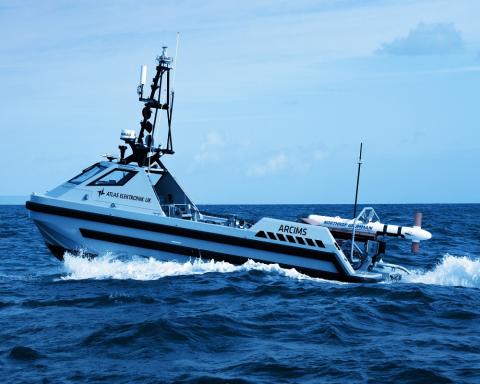
General Motors produces 130 Chevrolet Bolt EV test vehicles equipped with self-driving technology
General Motors (GM) has announced that it has completed production of 130 Chevrolet Bolt EV test vehicles, equipped with the company's next generation of self-driving technology.
The vehicles, which were produced at GM's Orion Assembly Plant in Orion Township, Michigan, are equipped with the latest array of equipment from GM, including cameras, sensors, LIDAR, and other hardware designed to “accelerate development of a safe and reliable fully autonomous vehicle.”
This latest batch of Chevrolet Bolt EV test vehicles will join more than 50 current-generation self-driving Bolt EVs that are currently a part of testing fleets in Scottsdale, Arizona, metro Detroit, and San Francisco.

uAvionix introduces PingStation, an all-weather, networkable ADS-B receiver for UAS
UAvionix has introduced its latest product, PingStation, which is an “all-weather, networkable ADS-B receiver for low and high altitude aircraft surveillance.”
Because of its robustness, PingStation can be “permanently mounted outdoors in harsh environmental conditions,” and it can also be used as a mobile asset for roaming operations thanks to its small size.
Among its many potential uses, PingStation could be used for Unmanned Traffic Management (UTM) systems, airport surface and region situational awareness, FBO/flight school fleet tracking and management, and it could be a component of UAS Ground Control Stations (GCS) and/or UAS Detect and Avoid (DAA) systems.
Audi performs first autonomous vehicle demonstration in New York State
Representatives from Audi of America Inc. performed the first demonstration of an autonomous vehicle in the state of New York on June 13.
Using Audi’s Highway Pilot technology, the vehicle, which was occupied by two trained engineers who monitored the system and made sure that everything transpired safely, drove autonomously for approximately 6.1 miles once reaching Interstate 90, after being guided there by a driver.

China’s solar-powered UAS flies in near space region
The project team under the China Aerospace Science and Technology Corporation has announced that the country’s first near-space solar drone, called Caihong (CH), or Rainbow, has successfully completed a flight at an altitude of 20 kilometers, or nearly 12 and a half miles.
The UAS, which has a wingspan of 45 meters, flew “smoothly in near space for over 15 hours under control, finishing its scheduled path,” and then landed safely.
Rochester Police Department demonstrates Indago UAS being used for Project Lifesaver program
The Rochester Police Department in Rochester, Minnesota, has demonstrated its new UAS, which is a Lockheed Martin-manufactured Indago UAS that can fly 55 minutes, and is capable of flying in inclement weather.
The Indago UAS will be used as a part of the Project Lifesaver program, which is designed to “respond quickly to save lives and reduce potential injury for adults and children who wander due to Alzheimer's, autism and other related conditions or disorders,” according to the Post Bulletin.
Through the program, when clients wander, a transmitter that they are wearing is activated.
Police in China using UAS for various tasks
UAS are being used across China to help police conduct a variety of missions.
Recently, a UAS was used to help search for, and capture, a man who robbed a woman and then disappeared into a “sprawling, muddy village” in the Minhang District.
Through the Shanghai Daily, officer Wen Jia of the Tianyuan Xincun police station (which handled the Minhang robbery) explained why the UAS was so beneficial in this situation by saying, “in the case of the June 1 robbery, we didn’t have enough manpower to quickly search the whole village. A drone did the work for us.”
Delair-Tech and RTE fly UAS 30 miles BVLOS using 3G Cell Network
Delair-Tech and RTE recently flew a civilian UAS 30 miles beyond visual line of sight (BVLOS), setting a new distance record.
The flight, which used a 3G communication network to guide the UAS, was flown in France.
“In collaboration with RTE, we used for the first time in France a 3G network to guide the drone, allowing real-time communication from any distance,” says Michael Lagarde, President & Co-Founder of Delair-Tech.
“This removes an important technological barrier. It is a first step toward making drones the most common method for inspections of infrastructure that stretches over large distances, such as power lines and pipelines.”
Traffic jam in the skies: NASA updates UTM effort
By Clark Perry
There could be 7 million UAS vehicles flying in U.S. airspace by the year 2020, according to the FAA. It’s a staggering number, especially when it comes to safely managing all that air traffic.
To get a sense of what the skies may be like in just a few years, imagine the following scenario: firefighting aircraft are racing to the scene of a wildfire, only to find their air path strewn with municipal UAS vehicles inspecting power lines, hobbyists capturing vacation footage with the latest off-the-shelf drone from Best Buy, and Amazon Prime’s local drone fleet launching to make their daily deliveries.
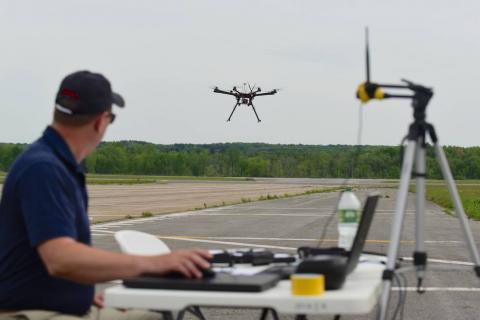
Virginia Tech takes part in testing of NASA's unmanned traffic management research platform
As a part of a national campaign to test NASA's unmanned traffic management research platform, UAS operations were conducted at Virginia Tech in Blacksburg, Virginia during the week of June 5, to test technology that is designed to allow multiple aircraft to safely share the same airspace.
The test flights were designed to “mimic what operators might encounter if widespread commercial UAS flights beyond line of sight become commonplace.” During the test flights, multiple aircraft carried out several different simulated missions simultaneously.
The aircraft communicated with NASA’s central cloud-based platform using different software interfaces, which allowed them to respond to changes in the airspace.